Filter by
Should formula for infants provide arachidonic acid along with DHA? A positio…
Recently adopted regulatory standards on infant and follow-on formula for the European Union stipulate that from February 2020 onwards, all such products marketed in the European Union must contain 20–50 mg omega-3 DHA (22:6n–3) per 100 kcal, which is equivalent to about 0.5–1% of fatty acids (FAs) and thus higher than typically found in human milk and current infant formula products, …
- Edition
- -
- ISBN/ISSN
- -
- Collation
- -
- Series Title
- -
- Call Number
- -
The pain of weight gain: self-experimentation with overfeeding
The Vermont overfeeding studies were published 50 y ago and began a change in the acceptance of obesity as a bona fide area of academic interest. This article chronicles the experience of the author with acute weight gain while overfeeding, in the context of current obesity research, and presents a glimpse of things to come. The pain associated with acute overeating is illustrated by the first…
- Edition
- -
- ISBN/ISSN
- -
- Collation
- -
- Series Title
- -
- Call Number
- -
Effect of dietary protein intake on albumin homeostasis in nephrotic patients
Animals with experimental renal disease maintained on dietsrest ricted in protein develop less severe renal lesions and less proteinuria than do animals maintained on a normal or high protein diet. To determine whether restriction of dietary protein will reduce urinary albumin excretion in patients with established nephroses and whether such dietary restriction will result in decreased albumi…
- Edition
- -
- ISBN/ISSN
- -
- Collation
- -
- Series Title
- -
- Call Number
- -
A Meta-Analysis of the Effects of Dietary Protein Restriction on the Rate of …
Dietary protein restriction has been reported to delay the need for renal replacement therapy in clinical trials and meta-analyses. However, less clear is what effect dietary protein has on the rate of decline in renal function. We pooled the results of 13 randomized controlled trials (n 5 1,919 patients) and found that dietary protein restriction reduced the rate of decline in estimated glo…
- Edition
- -
- ISBN/ISSN
- -
- Collation
- -
- Series Title
- -
- Call Number
- -
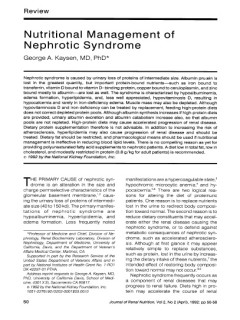
Nutritional Management of Nephrotic Syndrome
Nephrotic syndrome is caused by urinary loss of proteins of intermediate size. Albumin protein is lost in the greatest quantity, but important protein-bound nutrients-such as iron bound to transferrin, vitamin D bound to vitamin D-binding protein, copper bound to ceruloplasmin, and zinc bound mostly to albumin-are lost as well. The syndrome is characterized by hypoalbuminemia, edema formation, …
- Edition
- -
- ISBN/ISSN
- -
- Collation
- -
- Series Title
- -
- Call Number
- -
KDOQI CLINICAL PRACTICE GUIDELINE FOR NUTRITION IN CKD: 2020 UPDATE
The National Kidney Foundation’s Kidney Disease Outcomes Quality Initiative (KDOQI) has provided evidence-based guidelines for nutrition in kidney diseases since 1999.Since the publication of the first KDOQI nutrition guideline, there has been a great accumulation of newevidence regarding the management of nutritional aspects of kidney disease and sophistication in the guidelines process. The…
- Edition
- -
- ISBN/ISSN
- -
- Collation
- -
- Series Title
- -
- Call Number
- -
Clinical Nutrition Guidelines and Summaries for Patients
This document is about the development of clinical nutrition guidelines and the importance of summaries of these for patients as well as the need for patient involvement in the development processes, the importance of health literacy and informed decision-making concerning food and nutrition
- Edition
- -
- ISBN/ISSN
- -
- Collation
- -
- Series Title
- -
- Call Number
- -
ESPEN Guidelines on Parenteral Nutrition: Adult Renal Failure
Among patients with renal failure, those with ARF and critical illness represent by far the largest group unergoing artificial nutrition. ARF, especially in the ICU, seldom occurs as isolated organ failure but rather is a component of a much more complex metabolic environment, in the setting of the multiple organ failure. Nutritional programs for ARF patients must consider not only the metaboli…
- Edition
- -
- ISBN/ISSN
- -
- Collation
- -
- Series Title
- -
- Call Number
- -
Guidelines for parenteral and enteral nutrition in geriatric patients in China
Based on the expert consensus on parenteral and enteral nutrition support for geriatric patients in China in 2013, domestic multidisciplinary experts were gathered to summarize the new evidence in the field of elderly nutritional support at home and abroad. The 2013 consensus was comprehensively updated and upgraded to a guideline by referring to the World Health Organization (WHO) guidelines …
- Edition
- -
- ISBN/ISSN
- -
- Collation
- -
- Series Title
- -
- Call Number
- -
Current clinical aspects of parenteral nutrition in geriatric patients
Advancements in medicine, better diagnostics and zeal for a high quality of life have enabled many geriatric patients seeking medical attention for any type of illness. The elderly population is increasing globally and so does the number of such patients in hospital and critical care units. However, increased incidence of debilitating diseases in elderly makes them more prone to develop malnu…
- Edition
- -
- ISBN/ISSN
- -
- Collation
- -
- Series Title
- -
- Call Number
- -
 Computer Science, Information & General Works
  Philosophy & Psychology
  Religion
  Social Sciences
  Language
  Pure Science
  Applied Sciences
  Art & Recreation
  Literature
  History & Geography