Filter by
Hospital-acquired pneumonia in ICU
The French Society of Anesthesia and Intensive Care Medicine and the French Society of Intensive Care edited guidelines focused on hospital-acquired pneumonia (HAP) in intensive care unit (ICU). The goal of 16 French-speaking experts was to produce a framework enabling an easier decision-making process for intensivists. The guidelines were related to 3 specific areas related to HAP (prevention…
- Edition
- -
- ISBN/ISSN
- -
- Collation
- -
- Series Title
- -
- Call Number
- -
Recent advances in the management of radiation colitis
Radiation colitis, an insidious, progressive disease of increasing frequency, develops 6 mo to 5 years after regional radiotherapy for malignancy, owing to the deleterious effects of the latter on the colon and the small intestine. When dealing with radiation colitis and its complications, the most conservative modality should be employed because the areas of intestinal injury do not tend to h…
- Edition
- -
- ISBN/ISSN
- -
- Collation
- -
- Series Title
- -
- Call Number
- -
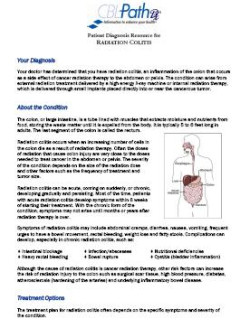
Patient Diagnosis Resource for Radiation Colitis
Your doctor has determined that you have radiation colitis, an inflammation of the colon that occurs as a side effect of cancer radiation therapy to the abdomen or pelvis. The condition can arise from external radiation treatment delivered by a high energy X-ray machine or internal radiation therapy, which is delivered through small implants placed directly into or near the cancerous tumor
- Edition
- -
- ISBN/ISSN
- -
- Collation
- -
- Series Title
- -
- Call Number
- -
Radiation Colitis and Proctitis
Radiation therapy is commonly utilized as a major component in the treatment of pelvic malignancy. Unfortunately, secondary toxicity to the lower gastrointestinal tract can occur. This most commonly affects the rectum, although injuries to the colon and small intestine are not uncommon. The presentation can be acute or chronic, and different mechanisms are responsible for each. Symptomatology i…
- Edition
- -
- ISBN/ISSN
- -
- Collation
- -
- Series Title
- -
- Call Number
- -
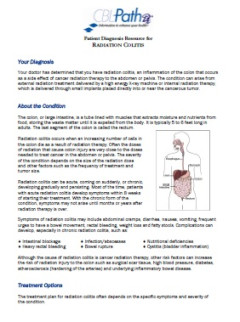
Patient Diagnosis Resource for RADIATION COLITIS
Your doctor has determined that you have radiation colitis, an inflammation of the colon that occurs as a side effect of cancer radiation therapy to the abdomen or pelvis. The condition can arise from external radiation treatment delivered by a high energy X-ray machine or internal radiation therapy, which is delivered through small implants placed directly into or near the cancerous tumor
- Edition
- -
- ISBN/ISSN
- -
- Collation
- -
- Series Title
- -
- Call Number
- -
 Computer Science, Information & General Works
  Philosophy & Psychology
  Religion
  Social Sciences
  Language
  Pure Science
  Applied Sciences
  Art & Recreation
  Literature
  History & Geography