Filter by

Prevalence of Urinary tract infections in children and their sensitivity to v…
Urinary tract infection (UTI) is one of the most common infections of childhood and its prevalence varies markedly with sex and age. In this study, urinary specimens from 200 children under 14 years of age suffering from urinary tract infections were investigated for bacterial agents. The most common bacterial agents of urinary tract infections were Escherichia coli (71.7% of total isolates in …
- Edition
- -
- ISBN/ISSN
- -
- Collation
- -
- Series Title
- -
- Call Number
- -

Practice Guidelines for the Diagnosis and Management of Skin and Soft-Tissue …
Soft-tissue infections are common, generally of mild to modest severity, and are easily treated with a variety of agents. An etiologic diagnosis of simple cellulitis is frequently difficult and generally unnecessary for patients with mild signs and symptoms of illness. Clinical assessment of the severity of infection is crucial, and several classification schemes and algorithms have been propo…
- Edition
- -
- ISBN/ISSN
- -
- Collation
- -
- Series Title
- -
- Call Number
- -

In-vitro susceptibility of 1982 respiratory tract pathogens and 1921 urinary …
A total of 3903 pathogens from 48 Canadian medical centres were tested against 19 antimicrobial agents. Five agents showed activity against 90% of all 1982 respiratory tract pathogens tested (ciprofloxacin, 90%; cefoperazone, 91%; ticarcillin/clavulanate, 92%; ceftazidime and imipenem, 93% each). Nine agents had 90% activity against Enterobacteriaceae from respiratory tract infection (cefotaxi…
- Edition
- -
- ISBN/ISSN
- -
- Collation
- -
- Series Title
- -
- Call Number
- -

Comparison of the post-antibiotic effect (PAE) induced by ceftizoxime, ceftri…
The exposure of bacteria to various groups of antimicrobials at different concentrations can produce damage to the bacteria that persists even after removal of the antimicrobial agent. The post antibiotic effect (PAE) of b-lactams on aerobic Gram-negative bacilli is relatively short (o1 h), however, little information is available regarding anaerobic Gram-negative bacilli. We studied the PAE…
- Edition
- -
- ISBN/ISSN
- -
- Collation
- -
- Series Title
- -
- Call Number
- -
Radiation Colitis and Proctitis
Radiation therapy is commonly utilized as a major component in the treatment of pelvic malignancy. Unfortunately, secondary toxicity to the lower gastrointestinal tract can occur. This most commonly affects the rectum, although injuries to the colon and small intestine are not uncommon. The presentation can be acute or chronic, and different mechanisms are responsible for each. Symptomatology i…
- Edition
- -
- ISBN/ISSN
- -
- Collation
- -
- Series Title
- -
- Call Number
- -
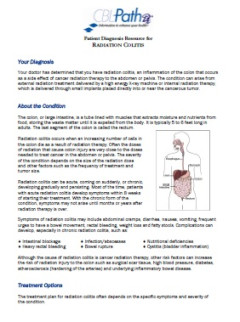
Patient Diagnosis Resource for RADIATION COLITIS
Your doctor has determined that you have radiation colitis, an inflammation of the colon that occurs as a side effect of cancer radiation therapy to the abdomen or pelvis. The condition can arise from external radiation treatment delivered by a high energy X-ray machine or internal radiation therapy, which is delivered through small implants placed directly into or near the cancerous tumor
- Edition
- -
- ISBN/ISSN
- -
- Collation
- -
- Series Title
- -
- Call Number
- -
 Computer Science, Information & General Works
  Philosophy & Psychology
  Religion
  Social Sciences
  Language
  Pure Science
  Applied Sciences
  Art & Recreation
  Literature
  History & Geography