Filter by
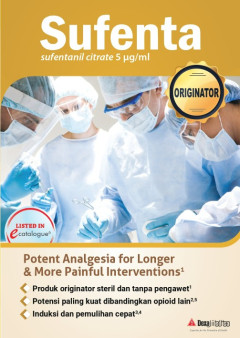
More Epidural than Intravenous Sufentanil is Required to Provide Comparable P…
The extent to which epidurally administered sufentanil acts directly on spinal opioid receptors remains controversial. We tested the hypothesis that smalldose boluses of sufentanil, given epidurally or IV, provide comparable analgesia at similar plasma sufentanil concentrations. The lipophilicity of sufentanil makes it likely to be absorbed into fat surrounding the epidural space
- Edition
- -
- ISBN/ISSN
- -
- Collation
- -
- Series Title
- -
- Call Number
- -
Early postoperative cognitive recovery after remifentanil– propofol or sufe…
This study was designed to evaluate early postoperative cognitive recovery after total intravenous anaesthesia with remifentanil–propofol or sufentanil–propofol in patients undergoing craniotomy for supratentorial expanding lesions
- Edition
- -
- ISBN/ISSN
- -
- Collation
- -
- Series Title
- -
- Call Number
- -
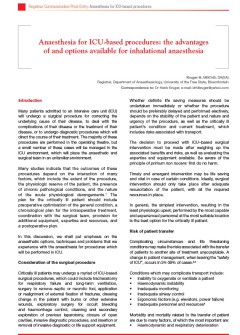
Anaesthesia for ICU-based procedures: the advantages of and options available…
Many patients admitted to an intensive care unit (ICU) will undergo a surgical procedure for correcting the underlying cause of their disease, to deal with the complications of their disease or the treatment of their disease, or to undergo diagnostic procedures which will direct the course of their treatment. The majority of these procedures are performed in the operating theatre, but a small …
- Edition
- -
- ISBN/ISSN
- -
- Collation
- -
- Series Title
- -
- Call Number
- -
GUIDELINES FOR THE PRACTICE OF CRITICAL CARE BY ANESTHESIOLOGISTS
The practice of anesthesiology includes provision of care to patients who are critically ill, while critical care medicine has its foundations in perioperative care provided by anesthesiologists, today’s critical care medicine encompasses care beyond traditional intraoperative and routine postoperative care. Critical care medicine includes a wide variety of clinical services provided by the a…
- Edition
- -
- ISBN/ISSN
- -
- Collation
- -
- Series Title
- -
- Call Number
- -
Comparison of the Analgesic Effect of Sufentanil versus Fentanyl in Intraveno…
Fentanyl is one of the most widely used opioids for intravenous patient-controlled analgesia (IV-PCA). Sufentanil, a fentanyl analog, is suitable for postoperative pain control because it has no active metabolites and shows a higher therapeutic index and lower frequency of respiratory suppression than fentanyl. This study aimed to compare the two opioids for postoperative pain relief on the bas…
- Edition
- -
- ISBN/ISSN
- -
- Collation
- -
- Series Title
- -
- Call Number
- -
Comparison of morphine, meperidine, fentanyl, and sufentanil in balanced anes…
A double-blind study comparing four narcotic analgesics of different potencies, meperidine, morphine, fentanyl, and sufentanil, was performed on consenting patients undergoing general or orthopedic surgery under balanced anesthesia. Blood pressure, measured through an indwelling arterial catheter, was recorded continuously, as were ECG and heart rates. The narcotics, made up in equipotent conce…
- Edition
- -
- ISBN/ISSN
- -
- Collation
- -
- Series Title
- -
- Call Number
- -
A Comparison of Morphine, Fentanyl, and Sufentanil Anesthesia for Cardiac Sur…
We compared anesthetic doses of three popular opiates, morphine (n = 10), fentanyl (n = 9), and sufentanil (n = 9) in patients undergoing cardiac surgery. Opiate administration after induction was based upon EEG and cardiovascular signs of the depth of anesthesia. Total doses were morphine, 4.4 ± 0.71 mg/kg, fentanyl, 95.4 ± 9.9 μg/kg, and sufentanil, 18.9 ± 2.2 μg/kg.
- Edition
- -
- ISBN/ISSN
- -
- Collation
- -
- Series Title
- -
- Call Number
- -
 Computer Science, Information & General Works
  Philosophy & Psychology
  Religion
  Social Sciences
  Language
  Pure Science
  Applied Sciences
  Art & Recreation
  Literature
  History & Geography