Filter by

Nebulized Salbutamol Vs Salbutamol and Ipratropium Combination in Asthma
To see the additional benefit of combined frequent nebulization with salbutamol and ipratropium bromide in acute attack of asthma with moderate severity
- Edition
- -
- ISBN/ISSN
- -
- Collation
- -
- Series Title
- -
- Call Number
- -

Efficacy and safety of ipratropium bromide/ albuterol compared with albuterol…
Many patients with asthma require frequent rescue medication for acute symptoms despite appropriate controller therapies. Thus, determining the most effective relief regimen is important in the management of more severe asthma. This study’s objective was to evaluate whether ipratropium bromide/albuterol metered-dose inhaler (CVT-MDI) provides more effective acute relief of bronchospasm in mod…
- Edition
- -
- ISBN/ISSN
- -
- Collation
- -
- Series Title
- -
- Call Number
- -

Comparison of clinical efficacy and safety between salbutamol-ipratropium bro…
Indonesian guidelines for childhood asthma recommend giving ipratropium bromide when there are no improvement after 2 times salbutamol nebulization. The efficacy and safety of early nebulization of ipratropium bromide combined with salbutamol as first line in moderate asthma exacerbation in children are still unknown
- Edition
- -
- ISBN/ISSN
- -
- Collation
- -
- Series Title
- -
- Call Number
- -
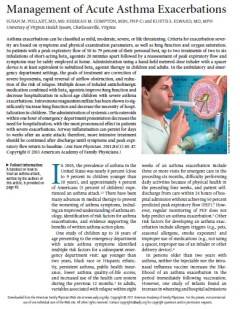
Management of Acute Asthma Exacerbations
Asthma exacerbations can be classified as mild, moderate, severe, or life threatening. Criteria for exacerbation severity are based on symptoms and physical examination parameters, as well as lung function and oxygen saturation. In patients with a peak expiratory flow of 50 to 79 percent of their personal best, up to two treatments of two to six inhalations of short-acting beta2 agonists 20 min…
- Edition
- -
- ISBN/ISSN
- -
- Collation
- -
- Series Title
- -
- Call Number
- -
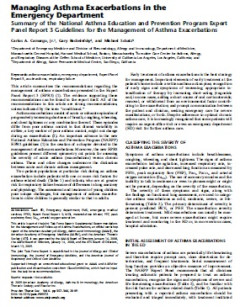
Managing Asthma Exacerbations in the Emergency Department Summary of the Nati…
This article summarizes the recommendations regarding the management of asthma exacerbations presented in the Expert Panel Report 3 (EPR3) (1). The evidence supporting these recommendations can be found in the report itself. All of the recommendations in this article are strong recommendations, unless indicated by the term ‘‘conditional.’’
- Edition
- -
- ISBN/ISSN
- -
- Collation
- -
- Series Title
- -
- Call Number
- -
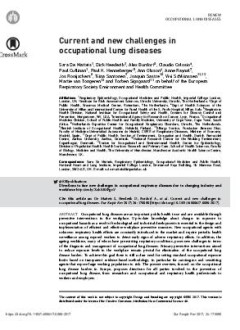
Current and new challenges in occupational lung diseases
Occupational lung diseases are an important public health issue and are avoidable through preventive interventions in the workplace. Up-to-date knowledge about changes in exposure to occupational hazards as a result of technological and industrial developments is essential to the design and implementation of efficient and effective workplace preventive measures.
- Edition
- -
- ISBN/ISSN
- -
- Collation
- -
- Series Title
- -
- Call Number
- -
 Computer Science, Information & General Works
  Philosophy & Psychology
  Religion
  Social Sciences
  Language
  Pure Science
  Applied Sciences
  Art & Recreation
  Literature
  History & Geography