Filter by
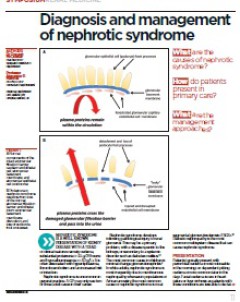
Diagnosis and management of nephrotic syndrome
NEPHROTIC SYNDROME IS A WELL KNOWN PRESENTATION OF KIDNEY DISEASE WITH A TRIAD of clinical features namely oedema, substantial proteinuria (> 3.5 g/24 hours) and hypoalbuminaemia (< 30 g/L). It is often associated with hyperlipidaemia, thromboembolism and an increased risk of infection.
- Edition
- -
- ISBN/ISSN
- -
- Collation
- -
- Series Title
- -
- Call Number
- -
Hepatorenal syndrome: current concepts related to diagnosis and management
Renal failure in cirrhotic patients is a very severe condition. Hepatorenal syndrome has the worst prognosis among all causes of kidney failure in such patients. Hepatorenal syndrome is diagnosed especially in cirrhotic patients with ascites who develop loss renal function, despite diuretic suspension and volume expansion with albumin and for whom other causes of kidney injury have been exclude…
- Edition
- -
- ISBN/ISSN
- -
- Collation
- -
- Series Title
- -
- Call Number
- -

Perioperative fluid management: science, art or random chaos?
As anaesthetists, we like to believe that the i.v. fluid we administer during surgery is based on a careful consideration of the contemporaneous clinical situation in the particular individual under our care. We estimate deficits; we use clinical assessment and haemodynamic monitoring to characterize circulating blood volume, and we respond to changes with fluid challenges and vasopressors
- Edition
- -
- ISBN/ISSN
- -
- Collation
- -
- Series Title
- -
- Call Number
- -
Perioperative fluid therapy recommendations for major abdominal surgery. Via …
About 230 million patients undergo surgery each year.1 Reported mortality rates for elective non-cardiac surgery range from 1% to 4%.2 Although less than 15% of inpatient procedures are performed in high-risk patients, such patients account for 80% of deaths
- Edition
- -
- ISBN/ISSN
- -
- Collation
- -
- Series Title
- -
- Call Number
- -
Three polymorphisms of tumor necrosis factor-alpha and hepatitis B virus rela…
This meta-analysis shows that AA genotype in TNF-a G308A and TNF-a G238A and CT genotype in TNF-a C863T may increase HBV-HCC risk. Therefore, HBV infection seemed to be a more important factor for tumorigenesis of HCC than genetic predisposition in G308A of TNF-a, and interaction between TNF-a C863T polymorphisms and HBV infection might be associated with increased HCC risk
- Edition
- -
- ISBN/ISSN
- -
- Collation
- -
- Series Title
- -
- Call Number
- -
S-index and APRI Score to Predict Liver Fibrosis Chronic in Hepatitis B and C…
A great interest has been dedicated to the development of non invasive predictive models in recent years to substitute liver biopsy for fibrosis assessment and follow-up. The aim of this study was to compare the accuracy between S-index and aspartate aminotransferase to platelet ratio index (APRI) to FibroScan for predicting liver fibrosis in chronic hepatitis B and C patients
- Edition
- -
- ISBN/ISSN
- -
- Collation
- -
- Series Title
- -
- Call Number
- -
The role of tumour necrosis factor in hepatitis B infection: Jekyll and Hyde
Chronic hepatitis B (CHB) is a major health problem worldwide and is associated with significant long-term morbidity and mortality. The hepatitis B virus (HBV) is a hepatotropic virus that is capable of integrating in the host nucleus permanently resulting in lifelong infection. To date, there is no definitive cure for HBV, as our current treatments cannot eradicate the viral reservoir that ha…
- Edition
- -
- ISBN/ISSN
- -
- Collation
- -
- Series Title
- -
- Call Number
- -
Impact of age on the diagnostic performances and cut-offs of APRI and FIB-4 f…
The APRI AUROC in patients aged
- Edition
- -
- ISBN/ISSN
- -
- Collation
- -
- Series Title
- -
- Call Number
- -
AST to platelet ratio index (APRI) for the noninvasive evaluation of liver fi…
Liver biopsy is the recognized gold standard for liver fibrosis staging. The aspartate minotransferase to platelet ratio index (APRI) has been proposed as a noninvasive and readily available tool for the assessment of liver fibrosis in chronic hepatitis C (CHC). This study aimed to validate, in a Mexican tertiary health care setting, the diagnostic usefulness of APRI in CHC, nonalcoholic fatty…
- Edition
- -
- ISBN/ISSN
- -
- Collation
- -
- Series Title
- -
- Call Number
- -
 Computer Science, Information & General Works
  Philosophy & Psychology
  Religion
  Social Sciences
  Language
  Pure Science
  Applied Sciences
  Art & Recreation
  Literature
  History & Geography