Filter by

Single-dose i.v. granisetron in the prevention of postoperative nausea and vo…
In this randomized, double-blind, parallel group, placebo-controlled, dose-ranging study, we have compared three doses (0.1 mg, 1.0 mg and 3.0 mg) of the 5-HT3 receptor antagonist, granisetron (Kytril), as prophylactic therapy for the prevention of postoperative nausea and vomiting. The aims were to determine the optimal dose of granisetron and to evaluate its safety profile. We studied 527 adu…
- Edition
- -
- ISBN/ISSN
- -
- Collation
- -
- Series Title
- -
- Call Number
- -

The Cardiotoxic Potential of the 5-HT3 Receptor Antagonist Antiemetics: Is Th…
To review and evaluate the potential cardiac effects of 5-HT3 antiemetic treatment in patients who may be predisposed to cardiac complications resulting from malignancy, cytotoxic oncologic regimens, or preexisting comorbid conditions
- Edition
- -
- ISBN/ISSN
- -
- Collation
- -
- Series Title
- -
- Call Number
- -

Granisetron: An Update on its Clinical Use in the Management of Nausea and Vo…
Nausea and vomiting are typical side effects of cytotoxic therapy and some surgical procedures. These symptoms can represent a major therapeutic challenge and, if inadequately controlled by antiemetic treatment, will result in increased mortality, morbidity, and health care costs. However, the management of nausea and vomiting has improved greatly in recent years following the introduction of t…
- Edition
- -
- ISBN/ISSN
- -
- Collation
- -
- Series Title
- -
- Call Number
- -
Variceal bleeding in cirrhotic patients
Variceal bleeding is one of the major causes of death in cirrhotic patients. The management during the acute phase and the secondary prophylaxis is well defined. Recent recommendations (2015 Baveno VI expert consensus) are available and should be followed for an optimal management, which must be performed as an emergency in a liver or general intensive-care unit. It is based on the early admini…
- Edition
- -
- ISBN/ISSN
- -
- Collation
- -
- Series Title
- -
- Call Number
- -
Evaluation and management of variceal bleeding
Acute variceal bleeding is one of the most fatal complications of cirrhosis and is responsible for about one-third of cirrhosis-related deaths.Therefore,every effort should be made to emergently resuscitate the patients,start pharma-cotherapy as soon as possible and do endoscopic therapy in a timely manner. Despite there cent advances in treatment, mortality rate is still high.We provide a comp…
- Edition
- -
- ISBN/ISSN
- -
- Collation
- -
- Series Title
- -
- Call Number
- -
Radiation Colitis and Proctitis
Radiation therapy is commonly utilized as a major component in the treatment of pelvic malignancy. Unfortunately, secondary toxicity to the lower gastrointestinal tract can occur. This most commonly affects the rectum, although injuries to the colon and small intestine are not uncommon. The presentation can be acute or chronic, and different mechanisms are responsible for each. Symptomatology i…
- Edition
- -
- ISBN/ISSN
- -
- Collation
- -
- Series Title
- -
- Call Number
- -
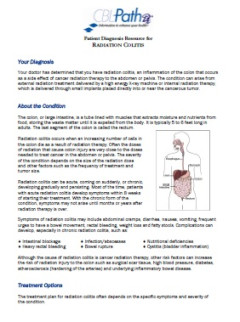
Patient Diagnosis Resource for RADIATION COLITIS
Your doctor has determined that you have radiation colitis, an inflammation of the colon that occurs as a side effect of cancer radiation therapy to the abdomen or pelvis. The condition can arise from external radiation treatment delivered by a high energy X-ray machine or internal radiation therapy, which is delivered through small implants placed directly into or near the cancerous tumor
- Edition
- -
- ISBN/ISSN
- -
- Collation
- -
- Series Title
- -
- Call Number
- -
 Computer Science, Information & General Works
  Philosophy & Psychology
  Religion
  Social Sciences
  Language
  Pure Science
  Applied Sciences
  Art & Recreation
  Literature
  History & Geography