Filter by
Perioperative fluid management: science, art or random chaos?
As anaesthetists, we like to believe that the i.v. fluid we administer during surgery is based on a careful consideration of the contemporaneous clinical situation in the particular individual under our care. We estimate deficits; we use clinical assessment and haemodynamic monitoring to characterize circulating blood volume, and we respond to changes with fluid challenges and vasopressors
- Edition
- -
- ISBN/ISSN
- -
- Collation
- -
- Series Title
- -
- Call Number
- -
Perioperative fluid therapy recommendations for major abdominal surgery. Via …
About 230 million patients undergo surgery each year.1 Reported mortality rates for elective non-cardiac surgery range from 1% to 4%.2 Although less than 15% of inpatient procedures are performed in high-risk patients, such patients account for 80% of deaths
- Edition
- -
- ISBN/ISSN
- -
- Collation
- -
- Series Title
- -
- Call Number
- -
Fluid Management in Acute Kidney Injury
Correction of intravascular hypovolemia is a key component of the prevention and management of acute kidney injury (AKI), but excessive fluid administration is associated with poor outcomes, including the development and progression of AKI. There is growing evidence that fluid administration should be individualized and take into account patient characteristics, nature of the acute illness and…
- Edition
- -
- ISBN/ISSN
- -
- Collation
- -
- Series Title
- -
- Call Number
- -
Fluid management in the critically ill
Fluid therapy, which is provided to restore and maintain tissue perfusion, is part of routine management for almost all critically ill patients. However, because either too much or too little fluid can have a negative impact on patient outcomes, fluid administration must be titrated carefully for each patient.
- Edition
- -
- ISBN/ISSN
- -
- Collation
- -
- Series Title
- -
- Call Number
- -
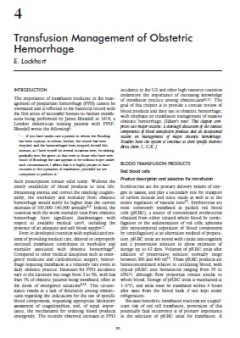
Transfusion Management of Obstetric Hemorrhage
The importance of transfusion medicine in the management of postpartum hemorrhage (PPH) cannot be overstated and is reflected in the historical record with the first series of successful human-to-human transfusions being performed by James Blundell in 1818, a London obstetrician treating patients with PPH
- Edition
- -
- ISBN/ISSN
- -
- Collation
- -
- Series Title
- -
- Call Number
- -
Developing a Systematic Approach to Obstetric Emergencies
Comparison of pre- and postassessments revealed improvements in perceived confidence and competence when managing obstetric emergencies. Nurse confidence increased by 35% and nurse competence increased by 32%. The 2-day educational program also realized significant cost savings. Overall costs for the educational program decreased from $94849 to $42974.
- Edition
- -
- ISBN/ISSN
- -
- Collation
- -
- Series Title
- -
- Call Number
- -
Postpartum Hemorrhage: Management of Massive Transfusion
In women with postpartumhemorrhage, the need to transfuse a large amount of blood products is frequent. The ABCD ofmassive transfusions—Assessment/Activation, Blood products, Complications, and Drugs—can helpmanage this complex situation. There needs to be a definedmethod to activate themassive transfusion protocol and a well-defined means to assess the coagulation status of the patient …
- Edition
- -
- ISBN/ISSN
- -
- Collation
- -
- Series Title
- -
- Call Number
- -
Fluid management in acute kidney injury
Acute kidney injury (AKI) and fluids are closely linked through oliguria, which is a marker of the former and a trigger for administration of the latter. Recent progress in this field has challenged the physiological and clinical rational of using oliguria as a trigger for the administration of fluid and brought attention to the delicate balance between benefits and harms of different aspects o…
- Edition
- -
- ISBN/ISSN
- -
- Collation
- -
- Series Title
- -
- Call Number
- -
The Effect of In Vitro Hemodilution with Gelatin, Dextran, Hydroxyethyl Starc…
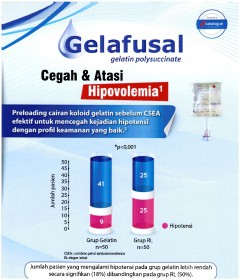
To determine the effects of progressive in vitro hemodilution with various plasma substitutes on whole blood coagulation, blood was obtained from six healthy volunteers. The Thrombelastograph® (TEG; Haemoscope Corp., Morton Grove, IL) variables of reaction time, coagulation time, maximum amplitude, and growth angle were determined. The following plasma substitutes were tested: two gelatin solu…
- Edition
- -
- ISBN/ISSN
- -
- Collation
- -
- Series Title
- -
- Call Number
- -
3.5% urea-linked gelatin is as effective as 6% HES 200/0.5 for volume managem…
To compare the efficacy of volume expansion with 3.5% gelatin and 6% hydroxyethyl starch 200/0.5 in patients undergoing cardiac surgery. The second objective was to compare the two colloids in terms of blood losses and allogeneic blood transfusion exposure rate.
- Edition
- -
- ISBN/ISSN
- -
- Collation
- -
- Series Title
- -
- Call Number
- -
 Computer Science, Information & General Works
  Philosophy & Psychology
  Religion
  Social Sciences
  Language
  Pure Science
  Applied Sciences
  Art & Recreation
  Literature
  History & Geography