Filter by

Head and neck cancer: causes, prevention and treatment
Alcohol and tobacco are still atop risk factors. Other factors may influence the development of head and neck carcinoma. Surgery is the main treatment option, and the addition of radiotherapy following surgery is frequent for patients in the early stages of the disease. Other therapies target specific genetic molecular components connected to tumor development. Disease preventive measures inclu…
- Edition
- -
- ISBN/ISSN
- -
- Collation
- -
- Series Title
- -
- Call Number
- -
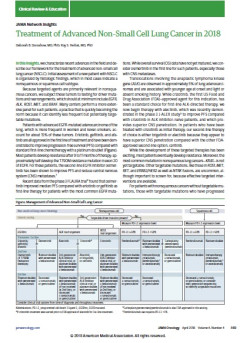
Treatment of Advanced Non–Small Cell Lung Cancer in 2018
In this Insights,we characterize recent advances inthe field and describe our framework for the treatment of advanced non–small cell lung cancer (NSCLC). Initial assessment of anewpatient withNSCLC is organized by histologic findings, which in most cases indicate a nonsquamous or squamous cell subtype.
- Edition
- -
- ISBN/ISSN
- -
- Collation
- -
- Series Title
- -
- Call Number
- -
Malignant pleural effusion: from bench to bedside
Malignant pleural effusion (MPE) is a common but serious condition that is related with poor quality of life, morbidity and mortality. Its incidence and associated healthcare costs are rising and its management remains palliative, with median survival ranging from 3 to 12 months. During the last decade there has been significant progress in unravelling the pathophysiology of MPE, as well as its…
- Edition
- -
- ISBN/ISSN
- -
- Collation
- -
- Series Title
- -
- Call Number
- -
Comparing approaches to the management of malignant pleural effusions
Management of symptomatic malignant pleural effusions is becoming more complex due to the range of treatment options, which include therapeutic thoracenteses, thoracoscopic talc pleurodesis, bedside pleurodesis with talc or other sclerosing agents via small-bore chest catheters, indwelling pleural catheters, surgery, or a combination of some of these procedures
- Edition
- -
- ISBN/ISSN
- -
- Collation
- -
- Series Title
- -
- Call Number
- -
Can malignant and inflammatory pleural effusions in dogs be distinguished usi…
Computed tomography (CT) is the primary imaging modality used to investigate human patients with suspected malignant or inflammatory pleural effusion, but there is a lack of information about the clinical use of this test in dogs. To identify CT signs that could be used to distinguish pleural malignant neoplasia from pleuritis, a retrospective case-control study was done based on dogs that had …
- Edition
- -
- ISBN/ISSN
- -
- Collation
- -
- Series Title
- -
- Call Number
- -
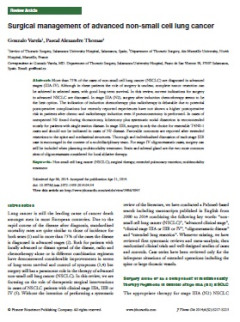
Surgical management of advanced non-small cell lung cancer
More than 75% of the cases of non-small cell lung cancer (NSCLC) are diagnosed in advanced stages (IIIA-IV). Although in these patients the role of surgery is unclear, complete tumor resection can be achieved in selected cases, with good long-term survival. In this review, current indications for surgery in advanced NSCLC are discussed. In stage IIIA (N2), surgery after induction chemotherap…
- Edition
- -
- ISBN/ISSN
- -
- Collation
- -
- Series Title
- -
- Call Number
- -
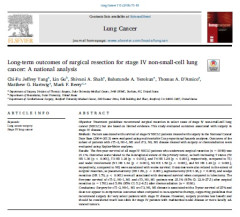
Long-term outcomes of surgical resection for stage IV non-small-cell lung can…
Surgery for cT1-2, N0-1, M1 or cT3, N0, M1 disease is associated with a 5-year survival of 25% and does not appear to compromise outcomes when compared to non-operative therapy, supporting guidelines that recommend surgery for very select patients with stage IV disease. However, surgery provides less benefit and should be considered much less often for stage IV patients with mediastinal noda…
- Edition
- -
- ISBN/ISSN
- -
- Collation
- -
- Series Title
- -
- Call Number
- -
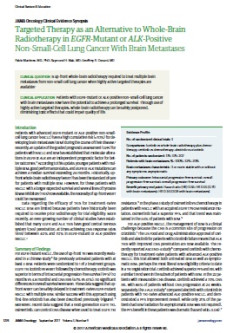
Targeted Therapy as an Alternative to Whole-Brain Radiotherapy in EGFR-Mutant…
Patients with advanced EGFR-mutant or ALK-positive non–smallcell lung cancer (NSCLC) have a high cumulative risk (>70%) for developing brainmetastases (BrM) during the course of their disease. Recently, an update of the graded prognostic assessment (GPA) for patients with NSCLCandBrMhas established that molecular alterations in EGFR or ALK are an independent prognostic factor for betteroutcomes.
- Edition
- -
- ISBN/ISSN
- -
- Collation
- -
- Series Title
- -
- Call Number
- -
Honk if You Love Rad Onc! OMG—What About Your QMP?
Recent figures as of December 2013 indicate that the ACR’s membership is 36,605, or 74% of all US radiologists, including 1,159 radiation oncologists (3%) and 634 medical physicists (1%). The number of radiation oncologists and physicsts is small, but these members make large contributions to the College and the profession.
- Edition
- -
- ISBN/ISSN
- -
- Collation
- -
- Series Title
- -
- Call Number
- -
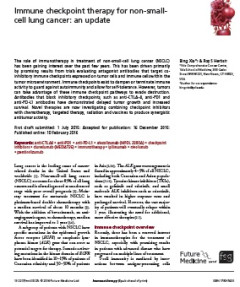
Immune checkpoint therapy for non-smallcell lung cancer: an update
The role of immunotherapy in treatment of non-small-cell lung cancer (NSCLC) has been gaining interest over the past few years. This has been driven primarily by promising results from trials evaluating antagonist antibodies that target coinhibitory immune checkpoints expressed on tumor cells and immune cells within the tumor microenvironment. Immune checkpoints exist to dampen or terminate im…
- Edition
- -
- ISBN/ISSN
- -
- Collation
- -
- Series Title
- -
- Call Number
- -
 Computer Science, Information & General Works
  Philosophy & Psychology
  Religion
  Social Sciences
  Language
  Pure Science
  Applied Sciences
  Art & Recreation
  Literature
  History & Geography