Filter by

Neoadjuvant Therapy in Patients with Pancreatic Cancer: A Disappointing Thera…
Pancreatic cancer is a devastating disease. It is the fourth leading cause of cancer-related death in Germany. The incidence in 2003/2004 was 16 cases per 100.000 inhabitants. Of all carcinomas, pancreatic cancer has the highest mortality rate, with one- and five-year survival rates of 25% and less than 5%, respectively, regardless of the stage at diagnosis. These low survival rates demonstrate…
- Edition
- -
- ISBN/ISSN
- -
- Collation
- -
- Series Title
- -
- Call Number
- -
Gemcitabine in advanced non-small cell lung cancer: A phase II study
Gemcitabine is an active agent for treatment of advanced nonsmall cell lung cancer (NSCLC). Weekly treatment with singleagent gemcitabine has shown response rates of 20% to 26%. This Phase II trial was conducted to determine the efficacy and safety of 1000 mg/m2 gemcitabine administered weekly for 3 weeks followed by 1 week or rest (28-day cycle). Patients were required to have histologic evide…
- Edition
- -
- ISBN/ISSN
- -
- Collation
- -
- Series Title
- -
- Call Number
- -
GEMCITABINE/CISPLATIN CONTAINING CHEMO-THERAPY IN PATIENTS WITH STAGE III-IV …
A two- drug platinum- based regimensis the standard first- line treatment for inoperable non- smallcell lung cancer /NSCLC/ patients with perfomance status/PS/ 0-2. The aim of this study was to evaluate the efficacyand safety of chemotherapy combination Gemcitabine- cis-Platinum in patients with advanced NSCLC
- Edition
- -
- ISBN/ISSN
- -
- Collation
- -
- Series Title
- -
- Call Number
- -
Adjuvant Chemotherapy With Gemcitabine and Long-term Outcomes Among Patients …
Among patients with macroscopic complete removal of pancreatic cancer, the use of adjuvant gemcitabine for 6 months compared with observation alone resulted in increased overall survival as well as disease-free survival. These findings provide strong support for the use of gemcitabine in this setting
- Edition
- -
- ISBN/ISSN
- -
- Collation
- -
- Series Title
- -
- Call Number
- -
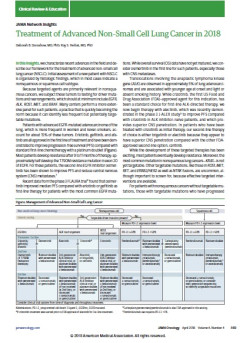
Treatment of Advanced Non–Small Cell Lung Cancer in 2018
In this Insights,we characterize recent advances inthe field and describe our framework for the treatment of advanced non–small cell lung cancer (NSCLC). Initial assessment of anewpatient withNSCLC is organized by histologic findings, which in most cases indicate a nonsquamous or squamous cell subtype.
- Edition
- -
- ISBN/ISSN
- -
- Collation
- -
- Series Title
- -
- Call Number
- -
Anti-Angiogenics: Their Value in Lung Cancer Therapy
Lung cancer is the second most common cancer and the leading cause of cancer-related deaths. Different targeted therapies and the introduction of immunotherapy have successfully improved outcome for patients with non-small lung cancer (NSCLC). Anti-angiogenic drugs are an essential component in the treatment of NSCLC patients. The vascular endothelial growth factor (VEGF)- A antibody bevacizuma…
- Edition
- -
- ISBN/ISSN
- -
- Collation
- -
- Series Title
- -
- Call Number
- -
Lung Cancer Biomarkers
The molecular characterization of lung cancer has considerably changed the classification and treatment of these tumors, becoming an essential component of pathologic diagnosis and oncologic therapy decisions. Through the recognition of novel biomarkers, such as epidermal growth factor receptor mutations and anaplastic lymphoma kinase translocations, it has been possible to identify subsets of …
- Edition
- -
- ISBN/ISSN
- -
- Collation
- -
- Series Title
- -
- Call Number
- -
Predictive value of tumor genetic alteration profiling for chemotherapy and E…
Previous studies have suggested that a variety of tumor driver genetic alterations affected the treatment efficacy of chemotherapy and epidermal growth factor receptor (EGFR)‑tyrosine kinase inhibitors (TKIs) in advanced non‑small cell lung cancer (NSCLC). The present study aimed to investigate the association between the tumor genetic alteration landscape and the treatment outcome of first…
- Edition
- -
- ISBN/ISSN
- -
- Collation
- -
- Series Title
- -
- Call Number
- -
Honk if You Love Rad Onc! OMG—What About Your QMP?
Recent figures as of December 2013 indicate that the ACR’s membership is 36,605, or 74% of all US radiologists, including 1,159 radiation oncologists (3%) and 634 medical physicists (1%). The number of radiation oncologists and physicsts is small, but these members make large contributions to the College and the profession.
- Edition
- -
- ISBN/ISSN
- -
- Collation
- -
- Series Title
- -
- Call Number
- -
 Computer Science, Information & General Works
  Philosophy & Psychology
  Religion
  Social Sciences
  Language
  Pure Science
  Applied Sciences
  Art & Recreation
  Literature
  History & Geography