Filter by
Vitamins in early pregnancy
- Edition
- -
- ISBN/ISSN
- -
- Collation
- -
- Series Title
- -
- Call Number
- -
- Edition
- -
- ISBN/ISSN
- -
- Collation
- -
- Series Title
- -
- Call Number
- -

TERATOGENICITY OF HIGH VITAMIN A INTAKE
Studies in animals indicate that natural forms of vitamin A are teratogenic. Synthetic retinoids chemically similar to vitamin A cause birth defects in humans; as in animals, the defects appear to affect tissues derived from the cranial neural crest
- Edition
- -
- ISBN/ISSN
- -
- Collation
- -
- Series Title
- -
- Call Number
- -
Preeclampsia Induced Ocular Change
Preeclampsia/eclampsia, the most common medical complication of pregnancy, can affect visual system as an end organ damage. Visual symptoms occur in 25% of patients with severe preeclampsia and 50% of patients with eclampsia. Visual system may be affected by hypertensive retinopathy, exudative retinal detachment, and cortical blindness.
- Edition
- -
- ISBN/ISSN
- -
- Collation
- -
- Series Title
- -
- Call Number
- -
signs of eclampsia during singleton deliveries and early neonatal mortality i…
- Edition
- -
- ISBN/ISSN
- -
- Collation
- -
- Series Title
- -
- Call Number
- -
- Edition
- -
- ISBN/ISSN
- -
- Collation
- -
- Series Title
- -
- Call Number
- -
Posterior reversible leukoencephalopathy syndrome (PRES) associated with seve…
PRES appears to accompany eclampsia in over half of all cases. The clinical picture of patients with eclampsia with or ithout associated PRES is similar, but certain biochemical characteristics suggest that PRES might be indicative of a more severe disease process
- Edition
- -
- ISBN/ISSN
- -
- Collation
- -
- Series Title
- -
- Call Number
- -
Eclampsia in Finland; 2006 to 2010
Eclampsia is a rare but serious threat to maternal and fetal wellbeing. Magnesium sulfate was introduced in Finland as management of eclampsia in the late 1990s. The aim of this study was to assess the incidence of eclampsia in Finland after the increased use of magnesium sulfate.
- Edition
- -
- ISBN/ISSN
- -
- Collation
- -
- Series Title
- -
- Call Number
- -
Pre-Eclampsia Increases the Risk of Postpartum Haemorrhage A Nationwide Cohor…
Postpartum haemorrhage is a leading cause of maternal morbidity and mortality worldwide. Identifying risk indicators for postpartum haemorrhage is crucial to predict this life threatening condition. Another major contributor to maternal morbidity and mortality is pre-eclampsia. Previous studies show conflicting results in the association between preeclampsia and postpartum haemorrhage. The p…
- Edition
- -
- ISBN/ISSN
- -
- Collation
- -
- Series Title
- -
- Call Number
- -
Pre-Eclampsia and Eclampsia: An Update on the Pharmacological Treatment Appli…
Pre-eclampsia and eclampsia are two hypertensive disorders of pregnancy, considered major causes of maternal and perinatal death worldwide. Pre-eclampsia is a multisystemic disease characterized by the development of hypertension after 20 weeks of gestation, with the presence of proteinuria or, in its absence, of signs or symptoms indicative of target organ injury. Eclampsia represents the con…
- Edition
- -
- ISBN/ISSN
- -
- Collation
- -
- Series Title
- -
- Call Number
- -
Intrauterine Devices: An Update
Three intrauterine devices (IUDs) are available in the United States: the copper T 380A and two levonorgestrel-releasing IUDs, one that releases 20 mcg of levonorgestrel per 24 hours, and one that releases 14 mcg per 24 hours. All are safe and effective methods of contraception that work predominantly by prefertilization mechanisms. The copper T 380A IUD may be placed in nonpregnant women at an…
- Edition
- -
- ISBN/ISSN
- -
- Collation
- -
- Series Title
- -
- Call Number
- -
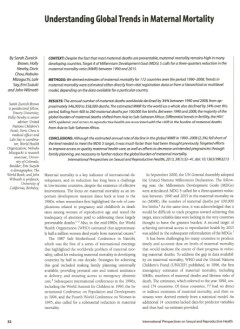
Understanding Global Trends in Maternal Mortality
Although the estimated annual rate of decline In the global MMR in 1990-2008 (2.3%) fell short of the level needed to meet the MDG 5 target, it was much faster than had been thought previously. Targeted efforts to Improve access to quality maternal health care, as well as efforts to decrease unintended pregnancies through family planning, are necessary to further reduce the global burden of mat…
- Edition
- -
- ISBN/ISSN
- -
- Collation
- -
- Series Title
- -
- Call Number
- -
 Computer Science, Information & General Works
  Philosophy & Psychology
  Religion
  Social Sciences
  Language
  Pure Science
  Applied Sciences
  Art & Recreation
  Literature
  History & Geography