Filter by
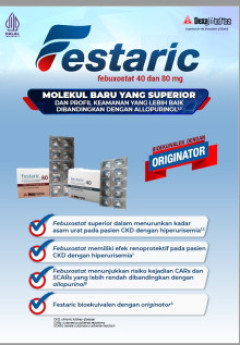
Hyperuricemia, A new cardiovascular risk
Hyperuricemia is strongly linked to increased cardiovascular risk, including hypertension, coronary artery disease, arrythmia, and heart failure. Uric acid, as the end-product of purine metabolism, plays a critical role in cellular processes, but elevated levels can drive inflammation and oxidative stress. This review aims to emphasize the robust association between hyperuricemia and cardiovasc…
- Edition
- -
- ISBN/ISSN
- -
- Collation
- -
- Series Title
- -
- Call Number
- -
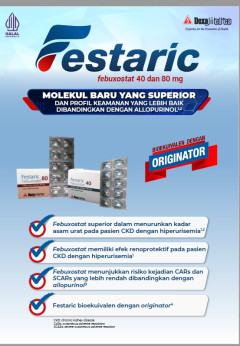
Clinical Efficacy and Safety of Successful Longterm Urate Lowering with Febux…
After 1 month initial treatment, > 80% of subjects receiving either febuxostat dose, but only 46% of subjects receiving allopurinol, achieved SUA < 6.0 mg/dl. After ULT reassignment, > 80% of all remaining subjects maintained the primary efficacy endpoint of SUA < 6.0 mg/dl at each visit. More subjects initially randomized to allopurinol required ULT reassignment to achieve SUA < 6.0 mg/dl com…
- Edition
- -
- ISBN/ISSN
- -
- Collation
- -
- Series Title
- -
- Call Number
- -
The urate-lowering efficacy and safety of febuxostat in the treatment of the …
The purpose of this study was to compare urate-lowering (UL) efficacy and safety of daily febuxostat and allopurinol in subjects with gout and serum urate (sUA) ≥ 8.0 mg/dL in a six-month trial
- Edition
- -
- ISBN/ISSN
- -
- Collation
- -
- Series Title
- -
- Call Number
- -
A pharmacokinetic-pharmacodynamic study of a single dose of febuxostat in hea…
To examine the pharmacokinetic-phamacodynamic (PK-PD) relationships of plasma febuxostat and serum urate and the effect of a single dose of the drug on renal excretion and fractional clearance of urate (FCU).
- Edition
- -
- ISBN/ISSN
- -
- Collation
- -
- Series Title
- -
- Call Number
- -
Comparison of uric acid reduction and renal outcomes of febuxostat vs allopur…
Whether the clinical trial treatment effect of urate-lowering therapy (ULT) in patient with chronic kidney disease (CKD) is generalizable to real-word settings is unclear. This study aimed to compare febuxostat with allopurinol for uric acid reduction and renal protection in patients with CKD. Adult CKD patients newly treated with ULT were identified using electronic health records from 2010 to…
- Edition
- -
- ISBN/ISSN
- -
- Collation
- -
- Series Title
- -
- Call Number
- -
Efficacy and safety of urate-lowering treatments in patients with hyperuricem…
What is known and objective: Hyperuricemia (HUA) and gout are considerable public health problems because of their increasing incidence and interactions with other diseases. We aimed to evaluate the efficacy and safety of urate-lowering therapies (ULTs) for patients.
- Edition
- -
- ISBN/ISSN
- -
- Collation
- -
- Series Title
- -
- Call Number
- -
Comparative effectiveness of urate lowering with febuxostat versus allopurino…
To assess the comparative effectiveness of febuxostat and allopurinol in reducing serum urate (sUA) levels in a real-world U.S. managed care setting.
- Edition
- -
- ISBN/ISSN
- -
- Collation
- -
- Series Title
- -
- Call Number
- -
Effects of febuxostat on renal function in patients with chronic kidney disea…
Hyperuricemia has been proven to be an independent risk factor for chronic kidney disease (CKD). However, the role of hyperuricemia in the progression of CKD remains unclear. Thus, we performed a systematic review and metaanalysis to evaluate the efficacy and safety of febuxostat, a first line urate-lowering agent, in CKD patients with hyperuricemia
- Edition
- -
- ISBN/ISSN
- -
- Collation
- -
- Series Title
- -
- Call Number
- -
Renal safety and urate-lowering efficacy of febuxostat in gout patients with …
The safety and efficacy of febuxostat in patients with stage 4–5 chronic kidney disease (CKD) are still unclear owing to a lack of studies in these patients. Therefore, we aimed to evaluate the effect of febuxostat on renal function, general safety, and efficacy in gout patients with stage 4–5 CKD
- Edition
- -
- ISBN/ISSN
- -
- Collation
- -
- Series Title
- -
- Call Number
- -
Risk of cutaneous adverse reactions associated with allopurinol or febuxostat…
Allopurinol carries a well‐known risk of cutaneous adverse reactions (CARs). Although febuxostat, a xanthine‐oxidase inhibitor with different chemical structure, has been considered an alternative to allopurinol, post‐marketing case reports of life‐ threatening febuxostat‐related CARs have been reported. We aimed to compare the risk of CARs between allopurinol and febuxostat in real 
- Edition
- -
- ISBN/ISSN
- -
- Collation
- -
- Series Title
- -
- Call Number
- -
 Computer Science, Information & General Works
  Philosophy & Psychology
  Religion
  Social Sciences
  Language
  Pure Science
  Applied Sciences
  Art & Recreation
  Literature
  History & Geography