Filter by
Typhoid and other invasive salmonellosis
Enteric fever (typhoid and paratyphoid fever) is caused by Salmonella enterica serovar Typhi (S. Typhi) and Salmonella enterica serovar Paratyphi (S. Paratyphi). S. Paratyphi A and B (and, uncommonly, S. Paratyphi C) cause a disease that is clinically indistinguishable from typhoid fever, particularly in parts of Asia.
- Edition
- -
- ISBN/ISSN
- -
- Collation
- -
- Series Title
- -
- Call Number
- -
What Have We Learned From the Typhoid Fever Surveillance in Africa Program?
The Typhoid Fever Surveillance in Africa Program (TSAP) was established in 2009 to fill the data void concerning invasive Salmonella disease in sub-Saharan Africa, and to specifically estimate the burden of bloodstream infections caused by the key pathogen, Salmonella enterica serovar Typhi. TSAP has achieved this ambitious target, finding high incidences of typhoid fever in both rural and u…
- Edition
- -
- ISBN/ISSN
- -
- Collation
- -
- Series Title
- -
- Call Number
- -
MANAJEMEN TERAPI DEMAM TIFOID: KAJIAN TERAPI FARMAKOLOGIS DAN NON FARMAKOLOGIS
Demam tifoid adalah penyakit demam akut yang disebabkan oleh infeksi bakteri Salmonella typhi. Penderita demam tifoid di Indonesia mencapai 81% per 100.000. Demam tifoid dapat diberikan terapi farmakologis maupun non farmakologis yang bertujuan untuk mempercepat penyembuhan, meminimalkan komplikasi sekaligus untuk mencegah penyebaran penyakit. Metode yang digunakan dalam pengerjaan literatur r…
- Edition
- -
- ISBN/ISSN
- -
- Collation
- -
- Series Title
- -
- Call Number
- -
Emerging insights into the biology of typhoid toxin
Typhoid toxin is a unique A2B5 exotoxin and an important virulence factor for Salmonella Typhi, the cause of typhoid fever. In the decade since its initial discovery, great strides have been made in deciphering the unusual biological program of this toxin, which is fundamentally different from related toxins in many ways. Purified typhoid toxin administered to laboratory animals causes many of …
- Edition
- -
- ISBN/ISSN
- -
- Collation
- -
- Series Title
- -
- Call Number
- -
Typhoid fever: issues in laboratory detection, treatment options & concerns i…
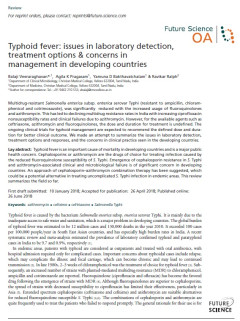
Multidrug-resistant Salmonella enterica subsp. enterica serovar Typhi (resistant to ampicillin, chloramphenicol and cotrimoxazole), was significantly reduced with the increased usage of fluoroquinolones and azithromycin. This has led to declining multidrug resistance rates in Indiawith increasing ciprofloxacin nonsusceptibility rates and clinical failures due to azithromycin. However, for the …
- Edition
- -
- ISBN/ISSN
- -
- Collation
- -
- Series Title
- -
- Call Number
- -

Pharmacokinetics of Single-Dose Intravenous, Oral, and Intraperitoneal Peflox…
Comparison of plasma and dialysate concentrations of pefloxacin after intravenous, oral, or intraperitoneal administration shows excellent bidirectional diffusion of the quinolone through the peritoneal membrane, demonstrating that therapeutical concentrations can be achieved in the dialysate after intravenous or oral administration. In this study, the half-life of the drug was 18.8 + 1.4 h, i.…
- Edition
- -
- ISBN/ISSN
- -
- Collation
- -
- Series Title
- -
- Call Number
- -
Pefloxacin Therapy for Experimental Endocarditis Caused by Methicillin-Suscep…
The therapeutic efficacy of pefloxacin in experimental endocarditis caused by methicillin-susceptible or methicillin-resistant Staphylococcus aureus was evaluated. In rabbits infected with a methicillin-susceptible strain, 4 days of pefloxacin therapy significantly reduced both the number of bacteria per gram of vegetation and the mortality rate compared with untreated controls, and pefloxacin …
- Edition
- -
- ISBN/ISSN
- -
- Collation
- -
- Series Title
- -
- Call Number
- -
Evaluation of Pefloxacin in Experimental Escherichia coli Meningitis
Pefloxacin mesylate, a new fluoroquinolone, has been shown to have a wide spectrum of activity both in vitro and in vivo (4, 8, 12, 13). Because of its excellent activity against members of the family Enterobacteriaceae and because in vitro tests may not reliably predict the bactericidal activity of a drug against meningitis (9), we evaluated the therapeutic efficacy of pefloxacin with a well-s…
- Edition
- -
- ISBN/ISSN
- -
- Collation
- -
- Series Title
- -
- Call Number
- -
Double blind randomized controlled study of once daily 400mg PefloxACIN SHORT…
- Edition
- -
- ISBN/ISSN
- -
- Collation
- -
- Series Title
- -
- Call Number
- -
- Edition
- -
- ISBN/ISSN
- -
- Collation
- -
- Series Title
- -
- Call Number
- -
Current Trends in the Management of Typhoid Fever
Typhoid (cloudy) fever is a systemic infection, caused mainly by Salmonella typhi found only in man. It is characterized by a continuous fever for 3-4 weeks, relative bradycardia, with involvement of lymphoid tissue and considerable constitutional symptoms. In western countries, the disease has been brought very close to eradication levels.
- Edition
- -
- ISBN/ISSN
- -
- Collation
- -
- Series Title
- -
- Call Number
- -
 Computer Science, Information & General Works
  Philosophy & Psychology
  Religion
  Social Sciences
  Language
  Pure Science
  Applied Sciences
  Art & Recreation
  Literature
  History & Geography