Filter by

The Safety and Tolerability of Lumbrokinase DLBS1033 in Healthy Adult Subjects
This study was aimed to evaluate the safety and tolerability of Lumbrokinase DLBS1033 in healthy adult subjects
- Edition
- -
- ISBN/ISSN
- -
- Collation
- -
- Series Title
- -
- Call Number
- -

Adjunctive Treatment with Lumbrokinase in NSTEMI patient: Evaluation with Myo…
Rupture of an atherosclerotic plaque is the usual initiating event in an acute coronary syndrome (ACS), leading to subsequent thrombus formation. Persistent thrombotic occlusion results in acute myocardial infarction (MI). Current American Heart Association (AHA) and European Society of Cardiology (ESC) recommendation for non-ST-elevation of myocardial infarction (NSTEMI) use antiplatelet and …
- Edition
- -
- ISBN/ISSN
- -
- Collation
- -
- Series Title
- -
- Call Number
- -

DLBS1033, A Protein Extract from Lumbricus rubellus, Possesses Antithrombotic…
The medicinal value of earthworm has been widely known since the history of Asian ancient medicine. This present study aims to determine the mechanism of action and effect of a standardized extract of Lumbricus rubellus named as DLBS1033. The fibrinogen degradation, antiplatelet aggregation, and ex vivo antithrombotic assay using human blood were performed to study antithrombotic activity
- Edition
- -
- ISBN/ISSN
- -
- Collation
- -
- Series Title
- -
- Call Number
- -
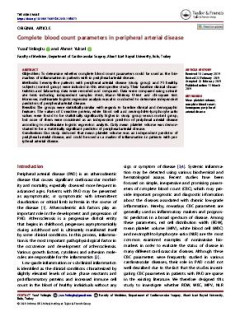
Complete blood count parameters in peripheral arterial disease
The groups were statistically similar with regards to baseline clinical and demographic features. The values of C-reactive protein, white blood cell and neutrophil-to-lymphocyte ratio values were found to be statistically significantly higher in study group versus control group, but none of them were considered as an independent predictor of peripheral arterial disease according to multivar…
- Edition
- -
- ISBN/ISSN
- -
- Collation
- -
- Series Title
- -
- Call Number
- -
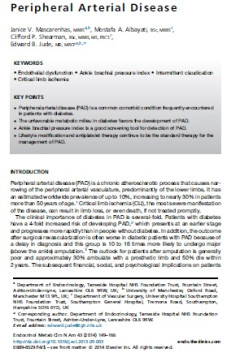
Peripheral Arterial Disease
Peripheral arterial disease (PAD) is a chronic atherosclerotic process that causes narrowing of the peripheral arterial vasculature, predominantly of the lower limbs. It has an estimated worldwide prevalence of up to 10%, increasing to nearly 30% in patients more than 50 years of age.1 Critical limb ischemia (CLI), the most severe manifestation of the disease, can result in limb loss, or even …
- Edition
- -
- ISBN/ISSN
- -
- Collation
- -
- Series Title
- -
- Call Number
- -
 Computer Science, Information & General Works
  Philosophy & Psychology
  Religion
  Social Sciences
  Language
  Pure Science
  Applied Sciences
  Art & Recreation
  Literature
  History & Geography