Filter by

A Review of Doripenem for the Treatment of Serious Bacterial Infections
Doripenem is a carbapenem bactericidal agent that demonstrates in vitro activity against a wide variety of Gram-negative and Gram-positive pathogens. In vitro data show that doripenem combines the intrinsic activity of meropenem against Gram-negative pathogens with the intrinsic activity of imipenem against Gram-positive pathogens. The availability of doripenem is particularly welcome in the cu…
- Edition
- -
- ISBN/ISSN
- -
- Collation
- -
- Series Title
- -
- Call Number
- -

Efficacy of doripenem in the treatment of Pseudomonas aeruginosa experimental…
In this model of P. aeruginosa pneumonia, doripenem had an efficacy equivalent to that of meropenem and imipenem at a high dose of 1 g three times a day and lower efficacy at a standard dose (0.5 g three times daily) than the other two agents in terms of bacteria cultivated from spleens. Doripenem is a new drug that offers new therapeutic options, especially for difficult-to-treat infections su…
- Edition
- -
- ISBN/ISSN
- -
- Collation
- -
- Series Title
- -
- Call Number
- -

Doripenem: A Review of its Use in the Treatment of Bacterial Infections
Doripenem, a parenteral, broad-spectrum antibacterial agent of the carbapenem family, is indicated as empirical therapy in serious bacterial infections in adults. Doripenem is indicated in Japan for use as a single agent in intra-abdominal infections (IAIs), lower respiratory tract infections (including nosocomial pneumonia), complicated urinary tract infections (cUTIs) and a variety of other b…
- Edition
- -
- ISBN/ISSN
- -
- Collation
- -
- Series Title
- -
- Call Number
- -

Hospital-acquired pneumonia in ICU
The French Society of Anesthesia and Intensive Care Medicine and the French Society of Intensive Care edited guidelines focused on hospital-acquired pneumonia (HAP) in intensive care unit (ICU). The goal of 16 French-speaking experts was to produce a framework enabling an easier decision-making process for intensivists. The guidelines were related to 3 specific areas related to HAP (prevention…
- Edition
- -
- ISBN/ISSN
- -
- Collation
- -
- Series Title
- -
- Call Number
- -

Early Administration of Antibiotics for Suspected Sepsis
- Edition
- -
- ISBN/ISSN
- -
- Collation
- -
- Series Title
- -
- Call Number
- -
- Edition
- -
- ISBN/ISSN
- -
- Collation
- -
- Series Title
- -
- Call Number
- -

Necrotizing fasciitis: Classification, diagnosis, and management
- Edition
- -
- ISBN/ISSN
- -
- Collation
- -
- Series Title
- -
- Call Number
- -
- Edition
- -
- ISBN/ISSN
- -
- Collation
- -
- Series Title
- -
- Call Number
- -
Defining of initial antibiotic treatment of pleural empyema
Parapneumonic effusions are often complications of bacterial pneumonia, occurring in 5-50% patients and in 15% cases it can progress into pleural empyema. Pleural empyema treatment includes drainage of pus, re-expansion of lung by using appropriate antibiotics. Initial antibiotics treatment of pleural empyema is usually started with antibiotics that are resistant to causes found in isolates.
- Edition
- -
- ISBN/ISSN
- -
- Collation
- -
- Series Title
- -
- Call Number
- -
Sepsis
Sepsis is a clinical syndrome that requires prompt recognition andrncontrol in order to optimize clinical outcomes in patients. It is very relevantrnto surgical practice, as it can affect perioperative patients andrnthose recovering on surgical wards. A working knowledge of sepsisrnis essential to any medical or surgical practitioner, and here werncover the topic with relevance to surgery and t…
- Edition
- -
- ISBN/ISSN
- -
- Collation
- -
- Series Title
- -
- Call Number
- -
Radiation Colitis and Proctitis
Radiation therapy is commonly utilized as a major component in the treatment of pelvic malignancy. Unfortunately, secondary toxicity to the lower gastrointestinal tract can occur. This most commonly affects the rectum, although injuries to the colon and small intestine are not uncommon. The presentation can be acute or chronic, and different mechanisms are responsible for each. Symptomatology i…
- Edition
- -
- ISBN/ISSN
- -
- Collation
- -
- Series Title
- -
- Call Number
- -
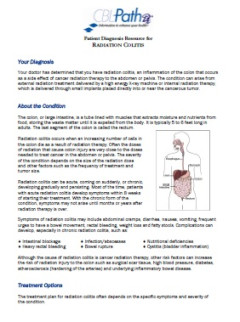
Patient Diagnosis Resource for RADIATION COLITIS
Your doctor has determined that you have radiation colitis, an inflammation of the colon that occurs as a side effect of cancer radiation therapy to the abdomen or pelvis. The condition can arise from external radiation treatment delivered by a high energy X-ray machine or internal radiation therapy, which is delivered through small implants placed directly into or near the cancerous tumor
- Edition
- -
- ISBN/ISSN
- -
- Collation
- -
- Series Title
- -
- Call Number
- -
 Computer Science, Information & General Works
  Philosophy & Psychology
  Religion
  Social Sciences
  Language
  Pure Science
  Applied Sciences
  Art & Recreation
  Literature
  History & Geography