Filter by

Bactericidal Activity of Low-Dose Clindamycin Administered at 8- and 12-Hour …
Twelve volunteers received 300 mg of clindamycin intravenously (i.v.) or orally (p.o.) administered every 8 h (q8h) or q12h by random assignment over four study periods. Serum bactericidal titers were determined for each regimen against two isolates each of Staphylococcus aureus, Streptococcus pneumoniae (one penicillinsensitive isolate and one penicillin-resistant isolate), and Bacteroides fra…
- Edition
- -
- ISBN/ISSN
- -
- Collation
- -
- Series Title
- -
- Call Number
- -
Clindamycin treatment of Staphylococcus aureus expressing inducible clindamyc…
- Edition
- -
- ISBN/ISSN
- -
- Collation
- -
- Series Title
- -
- Call Number
- -
- Edition
- -
- ISBN/ISSN
- -
- Collation
- -
- Series Title
- -
- Call Number
- -
Acceptability of Single-dose Clindamycin Gel for Bacterial Vaginosis: A Rando…
The goal of this study was to assess the acceptability of a single-dose bioadhesive 2% clindamycin vaginal gel for bacterial vaginosis (BV).
- Edition
- -
- ISBN/ISSN
- -
- Collation
- -
- Series Title
- -
- Call Number
- -
Effectiveness of adjunctive clindamycin in β-lactam antibiotictreated patien…
Clindamycin is strongly recommended as an adjunctive treatment to β-lactam antibiotics in patients with severe invasive group A β-haemolytic streptococcal (iGAS) infections. However, there is little evidence of a benefit in the use of clindamycin in humans, and its role, if any, in treating patients with invasive non-group A/B β-haemolytic streptococcal (iNABS) infections is unclear.
- Edition
- -
- ISBN/ISSN
- -
- Collation
- -
- Series Title
- -
- Call Number
- -
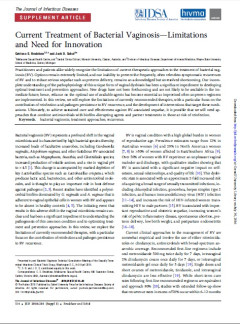
Current Treatment of Bacterial Vaginosis - limitations and Need for Innovation
Practitioners and patients alike widely recognize the limitations of current therapeutic approaches to the treatment of bacterial vaginosisrn(BV). Options remain extremely limited, and our inability to prevent the frequently, often relentless symptomatic recurrences of BV and to reduce serious sequelae such as preterm delivery, remains an acknowledged but unresolved shortcoming. Our incomplete …
- Edition
- -
- ISBN/ISSN
- -
- Collation
- -
- Series Title
- -
- Call Number
- -
 Computer Science, Information & General Works
  Philosophy & Psychology
  Religion
  Social Sciences
  Language
  Pure Science
  Applied Sciences
  Art & Recreation
  Literature
  History & Geography