Filter by

A Randomized Controlled Trial of the Use of Virtual Reality for Needle-Relate…
A large number of children report fear and distress when undergoing blood work and intravenous placement. In pediatric departments, Child Life interventions are considered to be the gold standard in nonmedical pain management techniques. Virtual reality (VR) has also been identified as an effective tool for pain distraction in children undergoing painful medical procedures. The aim of this stud…
- Edition
- -
- ISBN/ISSN
- -
- Collation
- -
- Series Title
- -
- Call Number
- -
Seizures and epilepsy in central nervous system infections
Infections are among the most common causes of seizures. All ages may have seizures due to infections ranging from toxoplasma in the newborn to the Creutzfeldt-Jacob disease in the elderly. Seizures may be the only presenting symptom of an infection such as neurocysticercosis or only one symptom of global central nervous system dysfunction, such as in subacute sclerosing panencephalitis and rab…
- Edition
- -
- ISBN/ISSN
- -
- Collation
- -
- Series Title
- -
- Call Number
- -

Correlation between preoperative imaging features and intraoperative blood lo…
Correlation between preoperative imaging features and intraoperative blood loss meningioma: a new scoring system for predicting intraoperative blood loss
- Edition
- -
- ISBN/ISSN
- -
- Collation
- -
- Series Title
- -
- Call Number
- -
Preventing and treating orthostatic hypotension: As easy as A, B, C
Orthostatic hypotension is a chronic, debilitating illness that is difficult to treat. The therapeutic goal is to improve postural symptoms, standing time, and function rather than to achieve upright normotension, which can lead to supine hypertension. Drug therapy alone is never adequate. Because orthostatic stress varies with circumstances during the day, a patient-oriented approach that …
- Edition
- -
- ISBN/ISSN
- -
- Collation
- -
- Series Title
- -
- Call Number
- -
Dysphagia in Acute Stroke: Incidence, Burden and Impact on Clinical Outcome
Reported frequency of post-stroke dysphagia in the literature is highly variable. In view of progress in stroke management, we aimed to assess the current burden of dysphagia in acute ischemic stroke.
- Edition
- -
- ISBN/ISSN
- -
- Collation
- -
- Series Title
- -
- Call Number
- -
A narrative review of interventions for improving sleep and reducing circadia…
- Edition
- -
- ISBN/ISSN
- -
- Collation
- -
- Series Title
- -
- Call Number
- -
- Edition
- -
- ISBN/ISSN
- -
- Collation
- -
- Series Title
- -
- Call Number
- -
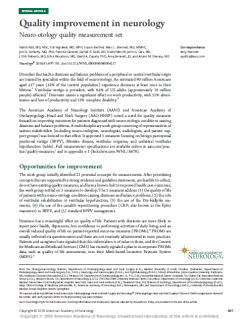
Quality improvement in neurology Epilepsy Quality Measurement Set 2017 update
Epilepsy is a common condition in the United States. It is estimated that 1.2% of the populationrnor 3.4 million people have epilepsy. This figure may be underestimated because of potentialrnrepercussions and stigma in disclosing epilepsy.1 Studies have shown that people with epilepsyrnare more likely to be unemployed or unable to work, have lower annual household incomes, bernobese and physica…
- Edition
- -
- ISBN/ISSN
- -
- Collation
- -
- Series Title
- -
- Call Number
- -
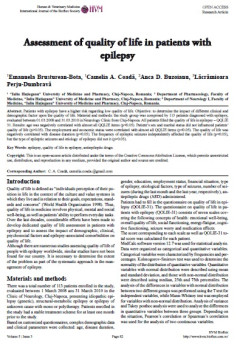
Assessment of quality of life in patients with epilepsy
Patients with epilepsy have a higher risk regarding low quality of life. Objective: to determine the impact of different clinical and demographic factor upon the quality of life. Material and methods: the study group was comprised by 113 patients diagnosed with epilepsy, evaluated between 01.03.2008 and 31.03.2010 in Neurology Clinic from Cluj-Napoca
- Edition
- -
- ISBN/ISSN
- -
- Collation
- -
- Series Title
- -
- Call Number
- -
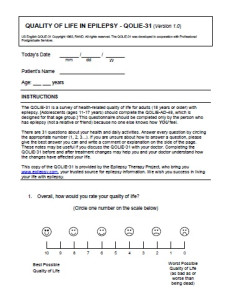
QUALITY OF LIFE IN EPILEPSY - QOLIE-31 (Version 1.0)
- Edition
- -
- ISBN/ISSN
- -
- Collation
- -
- Series Title
- -
- Call Number
- -
- Edition
- -
- ISBN/ISSN
- -
- Collation
- -
- Series Title
- -
- Call Number
- -
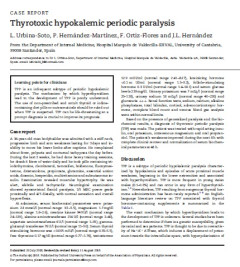
Thyrotoxic Hypokalemic Periodic Paralysis
TPP is an infrequent subtype of periodic hypokalemic paralysis. The mechanism by which hyperthyroidism lead to the development of TPP is poorly understood. The use of non-prescribed and occult thyroid or iodinecontaining diet pills or nutraceuticals should be ruled out when TPP is suspected. TPP can be life-threatening so a prompt diagnosis is crucial to improve its prognosis.
- Edition
- -
- ISBN/ISSN
- -
- Collation
- -
- Series Title
- -
- Call Number
- -
 Computer Science, Information & General Works
  Philosophy & Psychology
  Religion
  Social Sciences
  Language
  Pure Science
  Applied Sciences
  Art & Recreation
  Literature
  History & Geography