Filter by
Assessing the severity of acute pulmonaryrnembolism: back to the future?
This editorial refers to ?Prognostic value of right ventricularrndysfunction or elevated cardiac biomarkers in patients withrnlow-risk pulmonary embolism: a systematic review andrnmeta-analysis?? by S. Barco et al.,
- Edition
- -
- ISBN/ISSN
- -
- Collation
- -
- Series Title
- -
- Call Number
- -

Prediction of stroke after cardiac catherization: no reason, no stroke
In this issue, Tokushige and colleagues incestigated the incidence of cerebrovascular compliactions detected by difussion-weighted, head-focused magnetic resonance imaging (MRI) within 48 hours after CAG and determined its clinical risk factor
- Edition
- -
- ISBN/ISSN
- -
- Collation
- -
- Series Title
- -
- Call Number
- -
Understanding the mechanisms of kidney fibrosis
The year 2015 has seen great progress in the renal fibrosis field, as key studies began to build a consensus on the importance of epithelial-to‑mesenchymal transition, cell cycle arrest, and defective metabolism in the pathogenesis of kidney fibrosis. New findings also point to a role of developmental signalling in renal fibrogenesis
- Edition
- -
- ISBN/ISSN
- -
- Collation
- -
- Series Title
- -
- Call Number
- -
Veverimer versus placebo in patients with metabolic acidosis associated with …
Patients with advanced chronic kidney disease lose the capacity to fully excrete endogenous acid, resulting in chronic metabolic acidosis that increases the risk of disease progression and causes muscle catabolism and bone resorption. Veverimer, a non-absorbed, counterion-free, polymeric drug, selectively binds and removes hydrochloric acid from the gastrointestinal lumen, unlike current oral s…
- Edition
- -
- ISBN/ISSN
- -
- Collation
- -
- Series Title
- -
- Call Number
- -
Prognostic value of dynamic electrocardiographic T wave changes in non-ST ele…
To assess the relationship between the evolution of T wave inversion (TWI) on the 24–48 h postadmission ECG and the patient characteristics, management and clinical outcomes among those with non-ST elevation acute coronary syndrome (NSTE-ACS).
- Edition
- -
- ISBN/ISSN
- -
- Collation
- -
- Series Title
- -
- Call Number
- -
Orthostatic hypotension: managing a difficult problem
Orthostatic hypotension (OH) leads to a significant number of hospitalizations each year, and is associated with significant morbidity and mortality among affected individuals. Given the increased risk for cardiovascular events and falls, it is important to identify the underlying etiology of OH and to choose appropriate therapeutic agents. OH can be non-neurogenic or neurogenic (arising fr…
- Edition
- -
- ISBN/ISSN
- -
- Collation
- -
- Series Title
- -
- Call Number
- -
RELATIONSHIPS BETWEEN SERUM URIC ACID AND BLOOD PRESSURE, METABOLIC VARIABLES…
- Edition
- -
- ISBN/ISSN
- -
- Collation
- -
- Series Title
- -
- Call Number
- -
- Edition
- -
- ISBN/ISSN
- -
- Collation
- -
- Series Title
- -
- Call Number
- -
Acute Coronary Syndrome
Acute coronary syndrome (ACS) is a major health care and economic burden in the United States and accounts for more than 1 million hospitalizations annually. The morbidity and mortality due to ACS are substantial—nearly half of all deaths due to coronary heart disease occur following an ACS. This review provides an up-to-date summary of the pathophysiology, diagnosis, and treatment of ACS. We…
- Edition
- -
- ISBN/ISSN
- -
- Collation
- -
- Series Title
- -
- Call Number
- -
2015 ESC Guidelines for the management of acute coronary syndromes in patient…
Guidelines summarize and evaluate all available evidence on a particular issue at the time of the writing process, with the aim of assisting health professionals in selecting the best management strategies for an individual patient with a given condition, taking into account the impact on outcome, as well as the risk–benefit ratio of particular diagnostic or therapeutic means
- Edition
- -
- ISBN/ISSN
- -
- Collation
- -
- Series Title
- -
- Call Number
- -
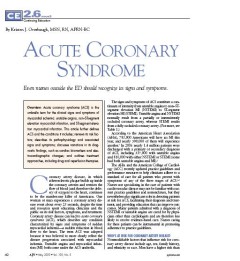
Acute Coronary Syndrome
Acute coronary syndrome (ACS) is the umbrella term for the clinical signs and symptoms of myocardial ischemia: unstable angina, non–ST-segment elevation myocardial infarction, and ST-segment elevation myocardial infarction. This article further defines ACS and the conditions it includes; reviews its risk factors; describes its pathophysiology and associated signs and symptoms; discusses vari…
- Edition
- -
- ISBN/ISSN
- -
- Collation
- -
- Series Title
- -
- Call Number
- -
 Computer Science, Information & General Works
  Philosophy & Psychology
  Religion
  Social Sciences
  Language
  Pure Science
  Applied Sciences
  Art & Recreation
  Literature
  History & Geography