Filter by
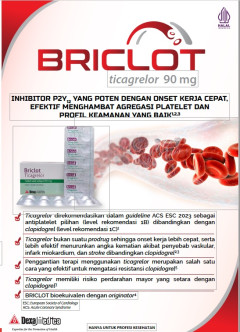
Pharmacokinetic–pharmacodynamic modelling of platelet response to ticagrelo…
To characterize ticagrelor exposure-response relationship for platelet inhibition in patients with stable coronary artery disease (CAD) and a history of myocardial infarction (MI), using nonlinear mixed effects modelling and simulation.
- Edition
- -
- ISBN/ISSN
- -
- Collation
- -
- Series Title
- -
- Call Number
- -
Ticagrelor: Pharmacokinetic, Pharmacodynamic and Pharmacogenetic Profile: An …
Despite advancements in treatments for acute coronary syndromes over the last 10 years, they continue to be life-threatening disorders. Currently, the standard of treatment includes dual antiplatelet therapy consisting of aspirin plus a P2Y12 receptor antagonist. The thienopyridine class of P2Y12 receptor antagonists, clopidogrel and prasugrel, have demonstrated efficacy. However, their use is…
- Edition
- -
- ISBN/ISSN
- -
- Collation
- -
- Series Title
- -
- Call Number
- -
Association of Ticagrelor vs Clopidogrel With Net Adverse Clinical Events in …
Current guidelines recommend ticagrelor as the preferred P2Y12 platelet inhibitor for patients with acute coronary syndrome (ACS), primarily based on a single large randomized clinical trial. The benefits and risks associated with ticagrelor vs clopidogrel in routine practice merits attention
- Edition
- -
- ISBN/ISSN
- -
- Collation
- -
- Series Title
- -
- Call Number
- -
Ticagrelor versus Clopidogrel in Patients with Acute Coronary Syndromes
Ticagrelor is an oral, reversible, direct-acting inhibitor of the adenosine diphosphate receptor P2Y12 that has a more rapid onset and more pronounced platelet inhibition than clopidogrel
- Edition
- -
- ISBN/ISSN
- -
- Collation
- -
- Series Title
- -
- Call Number
- -
Ticagrelor versus clopidogrel in patients with acute coronary syndromes
Ticagrelor is an oral, reversible, direct-acting inhibitor of the adenosine diphosphate receptor P2Y12 that has a more rapid onset and more pronounced platelet inhibition than clopidogrel.
- Edition
- -
- ISBN/ISSN
- -
- Collation
- -
- Series Title
- -
- Call Number
- -
Challenges in the management of older patients with acute coronary syndromes …
Ischaemic heart disease (IHD), in particular acute coronary syndrome (ACS), comprising ST-elevation myocardial infarction, non-ST- elevation myocardial infarction and unstable angina, is the leading cause of death worldwide. Age is a major predictor of adverse outcome following ACS
- Edition
- -
- ISBN/ISSN
- -
- Collation
- -
- Series Title
- -
- Call Number
- -
Cardiovascular Implications of the COVID-19 Pandemic: A Global Perspective
The coronavirus disease 2019 (COVID-19), caused by severe acute respiratory syndrome coronavirus-2 (SARS-CoV-2), represents the pandemic of the century, with approximately 3.5 million cases and 250,000 deaths worldwide as of May 2020. Although respiratory symptoms usually dominate the clinical presentation, COVID-19 is now known to also have potentially serious cardiovascular consequences, in…
- Edition
- -
- ISBN/ISSN
- -
- Collation
- -
- Series Title
- -
- Call Number
- -
ESC Guidance for the Diagnosis and Management of CV Disease during the COVID-…
The SARS-CoV-2 causing COVID-19 has reached pandemic levels since March 2020. In the absence of vaccines or curative medical treatment, COVID-19 exerts an unprecedented global impact on public health and health care delivery. Owing to the unexpected need for large capacities of intensive care unit (ICU) beds with the ability to provide respiratory support and mechanical ventilation, temporary r…
- Edition
- -
- ISBN/ISSN
- -
- Collation
- -
- Series Title
- -
- Call Number
- -
Antiplatelet Therapy in Ischemic Stroke and Transient Ischemic Attack An Over…
Stroke is a leading cause of mortality and disability worldwide. Initial manifestations of acute cerebral ischemia, such as ischemic stroke and transient ischemic attack (TIA), are often followed by recurrent vascular events, including recurrent stroke. To reduce this burden, antiplatelet therapy is a key component of the management of noncardioembolic ischemic stroke and TIA.
- Edition
- -
- ISBN/ISSN
- -
- Collation
- -
- Series Title
- -
- Call Number
- -
Guidelines for the Early Management of Patients With Acute Ischemic Stroke: 2…
The purpose of these guidelines is to provide an up-to-date comprehensive set of recommendations in a single document for clinicians caring for adult patients with acute arterial ischemic stroke. The intended audiences are prehospital care providers, physicians, allied health professionals, and hospital administrators. These guidelines supersede the 2013 Acute Ischemic Stroke (AIS) Guideline…
- Edition
- -
- ISBN/ISSN
- -
- Collation
- -
- Series Title
- -
- Call Number
- -
 Computer Science, Information & General Works
  Philosophy & Psychology
  Religion
  Social Sciences
  Language
  Pure Science
  Applied Sciences
  Art & Recreation
  Literature
  History & Geography