Filter by
Factors That Influence the Immune Response to Vaccination
There is substantial variation between individuals in the immune response to vaccination. In this review, we provide an overview of the plethora of studies that have investigated factors that influence humoral and cellular vaccine responses in humans. These include intrinsic host factors (such as age, sex, genetics, and comorbidities), perinatal factors (such as gestational age, birth weight, …
- Edition
- -
- ISBN/ISSN
- -
- Collation
- -
- Series Title
- -
- Call Number
- -
Innate and Adaptive Immunity in the Pathogenesis of Atherosclerosis
This review considers critically the evidence for the involvement of mediators of innate and acquired immunity in various stages of atherosclerosis. Rapidly mobilized arms of innate immunity, including phagocytic leukocytes, complement, and proinflammatory cytokines, contribute to atherogenesis. In addition, adaptive immunity, with its T cells, antibodies, and immunoregulatory cytokines, pow…
- Edition
- -
- ISBN/ISSN
- -
- Collation
- -
- Series Title
- -
- Call Number
- -
Adaptive immunity
The innate immune system provides critical mechanisms for the rapid sensing and elimination of pathogens. Adaptive immunity has evolved to provide a broader and more finely tuned repertoire of recognition for both self- and nonself-antigens. Adaptive immunity involves a tightly regulated interplay between antigen-presenting cells and T and B lymphocytes, which facilitate pathogen-specific immu…
- Edition
- -
- ISBN/ISSN
- -
- Collation
- -
- Series Title
- -
- Call Number
- -
Natural Antibodies Bridge Innate and Adaptive Immunity
Natural Abs, belonging to isotypes IgM, IgG3, and IgA, were discovered nearly half a century ago. Despite knowledge about the role of the polyreactive natural IgM in pathogen elimination, B cell survival and homeostasis, inflammatory diseases, and autoimmunity, there is a lack of clarity about the physiological role of natural IgG and natural IgA because they appear incapable of recognizing Ag…
- Edition
- -
- ISBN/ISSN
- -
- Collation
- -
- Series Title
- -
- Call Number
- -
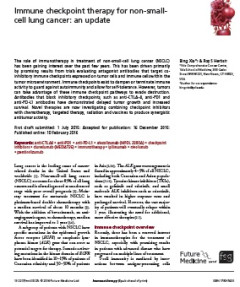
Immune checkpoint therapy for non-smallcell lung cancer: an update
The role of immunotherapy in treatment of non-small-cell lung cancer (NSCLC) has been gaining interest over the past few years. This has been driven primarily by promising results from trials evaluating antagonist antibodies that target coinhibitory immune checkpoints expressed on tumor cells and immune cells within the tumor microenvironment. Immune checkpoints exist to dampen or terminate im…
- Edition
- -
- ISBN/ISSN
- -
- Collation
- -
- Series Title
- -
- Call Number
- -
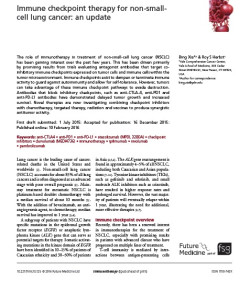
Immune checkpoint therapy for non-smallcell lung cancer: an update
The role of immunotherapy in treatment of non-small-cell lung cancer (NSCLC) has been gaining interest over the past few years. This has been driven primarily by promising results from trials evaluating antagonist antibodies that target coinhibitory immune checkpoints expressed on tumor cells and immune cells within the tumor microenvironment. Immune checkpoints exist to dampen or terminate…
- Edition
- -
- ISBN/ISSN
- -
- Collation
- -
- Series Title
- -
- Call Number
- -

Polysaccharide biological response modifiers
Biological response modifiers (BRMs) are substances which augment immune response. BRMs can be cytokines which are produced endogenously in our body by immune cells or derivatives of bacteria, fungi, brown algae, Aloe vera and photosynthetic plants. Such exogeneous derivatives (exogeneous BRMs) can be nucleic acid (CpG), lipid (lipotechoic acid), protein or polysaccharide in nature. The recepto…
- Edition
- -
- ISBN/ISSN
- -
- Collation
- -
- Series Title
- -
- Call Number
- -
Experience with Administration of Modified Arabinoxylan from Rice Bran (BioBr…
The functional food, rice bran arabinoxylan derivative (BioBran/MGN-3), was administered over a long period t patients with rheumatoid arthritis given mainly symptomatic treatment with steroids, to evaluate its supplementary effect with respresentative treatments fr rheumatism, such as steroids, analgesics, and thermtehrapy
- Edition
- -
- ISBN/ISSN
- -
- Collation
- -
- Series Title
- -
- Call Number
- -
Experience with administration of modified Arabinoxylan from rice bran (BioBr…
The functional food, rice bran arabinoxylan derivative (BioBran/MGBN-3), was administered over a long period to patients with rheumatoid arthritis given mainly symptomatic treatment with steroids, to evaluate its supplementary effect with respresentative treatment for rheumatism, such as steroids, analgesics and thermotherapy
- Edition
- -
- ISBN/ISSN
- -
- Collation
- -
- Series Title
- -
- Call Number
- -
Arabinoxylan Rice Bran (MGN-3) Enhances the Effects of Interventional Therapi…
This study examined the efficacy of arabinoxylan rice bran (MGN-3) in conjunction with an interventional therapy (IT) for the treatment of hepatocellular carcinoma patients. Patients and Methods: A total of sixty-eight patients with hepatocellular carcinoma (stages I and II) participated in the study. Patients were randomized to receive IT (30 patients, control group) or IT+MGN-3 (38 patients)…
- Edition
- -
- ISBN/ISSN
- -
- Collation
- -
- Series Title
- -
- Call Number
- -
 Computer Science, Information & General Works
  Philosophy & Psychology
  Religion
  Social Sciences
  Language
  Pure Science
  Applied Sciences
  Art & Recreation
  Literature
  History & Geography