Filter by
Clinical Diagnosis
- Edition
- -
- ISBN/ISSN
- -
- Collation
- -
- Series Title
- -
- Call Number
- -
- Edition
- -
- ISBN/ISSN
- -
- Collation
- -
- Series Title
- -
- Call Number
- -
Dengue Virus
Dengue viruses (DENVs) form dengue complex in genus Flavivirus, family Flaviviridae, and consists of four antigenically related but distinct DENV serotypes (DENV-1, DENV-2, DENV-2, DENV-3, and DENV-4). These DENV can cause a spectrum of illness ranging from asymptomatic dengue infection to dengue fever (DF) to dengue hemorrhagic fever (DHF) to dengue shock syndrome (DSS). It is estimated that …
- Edition
- -
- ISBN/ISSN
- -
- Collation
- -
- Series Title
- -
- Call Number
- -
Early diagnosis of dengue disease severity in a resource-limited Asian country
Dengue is endemic throughout Cambodia, a country faced with significant health and economic challenges. We undertook a clinical study at the National Paediatric Hospital in Phnom Penh to evaluate clinical diagnostic parameters for dengue and predictors of disease outcome
- Edition
- -
- ISBN/ISSN
- -
- Collation
- -
- Series Title
- -
- Call Number
- -
Diagnosis of dengue: an update
Early diagnosis of dengue, the most common mosquito-borne disease globally, remains challenging. Dengue presents initially as undifferentiated fever, with symptoms becoming more pathognomonic in the later stages of illness. This limits the timeliness in the delivery of appropriate supportive interventions. Laboratory tests are useful for diagnosis although the short-lived viremia and the presen…
- Edition
- -
- ISBN/ISSN
- -
- Collation
- -
- Series Title
- -
- Call Number
- -
COVID-19: A Global Challenge with Old History, Epidemiology and Progress So Far
Humans have witnessed three deadly pandemics so far in the twenty-first century which are associated with novel coronaviruses: SARS, Middle East respiratory syndrome (MERS), and COVID-19. All of these viruses, which are responsible for causing acute respiratory tract infections (ARTIs), are highly contagious in nature and/or have caused high mortalities. The recently emerged COVID-19 disease is…
- Edition
- -
- ISBN/ISSN
- -
- Collation
- -
- Series Title
- -
- Call Number
- -
Transmisi SARS-CoV-2: implikasi terhadap kewaspadaan pencegahan infeksi
Dokumen ini merupakan pemutakhiran pernyataan keilmuan berjudul “Modes of transmission of virus causing COVID-19: implications for infection prevention and control (IPC) precaution recommendations” yang diterbitkan pada tanggal 29 Maret 2020 dan mencakup bukti-bukti ilmiah baru yang tersedia mengenai transmisi SARS-CoV-2, virus yang mengakibatkan COVID-19
- Edition
- -
- ISBN/ISSN
- -
- Collation
- -
- Series Title
- -
- Call Number
- -
How the Covid-19 epidemic is challenging our practice in clinical nutrition 
The viral epidemic caused by the new Coronavirus SARS-CoV-2 is responsible for the new Coronavirus disease-2019 (Covid-19). Fifteen percent of the Covid-19 patients will require hospital stay, and 10% of them will need urgent respiratory and hemodynamic support in the intensive care unit (ICU). Covid-19 is an infectious disease characterized by inflammatory syndrome, itself leading to reduce…
- Edition
- -
- ISBN/ISSN
- -
- Collation
- -
- Series Title
- -
- Call Number
- -
COVID-19 and Older Adults: What We Know
Severe acute respiratory syndrome coronavirus 2 (SARSCoV- 2), a novel virus that causes COVID-19 infection, has recently emerged and caused a deadly pandemic. Studies have shown that this virus causes worse outcomes and a higher mortality rate in older adults and those with comorbidities such as hypertension, cardiovascular disease, diabetes, chronic respiratory disease, and chronic kidney dis…
- Edition
- -
- ISBN/ISSN
- -
- Collation
- -
- Series Title
- -
- Call Number
- -
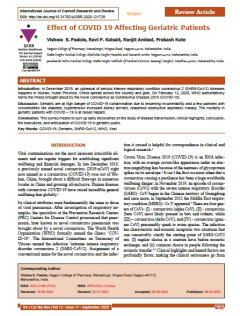
Effect of COVID 19 Affecting Geriatric Patients
In December 2019, an upheaval of serious intense respiratory condition coronavirus 2 (SARS-CoV-2) diseases happens in Wuhan, Hubei Province, China spread across the country and glob. On February 12, 2020, WHO authoritatively name the illness brought about by the novel coronavirus as Coronavirus Disease 2019 (COVID-19).
- Edition
- -
- ISBN/ISSN
- -
- Collation
- -
- Series Title
- -
- Call Number
- -
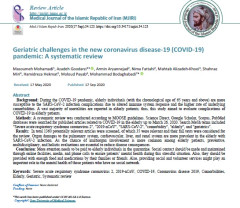
Geriatric challenges in the new coronavirus disease-19 (COVID-19) pandemic: A…
During the COVID-19 pandemic, elderly individuals (with the chronological age of 65 years and above) are more susceptible to the SARS-CoV-2 infection complications due to altered immune system response and the higher rate of underlying comorbidities. A vast majority of mortalities are reported in elderly patients; thus, this study aimed to evaluate complications of COVID-19 in elderly patients
- Edition
- -
- ISBN/ISSN
- -
- Collation
- -
- Series Title
- -
- Call Number
- -
 Computer Science, Information & General Works
  Philosophy & Psychology
  Religion
  Social Sciences
  Language
  Pure Science
  Applied Sciences
  Art & Recreation
  Literature
  History & Geography