Filter by
Standards of Care for Diabetic Nephropathy
There are currently more than 117 million people with diabetes worldwide. WHO figures estimate that this will rise to 300 million in 2025. Diabetes is the fourth main course of death in most developed countries. It is estimated that diabetes accounts for 5–10% of the nation’s health budget. The estimated diabetes prevalence varies between different countries (5 to 20%), but an increase in a…
- Edition
- -
- ISBN/ISSN
- -
- Collation
- -
- Series Title
- -
- Call Number
- -

The role of a low protein diet supplemented with ketoanalogues on kidney prog…
In slowing kidney progression, numerous pre-dialysis chronic kidney disease (CKD) patients could not adhere to the well-established dietary pattern, including a very low protein diet, 0.3–0.4 g/kg/ day, plus a full dose ketoanalogues (KAs) of amino acids. We evaluated the role of a low protein diet (LPD), 0.6–0.8 g/kg/day, combined with KAs (LPD–KAs) on CKD progression. We extracted data …
- Edition
- -
- ISBN/ISSN
- -
- Collation
- -
- Series Title
- -
- Call Number
- -

Ketoanalogue-Supplemented Vegetarian Very Low–Protein Diet and CKD Progression
Dietary protein restriction may improve determinants of CKD progression. However, the extent of improvement and effect of ketoanalogue supplementation are unclear. We conducted a prospective, randomized, controlled trial of safety and efficacy of ketoanalogue–supplemented vegetarian very low–protein diet (KD) compared with conventional low–protein diet (LPD). Primary end point was RRT ini…
- Edition
- -
- ISBN/ISSN
- -
- Collation
- -
- Series Title
- -
- Call Number
- -

Very low protein diet supplemented with ketoanalogs improves blood pressure c…
Blood pressure (BP) is hardly controlled in chronic kidney disease (CKD). We compared the effect of very low protein diet (VLPD) supplemented with ketoanalogs of essential amino acids (0.35 g/kg/day), low protein diet (LPD, 0.60 g/kg/ day), and free diet (FD) on BP in patients with CKD stages 4 and 5.
- Edition
- -
- ISBN/ISSN
- -
- Collation
- -
- Series Title
- -
- Call Number
- -

Influence of ketoanalogs supplementation on the progression in chronic kidney…
A low-protein diet (LPD) is a conservative treatment in patients with chronic kidney disease (CKD) to improve uremic symptoms and slow the progression of renal dysfunction. However, the deleterious effects of protein restriction on nutritional status have raised concern. We investigated whether ketoanalogs supplementation in CKD patients who had training on LPD retards the progression of CKD an…
- Edition
- -
- ISBN/ISSN
- -
- Collation
- -
- Series Title
- -
- Call Number
- -

Keto Acid Therapy in Predialysis Chronic Kidney Disease Patients: Final Conse…
PROTEIN-RESTRICTED DIETS SUPPLE-MENTED with keto/amino acids should be considered as one of the main approaches in the management program of chronic kidney disease (CKD) patients
- Edition
- -
- ISBN/ISSN
- -
- Collation
- -
- Series Title
- -
- Call Number
- -
Understanding the mechanisms of kidney fibrosis
The year 2015 has seen great progress in the renal fibrosis field, as key studies began to build a consensus on the importance of epithelial-to‑mesenchymal transition, cell cycle arrest, and defective metabolism in the pathogenesis of kidney fibrosis. New findings also point to a role of developmental signalling in renal fibrogenesis
- Edition
- -
- ISBN/ISSN
- -
- Collation
- -
- Series Title
- -
- Call Number
- -
Veverimer versus placebo in patients with metabolic acidosis associated with …
Patients with advanced chronic kidney disease lose the capacity to fully excrete endogenous acid, resulting in chronic metabolic acidosis that increases the risk of disease progression and causes muscle catabolism and bone resorption. Veverimer, a non-absorbed, counterion-free, polymeric drug, selectively binds and removes hydrochloric acid from the gastrointestinal lumen, unlike current oral s…
- Edition
- -
- ISBN/ISSN
- -
- Collation
- -
- Series Title
- -
- Call Number
- -
Autosomal dominant polycystic kidney disease
Autosomal dominant polycystic kidney disease (ADPKD) is the most common hereditary kidney disease and one of the most common causes of end-stage kidney disease. Multiple clinical manifestations, such as enlarged kidneys filled with growing cysts, hypertension, and multiple extrarenal complications, including liver cysts, intracranial aneurysms, and cardiac valvular disease, show that ADPKD i…
- Edition
- -
- ISBN/ISSN
- -
- Collation
- -
- Series Title
- -
- Call Number
- -
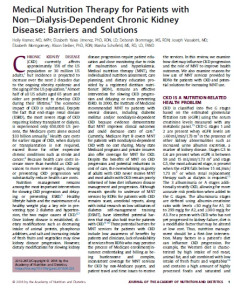
Medical Nutrition Therapy for Patients with None Dialysis-Dependent Chronic K…
CHRONIC KIDNEY DISEASE (CKD) currently affects approximately 15% of the US population or 30 million US adults,1 but incidence is projected to increase over the next 2 decades due to the ongoing obesity epidemic and the aging of the US population.2 Almost half of all US adults aged 65 years and older are predicted to develop CKD during their lifetime.2 The economic impact of CKD is substantial
- Edition
- -
- ISBN/ISSN
- -
- Collation
- -
- Series Title
- -
- Call Number
- -
 Computer Science, Information & General Works
  Philosophy & Psychology
  Religion
  Social Sciences
  Language
  Pure Science
  Applied Sciences
  Art & Recreation
  Literature
  History & Geography