Filter by

A Comparison of Albumin and Saline for Fluid Resuscitation in the Intensive C…
It remains uncertain whether the choice of resuscitation fluid for patients in intensive care units (ICUs) affects survival. We conducted a multicenter, randomized, double-blind trial to compare the effect of fluid resuscitation with albumin or saline on mortality in a heterogeneous population of patients in the ICU.
- Edition
- -
- ISBN/ISSN
- -
- Collation
- -
- Series Title
- -
- Call Number
- -
The urine albumin-to-creatinine ratio is a reliable indicator for evaluating …
This study investigated the correlation between the albumin-to-creatinine ratio in the urine and 24-hour urine proteinuria and whether the ratio can predict chronic kidney disease progression even more reliably than 24-hour proteinuria can, particularly in primary IgA nephropathy
- Edition
- -
- ISBN/ISSN
- -
- Collation
- -
- Series Title
- -
- Call Number
- -
Correlation between urinary albumin to creatinine ratio and systemic glycocal…
Increased capillary permeability in sepsis is associated with several complications and worse outcomes. Glycocalyx degradation, marked by increased serum syndecan-1 levels, alters vascular permeability, which can manifest as albuminuria in the glomerulus. Therefore, elevated urinary albumin to creatinine ratio (ACR) potentially provides an index of systemic glycocalyx degradation. The aim of…
- Edition
- -
- ISBN/ISSN
- -
- Collation
- -
- Series Title
- -
- Call Number
- -
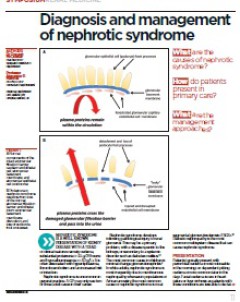
Diagnosis and management of nephrotic syndrome
NEPHROTIC SYNDROME IS A WELL KNOWN PRESENTATION OF KIDNEY DISEASE WITH A TRIAD of clinical features namely oedema, substantial proteinuria (> 3.5 g/24 hours) and hypoalbuminaemia (< 30 g/L). It is often associated with hyperlipidaemia, thromboembolism and an increased risk of infection.
- Edition
- -
- ISBN/ISSN
- -
- Collation
- -
- Series Title
- -
- Call Number
- -
Hepatorenal syndrome: current concepts related to diagnosis and management
Renal failure in cirrhotic patients is a very severe condition. Hepatorenal syndrome has the worst prognosis among all causes of kidney failure in such patients. Hepatorenal syndrome is diagnosed especially in cirrhotic patients with ascites who develop loss renal function, despite diuretic suspension and volume expansion with albumin and for whom other causes of kidney injury have been exclude…
- Edition
- -
- ISBN/ISSN
- -
- Collation
- -
- Series Title
- -
- Call Number
- -
Perioperative fluid management: science, art or random chaos?
As anaesthetists, we like to believe that the i.v. fluid we administer during surgery is based on a careful consideration of the contemporaneous clinical situation in the particular individual under our care. We estimate deficits; we use clinical assessment and haemodynamic monitoring to characterize circulating blood volume, and we respond to changes with fluid challenges and vasopressors
- Edition
- -
- ISBN/ISSN
- -
- Collation
- -
- Series Title
- -
- Call Number
- -
Perioperative fluid therapy recommendations for major abdominal surgery. Via …
About 230 million patients undergo surgery each year.1 Reported mortality rates for elective non-cardiac surgery range from 1% to 4%.2 Although less than 15% of inpatient procedures are performed in high-risk patients, such patients account for 80% of deaths
- Edition
- -
- ISBN/ISSN
- -
- Collation
- -
- Series Title
- -
- Call Number
- -
Fluid Management in Acute Kidney Injury
Correction of intravascular hypovolemia is a key component of the prevention and management of acute kidney injury (AKI), but excessive fluid administration is associated with poor outcomes, including the development and progression of AKI. There is growing evidence that fluid administration should be individualized and take into account patient characteristics, nature of the acute illness and…
- Edition
- -
- ISBN/ISSN
- -
- Collation
- -
- Series Title
- -
- Call Number
- -
Three polymorphisms of tumor necrosis factor-alpha and hepatitis B virus rela…
This meta-analysis shows that AA genotype in TNF-a G308A and TNF-a G238A and CT genotype in TNF-a C863T may increase HBV-HCC risk. Therefore, HBV infection seemed to be a more important factor for tumorigenesis of HCC than genetic predisposition in G308A of TNF-a, and interaction between TNF-a C863T polymorphisms and HBV infection might be associated with increased HCC risk
- Edition
- -
- ISBN/ISSN
- -
- Collation
- -
- Series Title
- -
- Call Number
- -
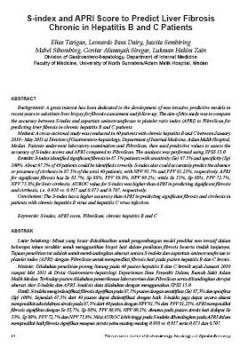
S-index and APRI Score to Predict Liver Fibrosis Chronic in Hepatitis B and C…
A great interest has been dedicated to the development of non invasive predictive models in recent years to substitute liver biopsy for fibrosis assessment and follow-up. The aim of this study was to compare the accuracy between S-index and aspartate aminotransferase to platelet ratio index (APRI) to FibroScan for predicting liver fibrosis in chronic hepatitis B and C patients
- Edition
- -
- ISBN/ISSN
- -
- Collation
- -
- Series Title
- -
- Call Number
- -
 Computer Science, Information & General Works
  Philosophy & Psychology
  Religion
  Social Sciences
  Language
  Pure Science
  Applied Sciences
  Art & Recreation
  Literature
  History & Geography