Filter by

Role of Yes-Associated Protein 1, Angiomotin and Mitogen Activated Kinase Kin…
The morula-stage embryo is transformed into a blastocyst composed of epiblast, hypoblast and trophectoderm (TE) through mechanisms that, at least in the mouse, involve the Hippo signaling and mitogen-activated kinase (MAPK) pathways. Using the cow as an additional model, we tested the hypotheses that TE and hypoblast differentiation were regulated by the Hippo pathway regulators, YAP1 and AMOT,…
- Edition
- -
- ISBN/ISSN
- -
- Collation
- -
- Series Title
- -
- Call Number
- -
Facial Canal Dehiscence and Coexisting abnormalities; Radiological - Surgical…
Facial canal dehiscence (FCD) is the most important consideration in the cholesteatoma surgery. The tympanic portion is the most common localization of FCDlization in the majority of cases. MDCT is the standardt imaging modality for temporal bone screening. In this study we aimed to compare coexisting the radiological and -surgical findings of patients who have were found during surgery to have…
- Edition
- -
- ISBN/ISSN
- -
- Collation
- -
- Series Title
- -
- Call Number
- -
Cholesteatoma Definition and Classification: A Literature Review
Cholesteatoma is a serious otolaryngologic condition that to date remains an important problem and poses a challenge to otolaryngologists around the world. To improve the approach pertaining to the diagnosis and management of middle ear cholesteatoma, clear, clinically applicable, and useful definition and classification of cholesteatoma are required. This review aimed to evaluate the current a…
- Edition
- -
- ISBN/ISSN
- -
- Collation
- -
- Series Title
- -
- Call Number
- -
Conners CBRS Update
The following updates have been made to the Conners Comprehensive Behavior Rating Scales™ (Conners CBRS™): (1) Validity scale interpretation, (2) T-score interpretation, (3) renaming the Aggressive Behaviors scale to Defiant/Aggressive Behaviors, (4) re-scoring the Violence Potential scale, and (5) adjusting triggers for the Other Clinical Indicators. These changes should improve the utilit…
- Edition
- -
- ISBN/ISSN
- -
- Collation
- -
- Series Title
- -
- Call Number
- -
Effect of Chloramphenicol and Thiamphenicol on the In Vitro Colony-forming Cell
STRONG EVIDENCE HAS been provided to indicate that chloramphenicol-(CAP) induced reversible bone marrow suppression results from inhibition of mitochondrial protein synthesis and consequent mitochondrial injury. ı Suppression of ferrochelatase activity, a mitochondrial-membraneassociated enzyme, with a block in the last step of heme synthesis has been suggested as a basis for the apparent vuln…
- Edition
- -
- ISBN/ISSN
- -
- Collation
- -
- Series Title
- -
- Call Number
- -
PHARMACOKINETIC STUDIES ON THIAMPHENICOL IN GOATS
Thiamphenicol is a semisynthetic structural analogue of chloramphenicol (CAP)(Sutter and Finegold, 1976). Chemically, it is D-d-threo-2-dichloro acetamido-l-(4-methylsulfonyl)-phenyl-l, 3-propanediol and has been derived by replacing the p-nitrophenol group of chloramphenicol by methylsulfonyl moietv
- Edition
- -
- ISBN/ISSN
- -
- Collation
- -
- Series Title
- -
- Call Number
- -
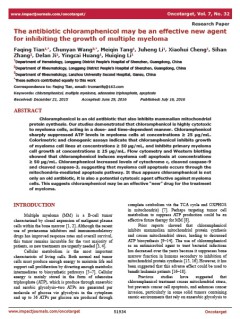
The antibiotic chloramphenicol may be an effective new agent for inhibiting t…
Chloramphenicol is an old antibiotic that also inhibits mammalian mitochondrial protein synthesis. Our studies demonstrated that chloramphenicol is highly cytotoxic to myeloma cells, acting in a dose- and time-dependent manner. Chloramphenicol sharply suppressed ATP levels in myeloma cells at concentrations ≥ 25 μg/mL. Colorimetric and clonogenic assays indicate that chloramphenicol inhibit…
- Edition
- -
- ISBN/ISSN
- -
- Collation
- -
- Series Title
- -
- Call Number
- -

Systemic Lupus Erythematosus : Epidemiology, Pathophysiology, Manifestations,…
Systemic lupus erythematosus (SLE) is a chronic autoimmune disorder, characterized by production of autoantibodies directed against nuclear and cytoplasmic antigens, which may affect several different organs, with a plethora of different clinical and immunologic abnormalities, characterized by a relapsing and remitting clinical course
- Edition
- -
- ISBN/ISSN
- -
- Collation
- -
- Series Title
- -
- Call Number
- -
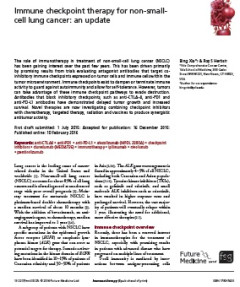
Immune checkpoint therapy for non-smallcell lung cancer: an update
The role of immunotherapy in treatment of non-small-cell lung cancer (NSCLC) has been gaining interest over the past few years. This has been driven primarily by promising results from trials evaluating antagonist antibodies that target coinhibitory immune checkpoints expressed on tumor cells and immune cells within the tumor microenvironment. Immune checkpoints exist to dampen or terminate im…
- Edition
- -
- ISBN/ISSN
- -
- Collation
- -
- Series Title
- -
- Call Number
- -
Immune checkpoint therapy for non-smallcell lung cancer: an update
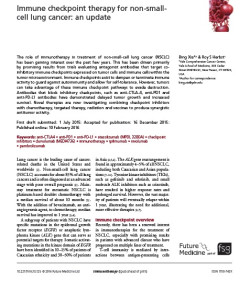
The role of immunotherapy in treatment of non-small-cell lung cancer (NSCLC) has been gaining interest over the past few years. This has been driven primarily by promising results from trials evaluating antagonist antibodies that target coinhibitory immune checkpoints expressed on tumor cells and immune cells within the tumor microenvironment. Immune checkpoints exist to dampen or terminate…
- Edition
- -
- ISBN/ISSN
- -
- Collation
- -
- Series Title
- -
- Call Number
- -
 Computer Science, Information & General Works
  Philosophy & Psychology
  Religion
  Social Sciences
  Language
  Pure Science
  Applied Sciences
  Art & Recreation
  Literature
  History & Geography