Filter by
Effect Initial Heart rate Cardiac Troponin & Ejection Fraction on patients wi…
Increased heart rate has shown to be associated with adverse cardiovascular outcomes. This aim of this study was to find the association of troponin level and ejection fraction (EF) with triage heart rate in patients with non-ST elevation myocardial infarction (NSTEMI). It was hypothesized that heart rate at triage will be independently associated with higher troponin level and lower EF after N…
- Edition
- -
- ISBN/ISSN
- -
- Collation
- -
- Series Title
- -
- Call Number
- -
Spironolactone vs placebo, Bisoprolol, and Doxazin to Determine the Optimal T…
Optimal drug treatment for patients with resistant hypertension is undefi ned. We aimed to test the hypotheses that resistant hypertension is most often caused by excessive sodium retention, and that spironolactone would therefore be superior to non-diuretic add-on drugs at lowering blood pressure.
- Edition
- -
- ISBN/ISSN
- -
- Collation
- -
- Series Title
- -
- Call Number
- -
Premature Ventricular Contraction Coupling Interval Variability Destabilizes …
Variability in premature ventricular contraction (PVC) coupling interval (CI) increases the risk of cardiomyopathy and sudden death. The autonomic nervous system regulates cardiac electrical and mechanical indices, and its dysregulation plays an important role in cardiac disease pathogenesis. The impact of PVCs on the intrinsic cardiac nervous system (ICNS), a neural network on the heart, remai…
- Edition
- -
- ISBN/ISSN
- -
- Collation
- -
- Series Title
- -
- Call Number
- -
Atrial Fibrillation and Mechanisms of Stroke: Time for a New Model
Thirty-three million people have atrial fibrillation (AF), a disorder of heart rhythm.1 Over the past several decades, we have learned that this dysrhythmia originates in the interplay between genetic predisposition, ectopic electrical activity, and abnormal atrial tissue substrate and then feeds back to remodel and worsen tissue substrate and, thereby, propagates itself.
- Edition
- -
- ISBN/ISSN
- -
- Collation
- -
- Series Title
- -
- Call Number
- -
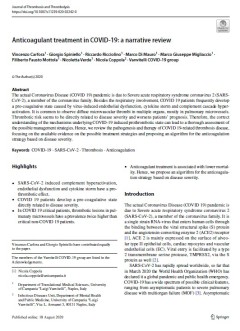
Anticoagulant treatment in COVID‑19: a narrative review
The actual Coronavirus Disease (COVID 19) pandemic is due to Severe acute respiratory syndrome coronavirus 2 (SARSCoV- 2), a member of the coronavirus family. Besides the respiratory involvement, COVID 19 patients frequently develop a pro-coagulative state caused by virus-induced endothelial dysfunction, cytokine storm and complement cascade hyperactivation. It is common to observe diffuse m…
- Edition
- -
- ISBN/ISSN
- -
- Collation
- -
- Series Title
- -
- Call Number
- -
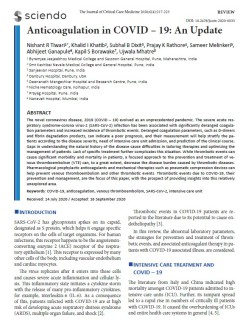
Anticoagulation in COVID – 19: An Update
The novel coronavirus disease, 2019 (COVID – 19) evolved as an unprecedented pandemic. The severe acute respiratory syndrome-corona virus-2 (SARS-CoV-2) infection has been associated with significantly deranged coagulation parameters and increased incidence of thrombotic events. Deranged coagulation parameters, such as D-dimers and fibrin degradation products, can indicate a poor prognosis…
- Edition
- -
- ISBN/ISSN
- -
- Collation
- -
- Series Title
- -
- Call Number
- -
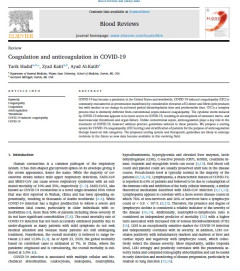
Coagulation and anticoagulation in COVID-19
COVID-19 has become a pandemic in the United States and worldwide. COVID-19-induced coagulopathy (CIC) is commonly encountered at presentation manifested by considerable elevation of D-dimer and fibrin split products but with modest or no change in activated partial thromboplastin time and prothrombin time. CIC is a complex process that is distinctly different from conventional sepsis-induced c…
- Edition
- -
- ISBN/ISSN
- -
- Collation
- -
- Series Title
- -
- Call Number
- -
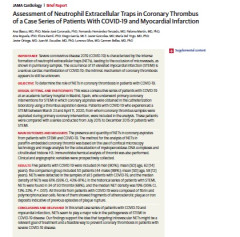
Assessment of Neutrophil Extracellular Traps in Coronary Thrombus of a Case S…
Severe coronavirus disease 2019 (COVID-19) is characterized by the intense formation of neutrophil extracellular traps (NETs), leading to the occlusion of microvessels, as shown in pulmonary samples. The occurrence of ST-elevated myocardial infarction (STEMI) is a serious cardiac manifestation of COVID-19; the intrinsic mechanism of coronary thrombosis appears to still be unknown.
- Edition
- -
- ISBN/ISSN
- -
- Collation
- -
- Series Title
- -
- Call Number
- -
Atherosclerotic Cardiovascular Disease and Heart Failure in Type 2 Diabetes â…
Cardiovascular disease remains the principal cause of death and disability among patients with diabetes mellitus. Diabetes exacerbates mechanisms underlying atherosclerosis and heart failure. Unfortunately, these mechanisms are not adequately modulated by therapeutic strategies focusing solely on optimal glycemic control with currently available drugs or approaches. In the setting of multi-fact…
- Edition
- -
- ISBN/ISSN
- -
- Collation
- -
- Series Title
- -
- Call Number
- -
Incidence and impact of stroke following surgery for low-grade gliomas
Ischemic complications are a common cause of neurological deficits following low-grade glioma (LGG) surgeries. In this study, the authors evaluated the incidence, risk factors, and long-term implications of intraoperative ischemic events.
- Edition
- -
- ISBN/ISSN
- -
- Collation
- -
- Series Title
- -
- Call Number
- -
 Computer Science, Information & General Works
  Philosophy & Psychology
  Religion
  Social Sciences
  Language
  Pure Science
  Applied Sciences
  Art & Recreation
  Literature
  History & Geography