Filter by
Kejadian Acute Kidney Injury dengan Kriteria pRIFLE pada Unit Perawatan Inten…
Dari 411 pasien yang dirawat di Unit Perawatan Intensif Anak, 149 (36,25%) dilakukan pemeriksaan blood urea nitrogen (BUN) dan serum kreatinin (SC). Terdapat 25 kasus (6,1%) merupakan kasus AKI. Sebagian besar subyek berusia di bawah 1 tahun (10/25) dan berjenis kelamin laki-laki 15/25. Berdasarkan kriteria pRIFLE, 3 termasuk dalam kriteria risk (R), 12 injury (I), dan 10 dimasukkan failure (F)…
- Edition
- -
- ISBN/ISSN
- -
- Collation
- -
- Series Title
- -
- Call Number
- -

Acute Kidney Injury in Pediatric Severe Sepsis, An Independent Risk Factor fo…
The prevalence of septic acute kidney injury (AKI) and impact on functional status of pediatric intensive care unit (PICU) survivors are unknown. We utilized data from an international prospective severe sepsis study to elucidate functional outcomes of children suffering septic AKI.
- Edition
- -
- ISBN/ISSN
- -
- Collation
- -
- Series Title
- -
- Call Number
- -

Risk Factors and Stroke Characteristic in Patients with Postoperative Strokes
- Edition
- -
- ISBN/ISSN
- -
- Collation
- -
- Series Title
- -
- Call Number
- -
- Edition
- -
- ISBN/ISSN
- -
- Collation
- -
- Series Title
- -
- Call Number
- -
Physical inactivity is a strong risk factor for stroke in the oldest old: Fin…
- Edition
- -
- ISBN/ISSN
- -
- Collation
- -
- Series Title
- -
- Call Number
- -
- Edition
- -
- ISBN/ISSN
- -
- Collation
- -
- Series Title
- -
- Call Number
- -
Thrombosis in pregnancy : update in diagnosis and management
Acute venous thromboembolism poses significant problems in pregnancy, a time when objective diagnosis and prompt treatment are essential. Events can occur at any stage in pregnancy, but the period of greatest risk is in the weeks after delivery. Ultrasound venography remains the diagnostic technique of choice for deep venous thrombosis. For pulmonary thromboembolism, ventilation perfusion lung…
- Edition
- -
- ISBN/ISSN
- -
- Collation
- -
- Series Title
- -
- Call Number
- -

Deep vein thrombosis: pathogenesis, diagnosis, and medical management
Deep vein thrombosis (DVT) is a major preventable cause of morbidity and mortality worldwide. Venous thromboembolism (VTE), which includes DVT and pulmonary embolism (PE), affects an estimated 1 per 1,000 people and contributes to 60,000–100,000 deaths annually. Normal blood physiology hinges on a delicate balance between pro- and anti-coagulant factors. Virchow’s Triad distills the multi…
- Edition
- -
- ISBN/ISSN
- -
- Collation
- -
- Series Title
- -
- Call Number
- -
Deep venous thrombosis: a literature review
Abstract: Deep vein thrombosis (DVT) refers to the formation of thrombosis within the deep veins, dominantly occurring in the pelvis or lower limbs. This clinical syndrome has gained attention as one complication of DVT, pulmonary embolization, can be fatal. Therefore, early detection and systematic management of DVT and related complica tions are essential in clinical practice. As the clinica…
- Edition
- -
- ISBN/ISSN
- -
- Collation
- -
- Series Title
- -
- Call Number
- -
The Role of MicroRNAs in Myocardial Infarction: From Molecular Mechanism to C…
MicroRNAs (miRNAs) are a class of small single-stranded and highly conserved non-coding RNAs, which are closely linked to cardiac disorders such as myocardial infarction (MI), cardiomyocyte hypertrophy, and heart failure. A growing number of studies have demonstrated that miRNAs determine the fate of the heart by regulating cardiac cell death and regeneration after MI. A deep understanding of …
- Edition
- -
- ISBN/ISSN
- -
- Collation
- -
- Series Title
- -
- Call Number
- -
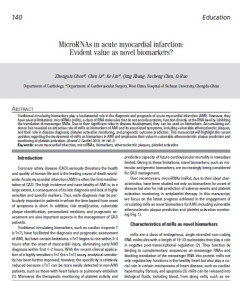
MicroRNAs in Acute Myocardial infarction: Evident Value as Novel Biomarkers?
Traditional circulating biomarkers play a fundamental role in the diagnosis and prognosis of acute myocardial infarction (AMI). However, they have several limitations. microRNAs (miRs), a class of RNA molecules that do not encode proteins, function directly at the RNA level by inhibiting the translation of messenger RNAs. Due to their significant roles in disease development, they can be used a…
- Edition
- -
- ISBN/ISSN
- -
- Collation
- -
- Series Title
- -
- Call Number
- -
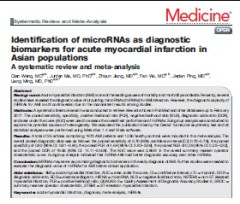
Identification of microRNAs as Diagnostic Biomarkers for Acute Myocardial Inf…
Acute myocardial infarction (AMI) is one of the leading causes of mortality and morbidity worldwide. Recently, several studies have revealed the diagnostic value of circulating microRNAs (miRNAs) for AMI detection. However, the diagnostic capacity of miRNAs for AMI is still controversial due to the inconsistent results among studies
- Edition
- -
- ISBN/ISSN
- -
- Collation
- -
- Series Title
- -
- Call Number
- -
 Computer Science, Information & General Works
  Philosophy & Psychology
  Religion
  Social Sciences
  Language
  Pure Science
  Applied Sciences
  Art & Recreation
  Literature
  History & Geography