Filter by
Clinical trials in progressive multiple sclerosis: lessons learned and future…
Progressive multiple sclerosis is characterized by the gradual accrual of disability independent of relapses and can occur with disease onset (primary progressive) or preceded by a relapsing disease course (secondary progressive). An effective disease modifying treatment for progressive multiple sclerosis has not been identified, and the results of clinical trials to date have been generally di…
- Edition
- -
- ISBN/ISSN
- -
- Collation
- -
- Series Title
- -
- Call Number
- -

Multiple sclerosis in children: an update on clinical diagnosis, therapeutic …
The clinical features, diagnostic challenges, neuroimaging appearance, therapeutic options, and pathobiological research progress in childhood—and adolescent—onset multiple sclerosis have been informed by many new insights in the past 7 years. National programmes in several countries, collaborative research efforts, and an established international paediatric multiple sclerosis study group …
- Edition
- -
- ISBN/ISSN
- -
- Collation
- -
- Series Title
- -
- Call Number
- -
Innate and Adaptive Immune Response to a Virus: An Integrated Learning Module
Medical schools must expand their teaching strategies to address a new generation of medical students and ensure their growth into lifelong, self-directed learners. Integration across basic science disciplines packaged together with clinical medicine produces learning materials that better enable medical students to achieve these goals
- Edition
- -
- ISBN/ISSN
- -
- Collation
- -
- Series Title
- -
- Call Number
- -
Innate immunity
Recent years have witnessed an explosion of interest in the innate immune system. Questions about how the innate immune system senses infection and empowers a protective immune response are being answered at the molecular level. These basic science discoveries are being translated into a more complete understanding of the central role innate immunity plays in the pathogenesis of many human inf…
- Edition
- -
- ISBN/ISSN
- -
- Collation
- -
- Series Title
- -
- Call Number
- -
CD11c.DTR mice develop a fatal fulminant myocarditis after local or systemic …
To assess the role of alveolar macrophages (AMs) during a pulmonary Aspergillus fumigatus infection AMs were depleted by intratracheal application of diphtheria toxin (DTX) to transgenic CD11c.DTR mice prior to fungal infection. Unexpectedly, all CD11c.DTR mice treated with DTX died within 4–5 days, whether being infected with A. fumigatus or not. Despite measurable impact of DTX on lung func…
- Edition
- -
- ISBN/ISSN
- -
- Collation
- -
- Series Title
- -
- Call Number
- -
An Analysis of Risk Factors for Incomplete Immunization for Children in Côte…
Immunization is said to be the most effective public health intervention to prevent morbidity, complications, and mortality due to infectious disease among children. Due to the importance of vaccination in terms of infectious disease prevention, in terms of high cost-effectiveness ratio, international organizations, governments, and donors have intensified efforts to increase immunization cove…
- Edition
- -
- ISBN/ISSN
- -
- Collation
- -
- Series Title
- -
- Call Number
- -
Use of Diphtheria Antitoxin (DAT) for Suspected Diphtheria Cases IND
The purpose of this Investigational New Drug (IND) protocol is to provide access to diphtheria antitoxin (DAT) for emergency treatment of suspected diphtheria cases and, under exceptional circumstances, to provide passive, transient protection against diphtheria toxin in an exposed contact. A FDA-licensed diphtheria antitoxin product is unavailable in the United States.
- Edition
- -
- ISBN/ISSN
- -
- Collation
- -
- Series Title
- -
- Call Number
- -
Characterization of serum anti-diphtheria antibody activity following adminis…
There is a global shortage of equine-derived diphtheria anti-toxin (DAT) for diphtheria treatment. There are few existing data on serum antibody concentrations and neutralizing activity post-treatment to support development of new therapeutics. Antibody concentrations were quantified by ELISA and anti-toxin neutralizing activity by cytotoxicity assay in serum from 4 patients receiving DAT for s…
- Edition
- -
- ISBN/ISSN
- -
- Collation
- -
- Series Title
- -
- Call Number
- -
Access to diphtheria antitoxin for therapy and diagnostics
The most effective treatment for diphtheria is swift administration of diphtheria antitoxin (DAT) with conjunct antibiotic therapy. DAT is an equine immunoglobulin preparation and listed among the World Health Organization Essential Medicines. Essential Medicines should be available in functioning health systems at all times in adequate amounts, in appropriate dosage forms, with assured qualit…
- Edition
- -
- ISBN/ISSN
- -
- Collation
- -
- Series Title
- -
- Call Number
- -
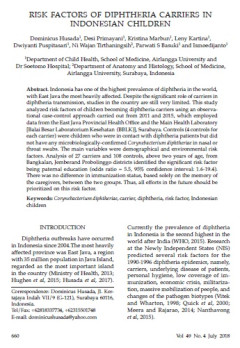
RISK FACTORS OF DIPHTHERIA CARRIERS IN INDONESIAN CHILDREN
Indonesia has one of the highest prevalence of diphtheria in the world, with East Java the most heavily affected. Despite the significant role of carriers in diphtheria transmission, studies in the country are still very limited. This study analyzed risk factors of children becoming diphtheria carriers using an observational case-control approach carried out from 2011 and 2015, which employed d…
- Edition
- -
- ISBN/ISSN
- -
- Collation
- -
- Series Title
- -
- Call Number
- -
 Computer Science, Information & General Works
  Philosophy & Psychology
  Religion
  Social Sciences
  Language
  Pure Science
  Applied Sciences
  Art & Recreation
  Literature
  History & Geography