Filter by
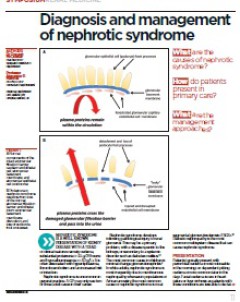
Diagnosis and management of nephrotic syndrome
NEPHROTIC SYNDROME IS A WELL KNOWN PRESENTATION OF KIDNEY DISEASE WITH A TRIAD of clinical features namely oedema, substantial proteinuria (> 3.5 g/24 hours) and hypoalbuminaemia (< 30 g/L). It is often associated with hyperlipidaemia, thromboembolism and an increased risk of infection.
- Edition
- -
- ISBN/ISSN
- -
- Collation
- -
- Series Title
- -
- Call Number
- -
Pathophysiology, Diagnosis and Clinical Management of Hepatorenal Syndrome: F…
Advanced cirrhosis is frequently associated with renal dysfunction. Hepatorenal syndrome (HRS) is characterized by the occurrence of kidney injury in cirrhotic patients in the absence of other identifiable causes. HRS is classified in 2 different types. Type 1 is characterized by acute renal failure and rapid functional deterioration of other organs, usually related to a precipitating event.…
- Edition
- -
- ISBN/ISSN
- -
- Collation
- -
- Series Title
- -
- Call Number
- -
Hepatorenal syndrome: current concepts related to diagnosis and management
Renal failure in cirrhotic patients is a very severe condition. Hepatorenal syndrome has the worst prognosis among all causes of kidney failure in such patients. Hepatorenal syndrome is diagnosed especially in cirrhotic patients with ascites who develop loss renal function, despite diuretic suspension and volume expansion with albumin and for whom other causes of kidney injury have been exclude…
- Edition
- -
- ISBN/ISSN
- -
- Collation
- -
- Series Title
- -
- Call Number
- -
A comprehensive review on clinical outcome of probiotic and synbiotic therapy…
The composition of gut microflora and its metabolic activity are closely correlated with the host immune system, and the changes in the biometric of the microbiome lead to inflammatory diseases like inflammatory bowel disease. The supplementation of probiotics and synbiotic could indeed manipulate the microflora, which can be an alternative therapy for ulcerative colitis, and Crohn’s disease.
- Edition
- -
- ISBN/ISSN
- -
- Collation
- -
- Series Title
- -
- Call Number
- -
Recent advances in the management of radiation colitis
Radiation colitis, an insidious, progressive disease of increasing frequency, develops 6 mo to 5 years after regional radiotherapy for malignancy, owing to the deleterious effects of the latter on the colon and the small intestine. When dealing with radiation colitis and its complications, the most conservative modality should be employed because the areas of intestinal injury do not tend to h…
- Edition
- -
- ISBN/ISSN
- -
- Collation
- -
- Series Title
- -
- Call Number
- -
Diagnosis of Hepatic Nodules in Patients at Risk for Q1 Hepatocellular Carcin…
Unequivocal diagnosis with avoidance of falsepositive results is very relevant in patients with liver disease in whom an imaging technique detects a nodule that raises the potential emergence of hepatocellular carcinoma (HCC). Although biopsy confirmation is standard in most cancers, several studies have shown that reliable HCC diagnosis may be established by imaging techniques in patients wit…
- Edition
- -
- ISBN/ISSN
- -
- Collation
- -
- Series Title
- -
- Call Number
- -
Acute Liver Failure
- Edition
- -
- ISBN/ISSN
- -
- Collation
- -
- Series Title
- -
- Call Number
- -
- Edition
- -
- ISBN/ISSN
- -
- Collation
- -
- Series Title
- -
- Call Number
- -
Serum IL-21 levels associated with chronic hepatitis B and hepatitis B-relate…
The aim of the present study was to investigate the role of interleukin (IL)-21 in chronic hepatitis B virus (HBV) infection. IL-21 stimulates T and B cell responses and plays a role in the control of chronic viral infections. Serum IL-21 levels were measured by enzyme immunoassay in 109 patients with chronic HBV infection at various clinical stages, as well as in 19 healthy controls (HCs).
- Edition
- -
- ISBN/ISSN
- -
- Collation
- -
- Series Title
- -
- Call Number
- -
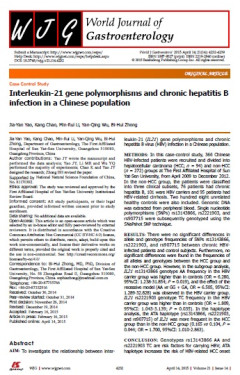
Interleukin-21 gene polymorphisms and chronic hepatitis B infection in a Chin…
In this case-control study, 366 Chinese HBV-infected patients were recruited and divided into hepatocellular carcinoma (HCC; n = 94) and non-HCC (n = 272) groups at The First Affiliated Hospital of Sun Yat-Sen University, from April 2009 to December 2012. In the non-HCC group, the patients were classified into three clinical subsets, 76 patients had chronic hepatitis B, 101 were HBV carriers a…
- Edition
- -
- ISBN/ISSN
- -
- Collation
- -
- Series Title
- -
- Call Number
- -
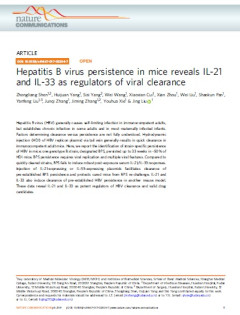
Hepatitis B virus persistence in mice reveals IL-21 and IL-33 as regulators o…
Hepatitis B virus (HBV) generally causes self-limiting infection in immunocompetent adults, but establishes chronic infection in some adults and in most maternally infected infants. Factors determining clearance versus persistence are not fully understood. Hydrodynamic injection (HDI) of HBV replicon plasmid via tail vein generally results in quick clearance in immunocompetent adult mice. Here,…
- Edition
- -
- ISBN/ISSN
- -
- Collation
- -
- Series Title
- -
- Call Number
- -
 Computer Science, Information & General Works
  Philosophy & Psychology
  Religion
  Social Sciences
  Language
  Pure Science
  Applied Sciences
  Art & Recreation
  Literature
  History & Geography