Filter by
Management of acute coronary syndromes during the COVID-19 outbreak in Lombar…
During the COVID-19 outbreak, healthcare Authorities of Lombardy modified the regional network concerning time-dependent emergencies. Specifically, 13 Macro-Hubs were identified to deliver timely optimal care to patients with acute coronary syndromes (ACS). Aim of this paper is to present the results of this experience
- Edition
- -
- ISBN/ISSN
- -
- Collation
- -
- Series Title
- -
- Call Number
- -
Antiplatelet Therapy in Ischemic Stroke and Transient Ischemic Attack An Over…
Stroke is a leading cause of mortality and disability worldwide. Initial manifestations of acute cerebral ischemia, such as ischemic stroke and transient ischemic attack (TIA), are often followed by recurrent vascular events, including recurrent stroke. To reduce this burden, antiplatelet therapy is a key component of the management of noncardioembolic ischemic stroke and TIA.
- Edition
- -
- ISBN/ISSN
- -
- Collation
- -
- Series Title
- -
- Call Number
- -
Antiplatelet Treatment After Transient Ischemic Attack and Ischemic Stroke in…
In patients with transient ischemic attack/ischemic stroke, microbleed burden predicts intracerebral hemorrhage (ICH), and ischemic stroke, but implications for antiplatelet treatment are uncertain. Previous cohort studies have had insufficient follow-up to assess the time course of risks, have not stratified risks by antithrombotic use, and have not reported extracranial bleeds or functional o…
- Edition
- -
- ISBN/ISSN
- -
- Collation
- -
- Series Title
- -
- Call Number
- -
Oral antiplatelet therapy for acute ischaemic stroke (Review)
In people with acute ischaemic stroke, platelets become activated and can cause blood clots to form and block an artery in the brain, resulting in damage to part of the brain. Such damage gives rise to the symptoms of stroke. Antiplatelet therapy might reduce the volume of brain damaged by ischaemia and also reduce the risk of early recurrent ischaemic stroke, thereby reducing the risk of ear…
- Edition
- -
- ISBN/ISSN
- -
- Collation
- -
- Series Title
- -
- Call Number
- -
2020 International Society of Hypertension Global Hypertension Practice Guide…
In the Guidelines, differentiation between optimal and essential standards were not always possible, and were made in sections where it was most practical and sensible. The Guidelines Committee is also aware that some recommended essential standards may not be feasible in low resource settings, for example, out-of-office BP measurements, the requirement of multiple visits for the diagnosis of h…
- Edition
- -
- ISBN/ISSN
- -
- Collation
- -
- Series Title
- -
- Call Number
- -
Resistant Hypertension: Detection, Evaluation, and Management: A Scientific S…
Resistant hypertension (RH) is defined as above-goal elevated blood pressure (BP) in a patient despite the concurrent use of 3 antihypertensive drug classes, commonly including a long-acting calcium channel blocker, a blocker of the renin-angiotensin system (angiotensin-converting enzyme inhibitor or angiotensin receptor blocker), and a diuretic. The antihypertensive drugs should be administere…
- Edition
- -
- ISBN/ISSN
- -
- Collation
- -
- Series Title
- -
- Call Number
- -
Lifestyle and Hypertension: An Evidence-Based Review
Emerging data suggest that lifestyle habits may affect blood pressure values. In this review, authors examine the more relevant clinical and epidemiological studies about the influence that multiple lifestyle factors play on development of hypertension. They conclude that there is clear evidence that lifestyle changes can have a favorable effect on prevention and treatment of hypertension, with…
- Edition
- -
- ISBN/ISSN
- -
- Collation
- -
- Series Title
- -
- Call Number
- -
Health Care Guideline: Diagnosis and Initial Treatment of Ischemic Stroke
Stroke is the fifth leading cause of death in the United States and a leading cause of serious long-term disability (Mozzafarian, 2015; Kochanek, 2014). Annually, approximately 800,000 people in the United States have a stroke, and 130,000 die (Centers for Disease Control and Prevention, 2016). Of all strokes, 87% are ischemic strokes (Mozaffarian, 2015). In Minnesota, ischemic stroke death rat…
- Edition
- -
- ISBN/ISSN
- -
- Collation
- -
- Series Title
- -
- Call Number
- -
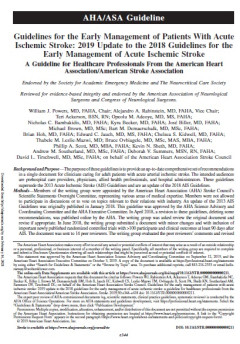
Guidelines for the Early Management of Patients With Acute Ischemic Stroke: 2…
The purpose of these guidelines is to provide an up-to-date comprehensive set of recommendations in a single document for clinicians caring for adult patients with acute arterial ischemic stroke. The intended audiences are prehospital care providers, physicians, allied health professionals, and hospital administrators. These guidelines supersede the 2013 Acute Ischemic Stroke (AIS) Guideline…
- Edition
- -
- ISBN/ISSN
- -
- Collation
- -
- Series Title
- -
- Call Number
- -
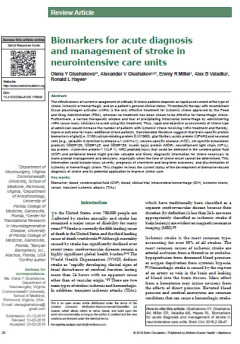
Biomarkers for acute diagnosis and management of stroke in neurointensive car…
The effectiveness of current management of critically ill stroke patients depends on rapid assessment of the type of stroke, ischemic or hemorrhagic, and on a patient’s general clinical status. Thrombolytic therapy with recombinant tissue plasminogen activator (r-tPA) is the only effective treatment for ischemic stroke approved by the Food and Drug Administration (FDA), whereas no treatment h…
- Edition
- -
- ISBN/ISSN
- -
- Collation
- -
- Series Title
- -
- Call Number
- -
 Computer Science, Information & General Works
  Philosophy & Psychology
  Religion
  Social Sciences
  Language
  Pure Science
  Applied Sciences
  Art & Recreation
  Literature
  History & Geography