Filter by
Empyema management: A cohort study Q5 evaluating antimicrobial therapy
Empyemas require aggressive antimicrobial and surgical management. However, the specifics of antimicrobial therapy have not been studied in clinical trials. The present study examines management and outcomes among a cohort of patients with empyema cared for in a tertiary-care referral hospital over a decade
- Edition
- -
- ISBN/ISSN
- -
- Collation
- -
- Series Title
- -
- Call Number
- -
Defining of initial antibiotic treatment of pleural empyema
Parapneumonic effusions are often complications of bacterial pneumonia, occurring in 5-50% patients and in 15% cases it can progress into pleural empyema. Pleural empyema treatment includes drainage of pus, re-expansion of lung by using appropriate antibiotics. Initial antibiotics treatment of pleural empyema is usually started with antibiotics that are resistant to causes found in isolates.
- Edition
- -
- ISBN/ISSN
- -
- Collation
- -
- Series Title
- -
- Call Number
- -
Is There Any Correlation Between Lactate And Base Excess In Septic Shock Pati…
Clinical, hemodynamics and perfusion variable are important tools in identify instable patients and guide therapy. Increased arterial lactate and decreased base excess (BE) have been shown to be predictive of depth of shock and severity of injury
- Edition
- -
- ISBN/ISSN
- -
- Collation
- -
- Series Title
- -
- Call Number
- -
Anti–N-Methyl-D-Aspartate Receptor Encephalitis in Children and Adolescents
Anti–N-methyl-D-aspartate receptor (NMDAR) encephalitis is an autoimmune disease that is becoming increasingly recognized in the pediatric population. It may be the most common cause of treatable autoimmune encephalitis. The majority of cases of anti-NMDAR encephalitis are idiopathic in etiology, but a significant minority can be attributed to a paraneoplastic origin.
- Edition
- -
- ISBN/ISSN
- -
- Collation
- -
- Series Title
- -
- Call Number
- -
Childhood community-acquired pneumonia: A review of etiology- and antimicrobi…
Community acquired pneumonia (CAP) is a leading cause of childhood morbidity worldwide. Because of the rising antimicrobial resistance rates and adverse effects of childhood antibiotic use on the developing microbiome, rational prescribing of antibiotics for CAP is important. This review summarizes and critically reflects on the available evidence for the epidemiology, etiology and antimicrobia…
- Edition
- -
- ISBN/ISSN
- -
- Collation
- -
- Series Title
- -
- Call Number
- -
Community-acquired pneumonia management and outcomes in the era of health inf…
Pneumonia continues to be a leading cause of hospitalization and mortality. Implementation of health information technology (HIT) can lead to cost savings and improved care. In this review, we examine the literature on the use of HIT in the management of community-acquired pneumonia. We also discuss barriers to adoption of technology in managing pneumonia, the reliability and quality of elec…
- Edition
- -
- ISBN/ISSN
- -
- Collation
- -
- Series Title
- -
- Call Number
- -
Spectrum of illness among returned Australian travellers from Bali, Indonesia…
Bali, Indonesia, presents significant infectious and non-infectious health risks for Australian travellers. Understanding this spectrum of illnesses has the potential to assist clinicians in evaluating unwell returning travellers and guide provision of pre-travel advice
- Edition
- -
- ISBN/ISSN
- -
- Collation
- -
- Series Title
- -
- Call Number
- -
Chronic pulmonary aspergillosis: rationale and clinical guidelines for diagno…
Chronic pulmonary aspergillosis (CPA) is an uncommon and problematic pulmonary disease, complicating many other respiratory disorders, thought to affect ∼240000 people in Europe. The most common form of CPA is chronic cavitary pulmonary aspergillosis (CCPA), which untreated may progress to chronic fibrosing pulmonary aspergillosis. Less common manifestations include: Aspergillus nodule and si…
- Edition
- -
- ISBN/ISSN
- -
- Collation
- -
- Series Title
- -
- Call Number
- -
Spontaneous Bacterial Peritonitis: Pathogenesis, Diagnosis, Treatment
Due to inadequate defence mechanisms, cirrhotic patients with ascites have an increased susceptibility to infections, the most frequent and the most severe one being spontaneous bacterial peritonitis (SBP). SBP diagnosis is based on testing of the ascitic fluid obtained by paracentesis. A polymorphonuclear cell count of more than 250 cells/mm3 of ascitic fluid is considered diagnostic and from …
- Edition
- -
- ISBN/ISSN
- -
- Collation
- -
- Series Title
- -
- Call Number
- -
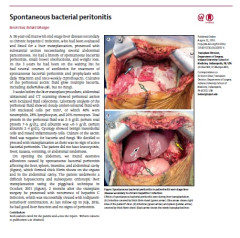
Spontaneous bacterial peritonitis
A 38-year-old man with end-stage liver disease secondary to chronic hepatitis C infection, who had been evaluated and listed for a liver transplantation, presented with substantial ascites necessitating several abdominal paracenteses. He had a history of spontaneous bacterial peritonitis, small bowel obstructions, and weight loss. In the 3 years he had been on the waiting list he had several…
- Edition
- -
- ISBN/ISSN
- -
- Collation
- -
- Series Title
- -
- Call Number
- -
 Computer Science, Information & General Works
  Philosophy & Psychology
  Religion
  Social Sciences
  Language
  Pure Science
  Applied Sciences
  Art & Recreation
  Literature
  History & Geography