Filter by
Obstetrics and Gynecology Emergencies
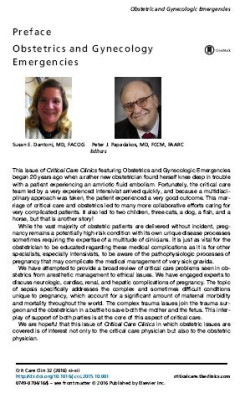
This issue of Critical Care Clinics featuring Obstetrics and Gynecologic Emergencies began 20 years ago when a rather new obstetrician found herself knee deep in trouble with a patient experiencing an amniotic fluid embolism. Fortunately, the critical care team led by a very experienced intensivist arrived quickly, and because a multidisciplinary approach was taken, the patient experienced a ve…
- Edition
- -
- ISBN/ISSN
- -
- Collation
- -
- Series Title
- -
- Call Number
- -

The Safety and Efficacy of Tranexamic Acid in Adult Spinal Deformity Surgery:…
Major spinal corrective surgeries can be associated with critical intra-operative blood loss. The objective of this systematic review and meta-analysis was to assess the safety and efficacy of tranexamic acid (TXA), a commonly used antifibrinolytic agent, in adult spinal deformity (ASD) surgery, defined as fusion of five or more levels.
- Edition
- -
- ISBN/ISSN
- -
- Collation
- -
- Series Title
- -
- Call Number
- -
TRANEXAMIC ACID COMPARED WITH HIGH-DOSE APROTININ IN PRIMARY ELECTIVE HEART O…
Since excessive fibrinolysis during cardiac surgery is frequently associated with abnormal perioperative bleeding, many authors have advocated prophylactic use of antifibrinolytic drugs to prevent hemorrhagic disorders. We compared the effects of tranexamic acid (a synthetic antifibrinolytic drug) with aprotinin (a natural derivative product with antifibrinolytic properties) on perioperative bl…
- Edition
- -
- ISBN/ISSN
- -
- Collation
- -
- Series Title
- -
- Call Number
- -
Clinical observation of blood loss reduced by tranexamic acid during and afte…
Tranexamic acid statistically reduces the extent of bleeding from placental delivery to 2 h postpartum and its use was not associated with any side effects or complications. Thus, tranexamic acid can be used safely and effectively to reduce bleeding resulting from CS.
- Edition
- -
- ISBN/ISSN
- -
- Collation
- -
- Series Title
- -
- Call Number
- -
The effect of tranexamic acid on the quality of life of women with heavy mens…
To investigate whether medical treatment with tranexamic acid would increase the quality of life women with heavy menstrual bleeding
- Edition
- -
- ISBN/ISSN
- -
- Collation
- -
- Series Title
- -
- Call Number
- -
Effects of tranexamic acid on postoperative bleeding and related hematochemic…
Bleeding and inflammation are major complications of extracorporeal circulation. Off-pump coronary artery bypass grafting may reduce the rate of complications, but it can only be applied in selected cases. Pilot studies have shown a potential benefit from the use of antifibrinolytic drugs, but efficacy in randomized double-blind studies evaluating off- and on-pump coronary artery bypass graftin…
- Edition
- -
- ISBN/ISSN
- -
- Collation
- -
- Series Title
- -
- Call Number
- -
 Computer Science, Information & General Works
  Philosophy & Psychology
  Religion
  Social Sciences
  Language
  Pure Science
  Applied Sciences
  Art & Recreation
  Literature
  History & Geography