Filter by
Demographic and Clinical Characteristics of Adult Acute Myeloid Leukemia - Te…
Acute myeloid leukemia (AML) is an acquired clonal frequent malignant disorder of myeloid progenitor cells. Our aim was to study demographical and clinicopathological features of adult Pakistani AML patients at presentation.
- Edition
- -
- ISBN/ISSN
- -
- Collation
- -
- Series Title
- -
- Call Number
- -
Tobacco Smoke Induces and Alters Immune Responses in the Lung Triggering Infl…
Many studies have been undertaken to reveal how tobacco smoke skews immune responses contributing to the development of chronic obstructive pulmonary disease (COPD) and other lung diseases. Recently, environmental tobacco smoke (ETS) has been linked with asthma and allergic diseases in children. This review presents the most actual knowledge on exact molecular mechanisms responsible for the ske…
- Edition
- -
- ISBN/ISSN
- -
- Collation
- -
- Series Title
- -
- Call Number
- -
Impacts of cigarette smoking on immune responsiveness: Up and down or upside …
Cigarette smoking is associated with numerous diseases and poses a serious challenge to the current healthcare system worldwide. Smoking impacts both innate and adaptive immunity and plays dual roles in regulating immunity by either exacerbation of pathogenic immune responses or attenuation of defensive immunity. Adaptive immune cells affected by smoking mainly include T helper cells (Th1/Th2/T…
- Edition
- -
- ISBN/ISSN
- -
- Collation
- -
- Series Title
- -
- Call Number
- -
Usefulness of carcinoembryonic antigen in the diagnosis of small cell lung ca…
Small cell lung cancer (SCLC) includes pure SCLC and SCLC combined with other pathologies (C-SCLC). C-SCLC accounts for about 28% of all SCLCs subjected to surgical resection, but only about 1–3% of C-SCLCs are detected by biopsy. Since less than 5% of SCLC patients are eligible for surgery, it is necessary to develop alternative methods for the detection of C-SCLC
- Edition
- -
- ISBN/ISSN
- -
- Collation
- -
- Series Title
- -
- Call Number
- -
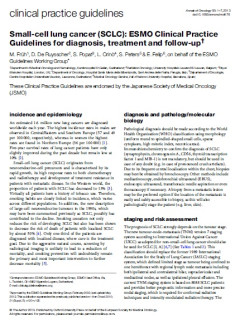
Small-cell lung cancer (SCLC): ESMO Clinical Practice Guidelines for diagnosi…
An estimated 1.6 million new lung cancers are diagnosed worldwide each year. The highest incidence rates in males are observed in Central/Eastern and Southern Europe (57 and 49 per 100 000, respectively), whereas in women the highest rates are found in Northern Europe (36 per 100 000) . Five-year survival rates of lung cancer patients have only slightly improved during the past decade but rema…
- Edition
- -
- ISBN/ISSN
- -
- Collation
- -
- Series Title
- -
- Call Number
- -

Diagnostic difficulties with the diagnosis of small cell carcinoma of the lung
Small cell carcinoma of the lung (SCLC) is a well characterized form of lung cancer that is frequently already metastatic at diagnosis. Thus, patients with SCLC are usually treated with chemotherapy, and therefore emphasis has been placed on distinguishing that tumor from squamous cell carcinomas, large cell carcinomas and other pulmonary neoplasms that can more often be managed surgically. SCL…
- Edition
- -
- ISBN/ISSN
- -
- Collation
- -
- Series Title
- -
- Call Number
- -
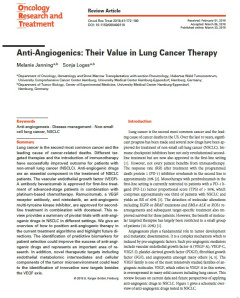
Anti-Angiogenics: Their Value in Lung Cancer Therapy
Lung cancer is the second most common cancer and the leading cause of cancer-related deaths. Different targeted therapies and the introduction of immunotherapy have successfully improved outcome for patients with non-small lung cancer (NSCLC). Anti-angiogenic drugs are an essential component in the treatment of NSCLC patients. The vascular endothelial growth factor (VEGF)- A antibody bevacizuma…
- Edition
- -
- ISBN/ISSN
- -
- Collation
- -
- Series Title
- -
- Call Number
- -
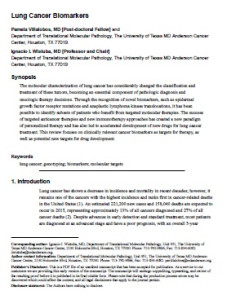
Lung Cancer Biomarkers
The molecular characterization of lung cancer has considerably changed the classification and treatment of these tumors, becoming an essential component of pathologic diagnosis and oncologic therapy decisions. Through the recognition of novel biomarkers, such as epidermal growth factor receptor mutations and anaplastic lymphoma kinase translocations, it has been possible to identify subsets of …
- Edition
- -
- ISBN/ISSN
- -
- Collation
- -
- Series Title
- -
- Call Number
- -
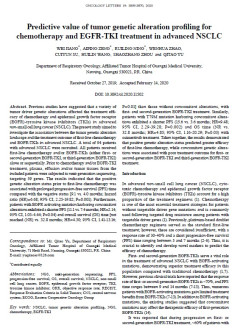
Predictive value of tumor genetic alteration profiling for chemotherapy and E…
Previous studies have suggested that a variety of tumor driver genetic alterations affected the treatment efficacy of chemotherapy and epidermal growth factor receptor (EGFR)‑tyrosine kinase inhibitors (TKIs) in advanced non‑small cell lung cancer (NSCLC). The present study aimed to investigate the association between the tumor genetic alteration landscape and the treatment outcome of first…
- Edition
- -
- ISBN/ISSN
- -
- Collation
- -
- Series Title
- -
- Call Number
- -
Spontaneous Bacterial Peritonitis: Pathogenesis, Diagnosis, Treatment
Due to inadequate defence mechanisms, cirrhotic patients with ascites have an increased susceptibility to infections, the most frequent and the most severe one being spontaneous bacterial peritonitis (SBP). SBP diagnosis is based on testing of the ascitic fluid obtained by paracentesis. A polymorphonuclear cell count of more than 250 cells/mm3 of ascitic fluid is considered diagnostic and from …
- Edition
- -
- ISBN/ISSN
- -
- Collation
- -
- Series Title
- -
- Call Number
- -
 Computer Science, Information & General Works
  Philosophy & Psychology
  Religion
  Social Sciences
  Language
  Pure Science
  Applied Sciences
  Art & Recreation
  Literature
  History & Geography