Filter by
Asthma
Asthma is the most common respiratory disorder in Canada. Despite significant improvement in the diagnosis and management of this disorder, the majority of Canadians with asthma remain poorly controlled. In most patients, however, control can be achieved through the use of avoidance measures and appropriate pharmacological interventions. Inhaled corticosteroids (ICS) represent the standard of c…
- Edition
- -
- ISBN/ISSN
- -
- Collation
- -
- Series Title
- -
- Call Number
- -
Management of Acute Asthma Exacerbations
Asthma exacerbations can be classified as mild, moderate, severe, or life threatening. Criteria for exacerbation severity are based on symptoms and physical examination parameters, as well as lung function and oxygen saturation. In patients with a peak expiratory flow of 50 to 79 percent of their personal best, up to two treatments of two to six inhalations of short-acting beta2 agonists 20 min…
- Edition
- -
- ISBN/ISSN
- -
- Collation
- -
- Series Title
- -
- Call Number
- -
Managing Asthma Exacerbations in the Emergency Department Summary of the Nati…
This article summarizes the recommendations regarding the management of asthma exacerbations presented in the Expert Panel Report 3 (EPR3) (1). The evidence supporting these recommendations can be found in the report itself. All of the recommendations in this article are strong recommendations, unless indicated by the term ‘‘conditional.’’
- Edition
- -
- ISBN/ISSN
- -
- Collation
- -
- Series Title
- -
- Call Number
- -
Asthma guidelines: the Global Initiative for Asthma in relation to national g…
Both GINA and national guidelines have furthered asthma care to narrow the care gap from what is known to how asthma care is delivered, hopefully in a more directed, personalized manner. As well, both GINA and national guidelines have helped to shape the direction of research for the future benefit of children and their families
- Edition
- -
- ISBN/ISSN
- -
- Collation
- -
- Series Title
- -
- Call Number
- -
Global Initiative for Chronic Obstructive Lung Disease Global Initiative for …
Attention health care professionals: The Global Initiative for Chronic Obstructive Lung Disease (GOLD) group has released their Pocket Guide to COPD Diagnosis, Management and Prevention – A Guide for Health Care Professionals, updated for 2016.
- Edition
- -
- ISBN/ISSN
- -
- Collation
- -
- Series Title
- -
- Call Number
- -
Global Strategy for Asthma Management and Prevention. (2017 update)
Asthma is a serious health problem throughout the world. During the past two decades, many scientific advances have improved our understanding of asthma and ability to manage and control it effectively. However, recommendations for asthma care need to be adapted to local conditions, resources and services
- Edition
- -
- ISBN/ISSN
- -
- Collation
- -
- Series Title
- -
- Call Number
- -
Current and new challenges in occupational lung diseases
Occupational lung diseases are an important public health issue and are avoidable through preventive interventions in the workplace. Up-to-date knowledge about changes in exposure to occupational hazards as a result of technological and industrial developments is essential to the design and implementation of efficient and effective workplace preventive measures.
- Edition
- -
- ISBN/ISSN
- -
- Collation
- -
- Series Title
- -
- Call Number
- -
Asthma: definitions and pathophysiology
Asthma is a common condition due to chronic inflammation of the lower respiratory tract. Chronic lower airway inflammation is known to be more common in individuals that also have inflammatory disorders of the upper airway. The scientific understanding of asthma continues to improve and it is important for providers who treat upper or lower airway inflammation to be familiar with asthma’s def…
- Edition
- -
- ISBN/ISSN
- -
- Collation
- -
- Series Title
- -
- Call Number
- -
Asthma and Exercise-Induced Bronchoconstriction in Athletes
Regular exercise is one of the most effective means to maintain good health. A substantial proportion of the general population engages in competitive sports, including many people with asthma; when controlled, asthma does not restrict exercise performance. Indeed, exercise training can improve asthma symptoms, quality of life, exercise capacity, and pulmonary function, as well as reduce airwa…
- Edition
- -
- ISBN/ISSN
- -
- Collation
- -
- Series Title
- -
- Call Number
- -
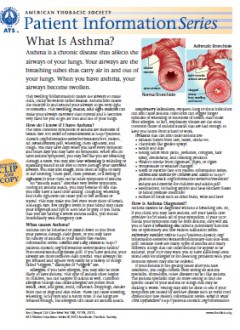
Patient Information Series : What Is Asthma?
Asthma is a chronic disease that affects the airways of your lungs. Your airways are the breathing tubes that carry air in and out of your lungs. When you have asthma, your airways become swollen
- Edition
- -
- ISBN/ISSN
- -
- Collation
- -
- Series Title
- -
- Call Number
- -
 Computer Science, Information & General Works
  Philosophy & Psychology
  Religion
  Social Sciences
  Language
  Pure Science
  Applied Sciences
  Art & Recreation
  Literature
  History & Geography