Filter by
Does adding variceal status to the Child–Turcotte–Pugh score improve its …
The Child–Turcotte–Pugh (CTP) score is widely used worldwide to predict outcomes across a broad spectrum of liver diseases, mainly cirrhosis. Portal hypertension and variceal bleed are significant causes of morbidity and mortality in cirrhotic patients, although the variceal status is not incorporated into the classical CTP score. We sought to determine whether the inclusion of variceal sta…
- Edition
- -
- ISBN/ISSN
- -
- Collation
- -
- Series Title
- -
- Call Number
- -
Cirrhosis of liver: Etiological factors, complications and prognosis
HCV infection is the major risk factor for cirrhosis in our setup. Ascites was the commonest complication. Patients with child-Pugh’s class ‘A’ cirrhosis had significantly longer survival than patients with child-Pugh’s class ‘B’ and ‘C’. A multidisciplinary approach for prevention and control of ever increasing HCV infection must be adopted and to make the public awareness thro…
- Edition
- -
- ISBN/ISSN
- -
- Collation
- -
- Series Title
- -
- Call Number
- -
Non-alcoholic fatty liver disease: What the clinician needs to know
Non-alcoholic fatty liver disease (NAFLD) is the most frequent cause of liver disease in the Western world. Furthermore, it is increasing worldwide, paralleling the obesity pandemic. Though highly frequent, only about one fifth of affected subjects are at risk of developing the progressive form of the disease, non-alcoholic steatohepatitis with fibrosis.
- Edition
- -
- ISBN/ISSN
- -
- Collation
- -
- Series Title
- -
- Call Number
- -
Clinical effectiveness of cell therapies in patients with chronic liver disea…
Chronic liver disease (CLD) is a major health burden worldwide. Liver cirrhosis, a form of CLD is the fifth most common cause of death in the UK. Acute-on-chronic liver failure (ACLF) is the result of an acute insult superimposed on patients with liver cirrhosis as a result of precipitating events such as infection or bleeding. ACLF has a high associated mortality as a result of multi-organ …
- Edition
- -
- ISBN/ISSN
- -
- Collation
- -
- Series Title
- -
- Call Number
- -
Granulocyte colony-stimulating factor and autologous CD133-positive stem-cell…
Results of small-scale studies have suggested that stem-cell therapy is safe and effective in patients with liver cirrhosis, but no adequately powered randomised controlled trials have been done. We assessed the safety and efficacy of granulocyte colony-stimulating factor (G-CSF) and haemopoietic stem-cell infusions in patients with liver cirrhosis.
- Edition
- -
- ISBN/ISSN
- -
- Collation
- -
- Series Title
- -
- Call Number
- -
Epidemiology and Prognosis of Paraneoplastic Syndromes in Hepatocellular Carc…
Paraneoplastic syndromes (PNS) such as hypercalcaemia, hypercholesterolaemia, and erythrocytosis have been described in hepatocellular carcinoma (HCC). Aims. (1) To examine the prevalence, clinical characteristics, and survival of PNS in HCC patients and (2) to evaluate the extent to which each individual PNS impacts on patient survival
- Edition
- -
- ISBN/ISSN
- -
- Collation
- -
- Series Title
- -
- Call Number
- -
Nutrition and chronic kidney disease
The incidence of malnutrition disorders in chronic kidney disease (CKD) appears unchanged over time, whereas patient-care and dialysis techniques continue to progress. Despite some evidence for cost-effective treatments, there are numerous caveats to applying these research findings on a daily care basis. There is a sustained generation of data confirming metabolic improvement when patients con…
- Edition
- -
- ISBN/ISSN
- -
- Collation
- -
- Series Title
- -
- Call Number
- -
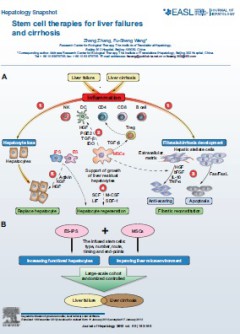
Stem cell therapies for liver failures and cirrhosis
Liver failure and cirrhosis occur as a result of a variety of chronic hepatic injuries. They display sequential and overlapping severe pathogenic processes that include severe inflammation, hepatocyte necrosis, and fibrosis/cirrhosis, and carry a high mortality rate
- Edition
- -
- ISBN/ISSN
- -
- Collation
- -
- Series Title
- -
- Call Number
- -
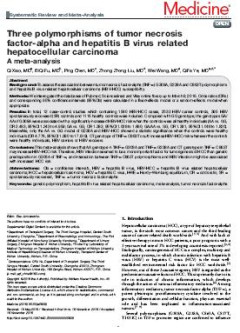
Three polymorphisms of tumor necrosis factor-alpha and hepatitis B virus rela…
This meta-analysis shows that AA genotype in TNF-a G308A and TNF-a G238A and CT genotype in TNF-a C863T may increase HBV-HCC risk. Therefore, HBV infection seemed to be a more important factor for tumorigenesis of HCC than genetic predisposition in G308A of TNF-a, and interaction between TNF-a C863T polymorphisms and HBV infection might be associated with increased HCC risk
- Edition
- -
- ISBN/ISSN
- -
- Collation
- -
- Series Title
- -
- Call Number
- -
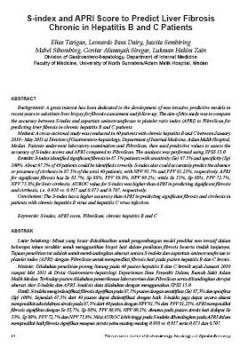
S-index and APRI Score to Predict Liver Fibrosis Chronic in Hepatitis B and C…
A great interest has been dedicated to the development of non invasive predictive models in recent years to substitute liver biopsy for fibrosis assessment and follow-up. The aim of this study was to compare the accuracy between S-index and aspartate aminotransferase to platelet ratio index (APRI) to FibroScan for predicting liver fibrosis in chronic hepatitis B and C patients
- Edition
- -
- ISBN/ISSN
- -
- Collation
- -
- Series Title
- -
- Call Number
- -
 Computer Science, Information & General Works
  Philosophy & Psychology
  Religion
  Social Sciences
  Language
  Pure Science
  Applied Sciences
  Art & Recreation
  Literature
  History & Geography