Filter by
Non–ST-Segment Acute Coronary Syndromes
- Edition
- -
- ISBN/ISSN
- -
- Collation
- -
- Series Title
- -
- Call Number
- -
- Edition
- -
- ISBN/ISSN
- -
- Collation
- -
- Series Title
- -
- Call Number
- -
The role of nitric oxide in cardiovascular diseases
Nitric oxide (NO) is a gaseous lipophilic free radical cellular messenger generated by three distinct isoforms of nitric oxide synthases (NOS), neuronal (nNOS), inducible (iNOS) and endothelial NOS (eNOS). NO plays an important role in the protection against the onset and progression of cardiovascular disease. Cardiovascular disease is associated with a number of different disorders including h…
- Edition
- -
- ISBN/ISSN
- -
- Collation
- -
- Series Title
- -
- Call Number
- -
Nitric oxide and cardiac function
Nitric oxide (NO) participates in the control of contractility and heart rate, limits cardiac remodeling after an infarction and contributes to the protective effect of ischemic pre- and postconditioning. Low concentrations of NO, with production of small amounts of cGMP, inhibit phosphodiesterase III, thus preventing the hydrolysis of cAMP. The subsequent activation of a protein-kinase A cause…
- Edition
- -
- ISBN/ISSN
- -
- Collation
- -
- Series Title
- -
- Call Number
- -
Strategies to increase nitric oxide signalling in cardiovascular disease
Nitric oxide (NO) is a key signalling molecule in the cardiovascular, immune and central nervous systems, and crucial steps in the regulation of NO bioavailability in health and disease are well characterized. Although early approaches to therapeutically modulate NO bioavailability failed in clinical trials, an enhanced understanding of fundamental subcellular signalling has enabled a range of …
- Edition
- -
- ISBN/ISSN
- -
- Collation
- -
- Series Title
- -
- Call Number
- -
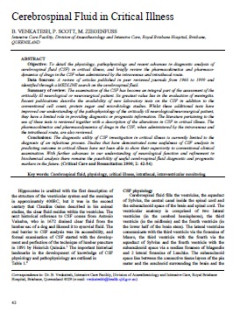
Cerebrospinal Fluid in Critical Illness
To detail the physiology, pathophysiology and recent advances in diagnostic analysis of cerebrospinal fluid (CSF) in critical illness, and briefly review the pharmacokinetics and pharmaco-dynamics of drugs in the CSF when administered by the intravenous and intrathecal route.
- Edition
- -
- ISBN/ISSN
- -
- Collation
- -
- Series Title
- -
- Call Number
- -
 Computer Science, Information & General Works
  Philosophy & Psychology
  Religion
  Social Sciences
  Language
  Pure Science
  Applied Sciences
  Art & Recreation
  Literature
  History & Geography