Filter by
Absence of Growth Retardation in Children With Perennial Allergic Rhinitis Af…
Intranasal corticosteroids are used widely for the treatment of allergic rhinitis because they are effective and well tolerated. However, their potential to suppress growth of pediatric subjects with allergic rhinitis continues to be a concern, particularly in light of reports of growth suppression after treatment with intranasal beclomethasone dipropionate or intranasal budesonide (see the ar…
- Edition
- -
- ISBN/ISSN
- -
- Collation
- -
- Series Title
- -
- Call Number
- -
Molecular and clinical pharmacology of intranasal corticosteroids: clinical a…
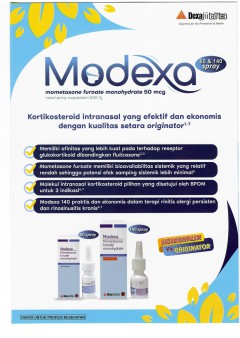
Intranasal corticosteroids (INSs) are effective treatments for allergic rhinitis, rhinosinusitis, and nasal polyposis. In recent years, increased understanding of corticosteroid and glucocorticoid receptor pharmacology has enabled the development of molecules designed specifically to achieve potent, localized activity with minimal risk of systemic exposure. Pharmacologic potency studies using…
- Edition
- -
- ISBN/ISSN
- -
- Collation
- -
- Series Title
- -
- Call Number
- -
Intranasal corticosteroids for allergic rhinitis: How do different agents com…
Intranasal steroids have proved to be an effective and safe form of therapy for allergic rhinitis. However, as the number of new glucocorticoid compounds has increased over the past decade, it has become important to consider whether significant differences exist between these agents. Pharmacologically, newer drugs such as mometasone furoate and fluticasone propionate appear to have substantia…
- Edition
- -
- ISBN/ISSN
- -
- Collation
- -
- Series Title
- -
- Call Number
- -

Efficacy and safety of mometasone furoate nasal spray in allergic rhinitis, a…
- Edition
- -
- ISBN/ISSN
- -
- Collation
- -
- Series Title
- -
- Call Number
- -
- Edition
- -
- ISBN/ISSN
- -
- Collation
- -
- Series Title
- -
- Call Number
- -
Local and Systemic Safety of Intranasal Corticosteroids
The safety and effi cacy of intranasal corticosteroids (INCs) are well established for the management of allergic rhinitis, rhinosinusitis, and nasal polyps. As seen in numerous studies, INCs demonstrate markedly reduced systemic bioavailability compared with oral and even inhaled corticosteroids and have shown an excellent safety profi le over 3 decades of use. Nonetheless, concerns remain am…
- Edition
- -
- ISBN/ISSN
- -
- Collation
- -
- Series Title
- -
- Call Number
- -
Comparative Study On The Efficacy Of Mometasone and Fluticasone Nasal Sprays …
Allergic rhinitis is the most prevalent of allergic diseases in the world. Nasal corticosteroids are the most applicable drugs for the treatment of allergic rhinitis. In this study, we compared the efficacy of fluticasone propionate (FP) and mometasone furoate (MF) nasal sprays in the treatment of allergic rhinitis based on total nasal symptom score (TNSS) questionnaire.
- Edition
- -
- ISBN/ISSN
- -
- Collation
- -
- Series Title
- -
- Call Number
- -
 Computer Science, Information & General Works
  Philosophy & Psychology
  Religion
  Social Sciences
  Language
  Pure Science
  Applied Sciences
  Art & Recreation
  Literature
  History & Geography