Filter by
Multidisciplinary OBGYN morbidity and mortality conference
Obstetrics and gynecology (OB-GYN) morbidity and mortality conferences allow for review of cases with poor or avoidable outcomes. Little data exist on standardized formats for presentation and evaluation. We designed a multidisciplinary morbidity and mortality conference. We formally evaluated resident performance using the milestones format, and evaluated resident understanding of case concep…
- Edition
- -
- ISBN/ISSN
- -
- Collation
- -
- Series Title
- -
- Call Number
- -
Assessment of quality of care among in-patients with postpartum haemorrhage a…
The maternal mortality ratio of Uganda is still high and the leading causes of maternal mortality are postpartum haemorrhage (PPH), severe pre-eclampsia and eclampsia. Criteria-based audit (CBA) is a way of improving quality of care that has not been commonly used in low income countries. This study aimed at finding out the quality of care provided to patients with these conditions and to find …
- Edition
- -
- ISBN/ISSN
- -
- Collation
- -
- Series Title
- -
- Call Number
- -
Mechanisms of action of intrauterine devices: Update and estimation of postfe…
There are many potential mechanisms of action for the intrauterine device (IUD), which vary by type of IUD (inert, copper, or hormonal). This paper reviews the evidence for each potential mechanism of action. On the basis of available data for fertilization rates and clinical pregnancy rates, the relative contribution of mechanisms acting before or after fertilization were quantitatively estima…
- Edition
- -
- ISBN/ISSN
- -
- Collation
- -
- Series Title
- -
- Call Number
- -
Intrauterine Devices: An Update
Three intrauterine devices (IUDs) are available in the United States: the copper T 380A and two levonorgestrel-releasing IUDs, one that releases 20 mcg of levonorgestrel per 24 hours, and one that releases 14 mcg per 24 hours. All are safe and effective methods of contraception that work predominantly by prefertilization mechanisms. The copper T 380A IUD may be placed in nonpregnant women at an…
- Edition
- -
- ISBN/ISSN
- -
- Collation
- -
- Series Title
- -
- Call Number
- -
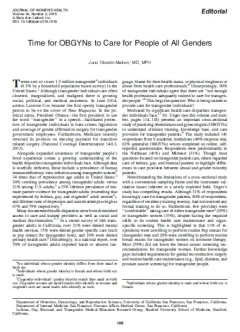
Time for OBGYNs to Care for People of All Genders
There are at least 1.5 million transgendera individuals (0.5% by a household population based survey) in the United States.1 Although transgender individuals are often closeted, marginalized, and maligned there is growing social, political, and medical awareness. In June 2014, actress Laverne Cox became the first openly transgender person to be on the cover of Time Magazine
- Edition
- -
- ISBN/ISSN
- -
- Collation
- -
- Series Title
- -
- Call Number
- -
OBGYN screening for environmental exposures: A call for action
Prenatal exposures have known adverse effects on maternal and neonatal outcomes. Professional societies recommend routine screening for environmental, occupational, and dietary exposures to reduce exposures and their associated sequelae.
- Edition
- -
- ISBN/ISSN
- -
- Collation
- -
- Series Title
- -
- Call Number
- -
 Computer Science, Information & General Works
  Philosophy & Psychology
  Religion
  Social Sciences
  Language
  Pure Science
  Applied Sciences
  Art & Recreation
  Literature
  History & Geography