Filter by
Endometriosis: advances and controversies in classification, pathogenesis, di…
Endometriosis is an enigmatic disease that could start at birth. Its pathogenesis is supported by different theories. Accumulating facts relate it to a multigenic disorder. In this review of recent publications, the principal symptoms of the disease, pain and infertility, as well as its pathogenesis, diagnosis, and classification will be addressed. Endometriosis presents three main variants: su…
- Edition
- -
- ISBN/ISSN
- -
- Collation
- -
- Series Title
- -
- Call Number
- -
Endometriosis
Pelvic endometriosis is a complex syndrome characterized by an estrogen-dependent chronic inflammatory process that affects primarily pelvic tissues, including the ovaries. It is caused when shed endometrial tissue travels retrograde into the lower abdominal cavity. Endometriosis is the most common cause of chronic pelvic pain in women and is associated with infertility. The underlying patho…
- Edition
- -
- ISBN/ISSN
- -
- Collation
- -
- Series Title
- -
- Call Number
- -
The management of menopause in women with a history of endometriosis: a syste…
Endometriosis is typically regarded as a premenopausal disease, resolving after natural or iatrogenic menopause due to declining oestrogen levels. Nonetheless, case reports over the years have highlighted the incidence of recurrent postmenopausal endometriosis. It is now clear that both recurrence and malignant transformation of endometriotic foci can occur in the postmenopausal period. Postm…
- Edition
- -
- ISBN/ISSN
- -
- Collation
- -
- Series Title
- -
- Call Number
- -
The Menopausal Transition
Menopause occurs when the ovaries have complete (or near-complete) follicular exhaustion, resulting in very low serum levels of estradiol and markedly increased follicle-stimulating hormone (FSH) levels. Common symptoms of menopause (Box 1) often begin during the perimenopausal transition at a median of 47 years or 4 to 6 years before menopause occurs.
- Edition
- -
- ISBN/ISSN
- -
- Collation
- -
- Series Title
- -
- Call Number
- -
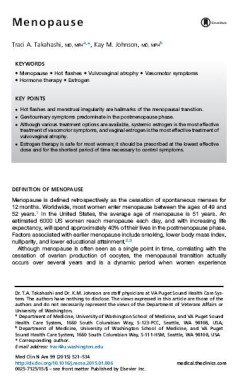
Menopause
Menopause is defined retrospectively as the cessation of spontaneous menses for 12 months. Worldwide, most women enter menopause between the ages of 49 and 52 years. In the United States, the average age of menopause is 51 years. An estimated 6000 US women reach menopause each day, and with increasing life expectancy, will spend approximately 40% of their lives in the postmenopause phase. Facto…
- Edition
- -
- ISBN/ISSN
- -
- Collation
- -
- Series Title
- -
- Call Number
- -
2017 American College of Rheumatology Guideline for the Prevention and Treatm…
Guidelines and recommendations developed and/or endorsed by the American College of Rheumatology (ACR) are intended to provide guidance for particular patterns of practice and not to dictate the care of a particular patient. The ACR considers adherence to the recommendations within this guideline to be voluntary, with the ultimate determination regarding their application to be made by the phys…
- Edition
- -
- ISBN/ISSN
- -
- Collation
- -
- Series Title
- -
- Call Number
- -
Intratympanic dexamethasone injection vs methylprednisolone for the treatment…
During the past years various drugs have been used for sudden sensorineural hearing loss (SSNHL) treatment including steroids that are shown to be beneficial. Directed delivery of high doses of steroids into the inner ear is suggested for its potential and known as intratympanic steroids therapy (IST). Despite the use of dexamethasone and methylprednisolone as the traditional treatments, there …
- Edition
- -
- ISBN/ISSN
- -
- Collation
- -
- Series Title
- -
- Call Number
- -
Factors Influencing Malaysian Men’s Perceptions of Gender Equity in Family …
Various factors influence men’s perceptions regarding gender equity in family planning (FP). Identifying these factors can contribute to a deeper understanding of the roles that men play in family planning and ultimately leads to women’s reproductive health outcomes.
- Edition
- -
- ISBN/ISSN
- -
- Collation
- -
- Series Title
- -
- Call Number
- -
 Computer Science, Information & General Works
  Philosophy & Psychology
  Religion
  Social Sciences
  Language
  Pure Science
  Applied Sciences
  Art & Recreation
  Literature
  History & Geography