Filter by
Corticosteroid-induced neuropsychiatric disorders: review and contrast with n…
The aim of this review is to analyze the available literature regarding the neuropsychiatric (NP) disturbances associated with corticosteroid (CS) therapy; to determine the nature, severity, and frequency of these NP symptoms; and to identify the various risk factors involved in the development of CS-induced NP disturbances. We searched the available literature since the advent of corticosteroi…
- Edition
- -
- ISBN/ISSN
- -
- Collation
- -
- Series Title
- -
- Call Number
- -
Role of Estrogens and Estrogen-Like Compounds in Female Sexual Function and D…
Observational studies that have considered relationship factors and physical or mental health have reported that these factors contribute more to sexual functioning than menopausal status or estrogen levels. Few clinical trials have investigated estrogen therapy with sexual function as a primary outcome. The available data do not support systemic estrogen therapy for the treatment of female sex…
- Edition
- -
- ISBN/ISSN
- -
- Collation
- -
- Series Title
- -
- Call Number
- -
Role of hormones in hypoactive sexual desire disorder and current treatment
Over the decades, female sexual dysfunction (FSD) has grown to be an increasingly potential problem that complicates the quality of life among women. In the current review, FSD refers to recurrent and persistent problems with sexual orgasm, desire, or response. One of the most common subtypes of FSD that has evoked increased research interest in the scientific community is hyposexuality. Today,…
- Edition
- -
- ISBN/ISSN
- -
- Collation
- -
- Series Title
- -
- Call Number
- -
The Role of Hormones in Male Sexual Function
Male sexual dysfunction has many different causes and is often multifactorial in nature. We aim to review the effects that testosterone (T), estrogen, thyroid hormone, prolactin (PRL), and cortisol have on male sexual function. Recent Findings T deficiency can cause decreased libido and diminished erectile function. Estrogen is necessary for sexual drive but is postulated to inhibit erectile fu…
- Edition
- -
- ISBN/ISSN
- -
- Collation
- -
- Series Title
- -
- Call Number
- -
Research Priorities for Endometriosis: Recommendations From a Global Consorti…
The 3rd International Consensus Workshop on Research Priorities in Endometriosis was held in Sa˜o Paulo on May 4, 2014, following the 12th World Congress on Endometriosis. The workshop was attended by 60 participants from 19 countries and was divided into 5 main sessions covering pathogenesis/pathophysiology, symptoms, diagnosis/classification/prognosis, disease/ symptom management, and res…
- Edition
- -
- ISBN/ISSN
- -
- Collation
- -
- Series Title
- -
- Call Number
- -
Endometriosis: advances and controversies in classification, pathogenesis, di…
Endometriosis is an enigmatic disease that could start at birth. Its pathogenesis is supported by different theories. Accumulating facts relate it to a multigenic disorder. In this review of recent publications, the principal symptoms of the disease, pain and infertility, as well as its pathogenesis, diagnosis, and classification will be addressed. Endometriosis presents three main variants: su…
- Edition
- -
- ISBN/ISSN
- -
- Collation
- -
- Series Title
- -
- Call Number
- -
Endometriosis
Pelvic endometriosis is a complex syndrome characterized by an estrogen-dependent chronic inflammatory process that affects primarily pelvic tissues, including the ovaries. It is caused when shed endometrial tissue travels retrograde into the lower abdominal cavity. Endometriosis is the most common cause of chronic pelvic pain in women and is associated with infertility. The underlying patho…
- Edition
- -
- ISBN/ISSN
- -
- Collation
- -
- Series Title
- -
- Call Number
- -
The management of menopause in women with a history of endometriosis: a syste…
Endometriosis is typically regarded as a premenopausal disease, resolving after natural or iatrogenic menopause due to declining oestrogen levels. Nonetheless, case reports over the years have highlighted the incidence of recurrent postmenopausal endometriosis. It is now clear that both recurrence and malignant transformation of endometriotic foci can occur in the postmenopausal period. Postm…
- Edition
- -
- ISBN/ISSN
- -
- Collation
- -
- Series Title
- -
- Call Number
- -
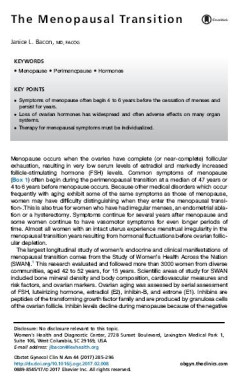
The Menopausal Transition
Menopause occurs when the ovaries have complete (or near-complete) follicular exhaustion, resulting in very low serum levels of estradiol and markedly increased follicle-stimulating hormone (FSH) levels. Common symptoms of menopause (Box 1) often begin during the perimenopausal transition at a median of 47 years or 4 to 6 years before menopause occurs.
- Edition
- -
- ISBN/ISSN
- -
- Collation
- -
- Series Title
- -
- Call Number
- -
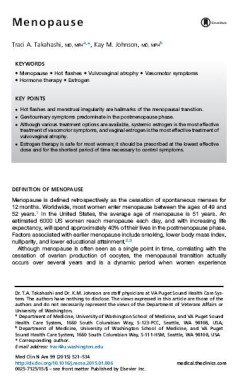
Menopause
Menopause is defined retrospectively as the cessation of spontaneous menses for 12 months. Worldwide, most women enter menopause between the ages of 49 and 52 years. In the United States, the average age of menopause is 51 years. An estimated 6000 US women reach menopause each day, and with increasing life expectancy, will spend approximately 40% of their lives in the postmenopause phase. Facto…
- Edition
- -
- ISBN/ISSN
- -
- Collation
- -
- Series Title
- -
- Call Number
- -
 Computer Science, Information & General Works
  Philosophy & Psychology
  Religion
  Social Sciences
  Language
  Pure Science
  Applied Sciences
  Art & Recreation
  Literature
  History & Geography