Filter by
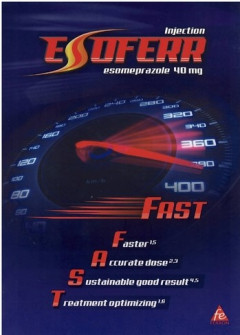
Intravenous esomeprazole 40 mg vs. intravenous lansoprazole 30 mg for control…
On days 1 and 5, intragastric pH was >4.0 significantly longer with esomeprazole than lansoprazole (least-squares means: day 1, 40.0% vs. 33.6%; day 5, 61.9% vs. 45.4%; both P < 0.0001). During the first 4 h of pH monitoring, intragastric pH was >4.0 significantly longer on days 1 and 5 with esomeprazole than lansoprazole (P < 0.0001). Kaplan–Meier estimates of median hours to stable pH >4.…
- Edition
- -
- ISBN/ISSN
- -
- Collation
- -
- Series Title
- -
- Call Number
- -
Esomeprazole 40 mg i.v. provides faster and more effective intragastric acid …
Once-daily dosing with esomeprazole 40 mg intravenously provides faster and more pronounced intragastric acid control than pantoprazole 40 mg intravenously
- Edition
- -
- ISBN/ISSN
- -
- Collation
- -
- Series Title
- -
- Call Number
- -
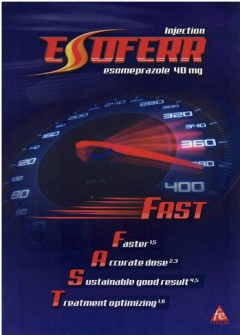
An extended 36-week oral esomeprazole improved long-term recurrent peptic ulc…
Patients with Rockall scores ≥6 have an increased risk of long-term peptic ulcer rebleeding. This study was aimed toward investigating whether an extended course of oral esomeprazole up to 1 year decreased ulcer rebleeding in such patients.
- Edition
- -
- ISBN/ISSN
- -
- Collation
- -
- Series Title
- -
- Call Number
- -
Pharmacokinetics of Esomeprazole in Critically Ill Patients
Esomeprazole, a potent proton pump inhibitor (PPI), is widely used for the prevention of stress ulcers in intensive care unit (ICU) patients.
- Edition
- -
- ISBN/ISSN
- -
- Collation
- -
- Series Title
- -
- Call Number
- -
Study on the preventive effect of intravenous esomeprazole in the management …
This retrospective study investigated the preventive effect of intravenous esomeprazole (IVEO) in the prevention of nonvarices upper gastrointestinal bleeding (NUGIB). This study enrolled 130 patients with NUGIB and all of them underwent successful endoscopic hemostasis, of which 65 cases received routine management and IVEO (Group A) and the other 65 cases received routine management alone (G…
- Edition
- -
- ISBN/ISSN
- -
- Collation
- -
- Series Title
- -
- Call Number
- -
Evaluation and management of variceal bleeding
Acute variceal bleeding is one of the most fatal complications of cirrhosis and is responsible for about one-third of cirrhosis-related deaths.Therefore,every effort should be made to emergently resuscitate the patients,start pharma-cotherapy as soon as possible and do endoscopic therapy in a timely manner. Despite there cent advances in treatment, mortality rate is still high.We provide a comp…
- Edition
- -
- ISBN/ISSN
- -
- Collation
- -
- Series Title
- -
- Call Number
- -
Radiation Colitis and Proctitis
Radiation therapy is commonly utilized as a major component in the treatment of pelvic malignancy. Unfortunately, secondary toxicity to the lower gastrointestinal tract can occur. This most commonly affects the rectum, although injuries to the colon and small intestine are not uncommon. The presentation can be acute or chronic, and different mechanisms are responsible for each. Symptomatology i…
- Edition
- -
- ISBN/ISSN
- -
- Collation
- -
- Series Title
- -
- Call Number
- -
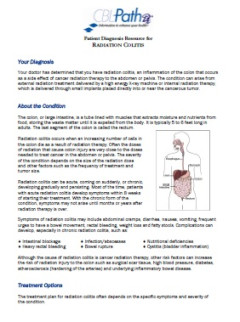
Patient Diagnosis Resource for RADIATION COLITIS
Your doctor has determined that you have radiation colitis, an inflammation of the colon that occurs as a side effect of cancer radiation therapy to the abdomen or pelvis. The condition can arise from external radiation treatment delivered by a high energy X-ray machine or internal radiation therapy, which is delivered through small implants placed directly into or near the cancerous tumor
- Edition
- -
- ISBN/ISSN
- -
- Collation
- -
- Series Title
- -
- Call Number
- -
 Computer Science, Information & General Works
  Philosophy & Psychology
  Religion
  Social Sciences
  Language
  Pure Science
  Applied Sciences
  Art & Recreation
  Literature
  History & Geography