Filter by
Nephrotic syndrome in children
Nephrotic syndrome is an important chronic disease in children, characterized by minimal change disease in the majority. Research on pathogenesis has emphasized the importance of T lymphocyte dysregulation and vascular permeability factors that might alter podocyte function and permselectivity. While mutations in genes that encode important podocyte proteins have also been identified, a hypoth…
- Edition
- -
- ISBN/ISSN
- -
- Collation
- -
- Series Title
- -
- Call Number
- -
Nephrotic Syndrome
Nephrotic syndrome is a disorder of the kidneys that results from increased permeability of the glomerular filtration barrier. It is characterized by 4 major clinical characteristics that are used in establishing the diagnosis: proteinuria, hypoalbuminemia, edema, and hyperlipidemia. This article reviews nephrotic syndrome in the pediatric population, with special attention paid to minimal chan…
- Edition
- -
- ISBN/ISSN
- -
- Collation
- -
- Series Title
- -
- Call Number
- -
Effects of candesartan and amlodipine on cardiovascular events in hypertensiv…
We examined the effects of candesartan and amlodipine on cardiovascular events in hypertensive patients with chronic kidney disease (CKD) using the data from the Candesartan Antihypertensive Survival Evaluation in Japan (CASE-J) trial. CKD was defined as proteinuria and/or decreased GFR (o60 ml per min per 1.73m2) at enrollment. Among 2720 subjects with CKD, there were 1376 and 1344 patients…
- Edition
- -
- ISBN/ISSN
- -
- Collation
- -
- Series Title
- -
- Call Number
- -
Efficacy and Tolerability of Combination Therapy Versus Monotherapy with Cand…
Intensive blood pressure (BP)lowering is important for the treatment of hypertension; however, it has been a challenge to achieve target BP in many patients. The purpose of this study was to explore the optimal dosage of a fixed-dose combination o candesartan cilexetil (CAN) and amlodipine besylate (AML),by examining the tolerability and efficacy of CAN/AML combination therapy compared with th…
- Edition
- -
- ISBN/ISSN
- -
- Collation
- -
- Series Title
- -
- Call Number
- -
Evaluation of the Efficacy and Tolerability of Combination Therapy With Cande…
Blood pressure is reported to be insufficiently controlledin>50% of patients with hypertension. Guidelines for the management of hypertension recommend using drugs with different mechanisms of action when >1 agent is needed to achieve the blood pressure target. The combination of an angiotens inreceptor blocker and a calcium channel blockeris recommended asthe preferred antihypertensive medicat…
- Edition
- -
- ISBN/ISSN
- -
- Collation
- -
- Series Title
- -
- Call Number
- -
The Relationships Between Dose and Antihypertensive Effect of Four AT1-recept…
The relationships between dose and antihypertensive effect of the first four available AT1-receptor blockers, i.e. losartan, valsartan, irbesartan and candesartan, were assessed based on data obtained from the FDA’s evaluation reports of the respective New Drug Application files. All available randomized, double-blind, placebo-controlled, parallel-group studies in adult men and women with mil…
- Edition
- -
- ISBN/ISSN
- -
- Collation
- -
- Series Title
- -
- Call Number
- -
Sartan- AT receptor interactions: evidence for insurmountable antagonism and …
Sartans are non-peptide AT1 receptor antagonists used to treat hypertension and related pathologies. Their effects on the G protein-dependent responses of angiotensin II (Ang II) were the same in vascular tissues and in isolated cell systems. All are competitive but, when pre-incubated, they act surmountably (only rightward shift of the Ang II concentration-response curve) or insurmountably (a…
- Edition
- -
- ISBN/ISSN
- -
- Collation
- -
- Series Title
- -
- Call Number
- -
Stroke Prevention With the Angiotensin II Type 1-Receptor Blocker Candesartan…
In elderly patients with ISH, antihypertensive treatment based on the ARB candesartan resulted in a significant 42% RR reduction in stroke in comparison with other antihypertensive treatment, despite little difference in blood pressure reduction.
- Edition
- -
- ISBN/ISSN
- -
- Collation
- -
- Series Title
- -
- Call Number
- -
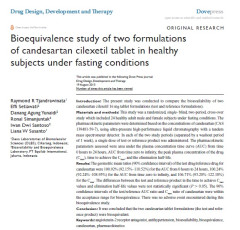
Bioequivalence study of two formulations of candesartan cilexetil tablet in h…
This study was a randomized, single- blind, two-period, cross-over study which included 24 healthy adult male and female subjects under fasting conditions. The pharmacokinetic parameters were determined based on the concentrations of candesartan (CAS 139481-59-7), using ultra-pressure high-performance liquid chromatography with a tandem mass spectrometer detector. In each of the two study perio…
- Edition
- -
- ISBN/ISSN
- -
- Collation
- -
- Series Title
- -
- Call Number
- -
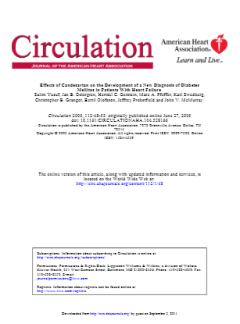
Effects of Candesartan on the Development of a New Diagnosis of Diabetes Mell…
Diabetes is a risk factor for heart failure, and both conditions are increasing. Identifying treatments that prevent both conditions will be clinically important. We previously reported that candesartan (an angiotensin receptor blocker) reduces cardiovascular mortality and heart failure hospitalizations in heart failure patients (CHARM: Candesartan in Heart Failure—Assessment of Reduction …
- Edition
- -
- ISBN/ISSN
- -
- Collation
- -
- Series Title
- -
- Call Number
- -
 Computer Science, Information & General Works
  Philosophy & Psychology
  Religion
  Social Sciences
  Language
  Pure Science
  Applied Sciences
  Art & Recreation
  Literature
  History & Geography