Filter by
Orthopaedic traumatology: fundamental principles and current controversies fo…
Multiply injured patients with fractures are co-managed by acute care surgeons and orthopaedic surgeons. In most centers, orthopaedic surgeons definitively manage fractures, but preliminary management, including washouts, splinting, reductions, and external fixations, may be performed by selected acute care surgeons. The acute care surgeon should have a working knowledge of orthopaedic termino…
- Edition
- -
- ISBN/ISSN
- -
- Collation
- -
- Series Title
- -
- Call Number
- -
The orthopaedic and traumatology scenario during Covid-19 outbreak in Italy: …
From February 21, the day of hospitalisation in ICU of the first diagnosed case of Covid-19, the social situation and the hospitals’ organisation throughout Italy dramatically changed
- Edition
- -
- ISBN/ISSN
- -
- Collation
- -
- Series Title
- -
- Call Number
- -
Downward trend in pediatric resident laryngoscopy participation in pediatric …
As of July 2013, pediatric resident trainee guidelines in the United States (US) no longer require proficiency in non-neonatal tracheal intubation (TI). We hypothesized that laryngoscopy by pediatric residents has decreased over time, with a more pronounced decrease after this guideline change.
- Edition
- -
- ISBN/ISSN
- -
- Collation
- -
- Series Title
- -
- Call Number
- -
COVID‑19 coronavirus: recommended personal protective equipment for the ort…
Purpose With the COVID-19 crisis, recommendations for personal protective equipment (PPE) are necessary for protection in orthopaedics and traumatology. The primary purpose of this study is to review and present current evidence and recommendations for personal protective equipment and safety recommendations for orthopaedic surgeons and trauma surgeons.
- Edition
- -
- ISBN/ISSN
- -
- Collation
- -
- Series Title
- -
- Call Number
- -
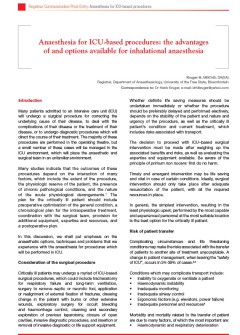
Anaesthesia for ICU-based procedures: the advantages of and options available…
Many patients admitted to an intensive care unit (ICU) will undergo a surgical procedure for correcting the underlying cause of their disease, to deal with the complications of their disease or the treatment of their disease, or to undergo diagnostic procedures which will direct the course of their treatment. The majority of these procedures are performed in the operating theatre, but a small …
- Edition
- -
- ISBN/ISSN
- -
- Collation
- -
- Series Title
- -
- Call Number
- -
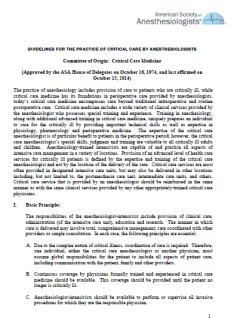
GUIDELINES FOR THE PRACTICE OF CRITICAL CARE BY ANESTHESIOLOGISTS
The practice of anesthesiology includes provision of care to patients who are critically ill, while critical care medicine has its foundations in perioperative care provided by anesthesiologists, today’s critical care medicine encompasses care beyond traditional intraoperative and routine postoperative care. Critical care medicine includes a wide variety of clinical services provided by the a…
- Edition
- -
- ISBN/ISSN
- -
- Collation
- -
- Series Title
- -
- Call Number
- -
 Computer Science, Information & General Works
  Philosophy & Psychology
  Religion
  Social Sciences
  Language
  Pure Science
  Applied Sciences
  Art & Recreation
  Literature
  History & Geography