Filter by
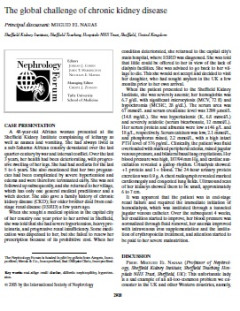
The global challenge of chronic kidney disease
A 48-year-old African woman presented at the Sheffield Kidney Institute complaining of lethargy as well as nausea and vomiting. She had always lived in a sub-Saharan African country devastated over the last quarter-century by war and internal conflict. Over the last 3 years, her health had been deteriorating, with progressive swelling of her legs.
- Edition
- -
- ISBN/ISSN
- -
- Collation
- -
- Series Title
- -
- Call Number
- -
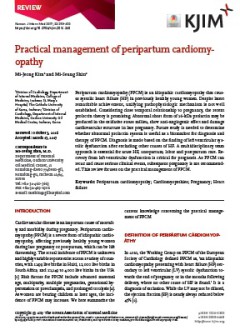
Practical management of peripartum cardiomyopathy
Peripartum cardiomyopathy (PPCM) is an idiopathic cardiomyopathy that causes systolic heart failure (HF) in previously healthy young women. Despite latest remarkable achievement, unifying pathophysiologic mechanism is not well established. Considering close temporal relationship to pregnancy, the recent prolactin theory is promising.
- Edition
- -
- ISBN/ISSN
- -
- Collation
- -
- Series Title
- -
- Call Number
- -
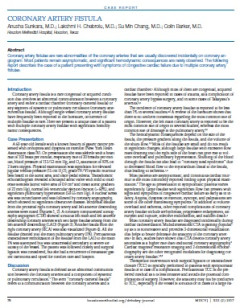
CORONARY ARTERY FISTULA
Coronary artery fistulae are rare abnormalities of the coronary arteries that are usually discovered incidentally on coronary angiogram. Most patients remain asymptomatic, and significant hemodynamic consequences are rarely observed. The following report describes the case of a patient presenting with symptoms of congestive cardiac failure due to multiple coronary artery fistulae.
- Edition
- -
- ISBN/ISSN
- -
- Collation
- -
- Series Title
- -
- Call Number
- -
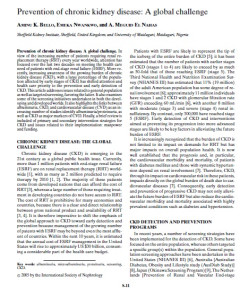
Prevention of chronic kidney disease: A global challenge
In view of the increasing number of patients requiring renal replacement therapy (RRT) every year worldwide, attention has focused over the last two decades on meeting the health care need of patients with end-stage renal failure (ESRF). More recently, increasing awareness of the growing burden of chronic kidney disease (CKD), with a large percentage of the population affected by early stages …
- Edition
- -
- ISBN/ISSN
- -
- Collation
- -
- Series Title
- -
- Call Number
- -
Chronic kidney disease: the global challenge
The worldwide rise in the number of patients with chronic kidney disease (CKD) and consequent end-stage renal failure necessitating renal replacement therapy is threatening to reach epidemic proportions over the next decade, and only a small number of countries have robust economies able to meet the challenges posed. A change in global approach to CKD from treatment of end-stage renal diseas…
- Edition
- -
- ISBN/ISSN
- -
- Collation
- -
- Series Title
- -
- Call Number
- -
Novel insights into acute kidney injuryechronic kidney disease continuum and …
Acute kidney injury (AKI) is an independent risk factor for chronic kidney disease (CKD). If injury is mild, a repair process can be adaptive and lead to complete renal recovery. However, severe injury will be accompanied by a maladaptive repair which usually leads to nephron loss, fibrosis, vascular rarefaction, and chronic inflammation. Although various mechanisms underlying AKI-CKD transitio…
- Edition
- -
- ISBN/ISSN
- -
- Collation
- -
- Series Title
- -
- Call Number
- -
Angiotensin-converting enzyme inhibitors and receptor blockers in heart failu…
In clinical setting, congestive heart failure (CHF) and chronic kidney disease (CKD) often co-exist in patients due to common underlying predisposing factors. An intricate equilibrium between the cardiovascular and renal system is maintained through rennin angiotensin–aldosterone axis and autonomic nervous system. Consequent to favorable hemodynamic modification, angiotensin converting enzyme…
- Edition
- -
- ISBN/ISSN
- -
- Collation
- -
- Series Title
- -
- Call Number
- -
Angiotensin receptor blockers are associated with lower mortality than ACE in…
Dual renin angiotensin system (RAS) blockade using angiotensin-receptor blockers (ARBs) in combination with angiotensin converting enzyme inhibitors (ACEIs) is reported to improve proteinuria in both diabetic and non-diabetic patients. However, its renoprotective effect and safety remain uncertain in patients with advanced chronic kidney disease (CKD). From January 1, 2000 through June 30, 2009…
- Edition
- -
- ISBN/ISSN
- -
- Collation
- -
- Series Title
- -
- Call Number
- -
Update on Angiotensin II : New Endocrine Connections between the Brain, Adren…
In the brain, angiotensinergic pathways play a major role in chronic regulation of cardiovascular and electrolyte homeostasis. Increases in plasma angiotensin II (Ang II), aldosterone, [Na+] and cytokines can directly activate these pathways. Chronically, these stimuli also activate a slow neuromodulatory pathway involving local aldosterone, mineralocorticoid receptors (MRs), epithelial sodium …
- Edition
- -
- ISBN/ISSN
- -
- Collation
- -
- Series Title
- -
- Call Number
- -
Update on angiotensin AT2 receptors
This review updates major new findings and concepts introduced during the past year on the role of angiotensin II (Ang II) subtype 2 receptors (AT2Rs) in the control of blood pressure and renal function
- Edition
- -
- ISBN/ISSN
- -
- Collation
- -
- Series Title
- -
- Call Number
- -
 Computer Science, Information & General Works
  Philosophy & Psychology
  Religion
  Social Sciences
  Language
  Pure Science
  Applied Sciences
  Art & Recreation
  Literature
  History & Geography