Filter by

The Effect of Maintenance Treatment with Erdosteine on Exacerbation Treatment…
To explore the effect of erdosteine on COPD exacerbations, health-related quality of life (HRQoL), and subjectively assessed COPD severity
- Edition
- -
- ISBN/ISSN
- -
- Collation
- -
- Series Title
- -
- Call Number
- -

Fixed drug eruption and anaphylaxis induced concurrently by erdosteine: a cas…
Erdosteine is used as a mucolytic agent and has a low incidence of adverse drug reactions, most of which are gastrointestinal and mild. Moreover, drug antigens rarely induce multiple simultaneous immunologic reactions. Only one previous case report has demonstrated hypersensitivity reaction induced by erdosteine. Here, we report a case of fixed drug eruption and anaphylaxis, which were concurre…
- Edition
- -
- ISBN/ISSN
- -
- Collation
- -
- Series Title
- -
- Call Number
- -

Erdosteine in children and adults with bronchiectasis (BETTER trial): study p…
Bronchiectasis is a worldwide chronic lung disorder where exacerbations are common. It affects people of all ages, but especially Indigenous populations in high-income nations. Despite being a major contributor to chronic lung disease, there are no licensed therapies for bronchiectasis and there remain relatively few randomised controlled trials (RCTs) conducted in children and adults. Our RCT …
- Edition
- -
- ISBN/ISSN
- -
- Collation
- -
- Series Title
- -
- Call Number
- -
Multifaceted Beneficial Effects of Erdosteine: More than a Mucolytic Agent
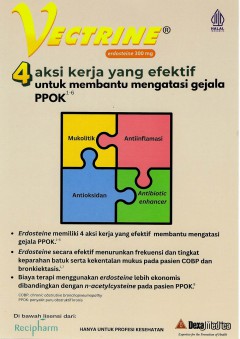
Erdosteine is a drug approved for the treatment of acute and chronic pulmonary diseases, originally developed as a mucolytic agent. It belongs to the thiol-based family of drugs that are known to also possess potentially important antioxidant and anti-inflammatory properties, and exhibit antibacterial activity against a variety of medically important bacterial species. Erdosteine is a prodru…
- Edition
- -
- ISBN/ISSN
- -
- Collation
- -
- Series Title
- -
- Call Number
- -

Multifaceted Beneficial Effects of Erdosteine: More than a Mucolytic Agent
Erdosteine is a drug approved for the treatment of acute and chronic pulmonary diseases, originally developed as a mucolytic agent. It belongs to the thiol-based family of drugs that are known to also possess potentially important antioxidant and anti-inflammatory properties, and exhibit antibacterial activity against a variety of medically important bacterial species. Erdosteine is a prodru…
- Edition
- -
- ISBN/ISSN
- -
- Collation
- -
- Series Title
- -
- Call Number
- -
Efficacy and safety profile of mucolytic/antioxidant agents in chronic obstru…
To date there are no head-to-head studies comparing different mucolytic/antioxidant agents. Considering the inconsistent evidence resulting from the pivotal studies on mucolytic/antioxidant agents tested in chronic obstructive pulmonary disease (COPD), and the recent publication of Reducing Exacerbations and Symptoms by Treatment with ORal Erdosteine in COPD (RESTORE) study, we have performed a…
- Edition
- -
- ISBN/ISSN
- -
- Collation
- -
- Series Title
- -
- Call Number
- -
Effect of erdosteine on the rate and duration of COPD exacerbations: the REST…
Oxidative stress contributes to chronic obstructive pulmonary disease (COPD) exacerbations and antioxidants can decrease exacerbation rates, although we lack data about the effect of such drugs on exacerbation duration. The RESTORE (Reducing Exacerbations and Symptoms by Treatment with ORal Erdosteine in COPD) study was a prospective randomised, double-blind, placebo-controlled study, enrollin…
- Edition
- -
- ISBN/ISSN
- -
- Collation
- -
- Series Title
- -
- Call Number
- -
Effect of Erdosteine on COPD Exacerbations in COPD Patients with Moderate Air…
The RESTORE study, a multi-national randomized, placebo-controlled study, showed that erdosteine – a muco-active antioxidant that modulates bacterial adhesiveness – reduced the rate and duration of exacerbations in moderate and severe COPD with a history of exacerbations. How much benefit patients with less severe disease experience when taking this drug remains unclear
- Edition
- -
- ISBN/ISSN
- -
- Collation
- -
- Series Title
- -
- Call Number
- -
Effectiveness of Erdosteine in Elderly Patients with Bronchiectasis and Hyper…
Mucus plugging and hypersecretion have been associated with an increased relative risk of death in patients with bronchiectasis who may or may not have chronic obstructive pulmonary disease (COPD), which is of prognostic relevance in the elderly. However, chest physiotherapy and/or the use of mucoactive agents is considered to be an effective therapeutic model in treating patients with COPD and…
- Edition
- -
- ISBN/ISSN
- -
- Collation
- -
- Series Title
- -
- Call Number
- -
The therapeutic efficacy of erdosteine in the treatment of chronic obstructiv…
Erdosteine, a drug approved for the treatment of acute and chronic pulmonary diseases, has been shownrnto be an effective treatment for chronic bronchitis or COPD (CB/COPD) in several studies, althoughrnmarked differences in the perception of its usefulness still remain.
- Edition
- -
- ISBN/ISSN
- -
- Collation
- -
- Series Title
- -
- Call Number
- -
 Computer Science, Information & General Works
  Philosophy & Psychology
  Religion
  Social Sciences
  Language
  Pure Science
  Applied Sciences
  Art & Recreation
  Literature
  History & Geography