THERAPEUTIC CLASS
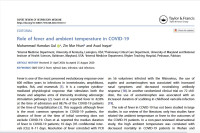
Role of fever and ambient temperature in COVID-19
The role of fever in COVID-19 has not been studied in large
studies. In our review of the literature, only two studies have
related the ambient temperature or fever to the outcomes of
the COVID-19 patients. In a non-peer-reviewed observational
study, the high ambient temperature was correlated with
decreased mortality in COVID-19 patients in Wuhan and
Hubei provinces; however, no data on the patient’s tempera-
ture was available in the study which limits the derivation of
any conclusion from the study [20]. Regular high fever in
COVID-19 is considered to be an indicator of severe infection.
In a study of 201 patients in Wuhan, high fever (>39°C) was
associated with a higher likelihood of acute respiratory distress
syndrome (HR, 1.77; 95% CI, 1.11–2.84), and lower risk of
mortality (HR, 0.41; 95% CI, 0.21–0.82) [21]. The preliminary
results may point toward an association of improved prog-
nosis in terms of mortality in severe COVID-19 patients with
fever. The study was not geared toward identifying the impact
of fever or antipyretics in COVID-19 patients, however, it pro-
vides a glimpse into the possible impact of fever on COVID-19
prognosis.
Availability
Detail Information
- Series Title
-
-
- Call Number
-
-
- Publisher
- : .,
- Collation
-
-
- Language
-
English
- ISBN/ISSN
-
-
- Classification
-
NONE
- Content Type
-
Therapeutic Class
- Media Type
-
-
- Carrier Type
-
-
- Edition
-
-
- Subject(s)
- Specific Detail Info
-
-
- Statement of Responsibility
-
-
Other version/related
No other version available
File Attachment
Comments
You must be logged in to post a comment
 Computer Science, Information & General Works
  Philosophy & Psychology
  Religion
  Social Sciences
  Language
  Pure Science
  Applied Sciences
  Art & Recreation
  Literature
  History & Geography