Filter by
Role of diet in type 2 diabetes incidence: umbrella review of meta- analyses …
To summarise the evidence of associations between dietary factors and incidence of type 2 diabetes and to evaluate the strength and validity of these associations
- Edition
- -
- ISBN/ISSN
- -
- Collation
- -
- Series Title
- -
- Call Number
- -
Nutrition Therapy Recommendations for the Management of Adults With Diabetes
A healthful eating pattern, regular physical activity, and often pharmacotherapy are key components of diabetes management. For many individuals with diabetes, the most challenging part of the treatment plan is determining what to eat. It is the position of the American Diabetes Association (ADA) that there is not a “one-size-fits-all” eating pattern for individuals with diabetes. The ADA a…
- Edition
- -
- ISBN/ISSN
- -
- Collation
- -
- Series Title
- -
- Call Number
- -
Efficacy and safety of COVID-19 vaccines in older people
Several vaccines against coronavirus disease 2019 (COVID-19) are on the cusp of regulatory approval. eir safety and efficacy in older people is critical to their success. Even though care home residents and older people are likely to be amongst the first to be vaccinated, these patient groups are usually excluded from clinical trials. Data from several Phase II trials have given cause for op…
- Edition
- -
- ISBN/ISSN
- -
- Collation
- -
- Series Title
- -
- Call Number
- -
COVID-19 in the geriatric population
The global COVID-19 pandemic has caused rapid and monumental changes around the world. Older people, who already experience higher rates of social isolation and loneliness, are more susceptible to adverse effects as a result of the social distancing protocols enacted to slow the spread of COVID-19. Based on prior outbreaks, we speculate the detrimental outcomes and offer solutions
- Edition
- -
- ISBN/ISSN
- -
- Collation
- -
- Series Title
- -
- Call Number
- -
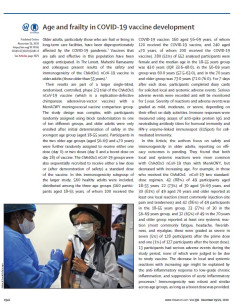
Age and frailty in COVID-19 vaccine development
Older adults, particularly those who are frail or living in long-term care facilities, have been disproportionately affected by the COVID-19 pandemic.1 Vaccines that are safe and effective in this population have been eagerly anticipated. In The Lancet, Maheshi Ramasamy and colleagues present results of the safety and immunogenicity of the ChAdOx1 nCoV-19 vaccine in older adults (those older t…
- Edition
- -
- ISBN/ISSN
- -
- Collation
- -
- Series Title
- -
- Call Number
- -
Health Care Guideline: Diagnosis and Initial Treatment of Ischemic Stroke
Stroke is the fifth leading cause of death in the United States and a leading cause of serious long-term disability (Mozzafarian, 2015; Kochanek, 2014). Annually, approximately 800,000 people in the United States have a stroke, and 130,000 die (Centers for Disease Control and Prevention, 2016). Of all strokes, 87% are ischemic strokes (Mozaffarian, 2015). In Minnesota, ischemic stroke death rat…
- Edition
- -
- ISBN/ISSN
- -
- Collation
- -
- Series Title
- -
- Call Number
- -
Guidelines for the Early Management of Patients With Acute Ischemic Stroke: 2…
The purpose of these guidelines is to provide an up-to-date comprehensive set of recommendations in a single document for clinicians caring for adult patients with acute arterial ischemic stroke. The intended audiences are prehospital care providers, physicians, allied health professionals, and hospital administrators. These guidelines supersede the 2013 Acute Ischemic Stroke (AIS) Guideline…
- Edition
- -
- ISBN/ISSN
- -
- Collation
- -
- Series Title
- -
- Call Number
- -
Biomarkers for acute diagnosis and management of stroke in neurointensive car…
The effectiveness of current management of critically ill stroke patients depends on rapid assessment of the type of stroke, ischemic or hemorrhagic, and on a patient’s general clinical status. Thrombolytic therapy with recombinant tissue plasminogen activator (r-tPA) is the only effective treatment for ischemic stroke approved by the Food and Drug Administration (FDA), whereas no treatment h…
- Edition
- -
- ISBN/ISSN
- -
- Collation
- -
- Series Title
- -
- Call Number
- -
Typhoid and other invasive salmonellosis
Enteric fever (typhoid and paratyphoid fever) is caused by Salmonella enterica serovar Typhi (S. Typhi) and Salmonella enterica serovar Paratyphi (S. Paratyphi). S. Paratyphi A and B (and, uncommonly, S. Paratyphi C) cause a disease that is clinically indistinguishable from typhoid fever, particularly in parts of Asia.
- Edition
- -
- ISBN/ISSN
- -
- Collation
- -
- Series Title
- -
- Call Number
- -
Review of current typhoid fever vaccines, cross protection against paratyphoi…
Typhoid and paratyphoid fever remain a global health problem, which – in nonendemic countries – are mainly seen in travelers, particularly in VFRs (visiting friends and relatives), with occasional local outbreaks occurring. A rise in anti-microbial resistance emphasizes the role of preventive measures, especially vaccinations against typhoid and paratyphoid fever for travelers visiting end…
- Edition
- -
- ISBN/ISSN
- -
- Collation
- -
- Series Title
- -
- Call Number
- -
 Computer Science, Information & General Works
  Philosophy & Psychology
  Religion
  Social Sciences
  Language
  Pure Science
  Applied Sciences
  Art & Recreation
  Literature
  History & Geography