Filter by
Outcomes Associated With Invasive and Noninvasive Ventilation Among Patients …
Small clinical trials have shown that noninvasive ventilation (NIV) is efficacious in reducing the need for intubation and improving short-term survival among patients with severe exacerbations of chronic obstructive pulmonary disease (COPD). Little is known, however, about the effectiveness of NIV in routine clinical practice
- Edition
- -
- ISBN/ISSN
- -
- Collation
- -
- Series Title
- -
- Call Number
- -
2020 International Society of Hypertension Global Hypertension Practice Guide…
In the Guidelines, differentiation between optimal and essential standards were not always possible, and were made in sections where it was most practical and sensible. The Guidelines Committee is also aware that some recommended essential standards may not be feasible in low resource settings, for example, out-of-office BP measurements, the requirement of multiple visits for the diagnosis of h…
- Edition
- -
- ISBN/ISSN
- -
- Collation
- -
- Series Title
- -
- Call Number
- -
Updates in Hypertension Studies According to the Main Clinical Trials: A Revi…
High blood pressure remains one of the most important risk factors for cardiovascular disease. Although there is no consensus, all the clinical practice guidelines agree on the need to reduce blood pressure levels tominimize the risks. There aremany clinical trials conducted to try to find the best pharmacotherapy to achieve this goal. The aim was to compare the main international randomized c…
- Edition
- -
- ISBN/ISSN
- -
- Collation
- -
- Series Title
- -
- Call Number
- -
COVID-19 can present with a rash and be mistaken for dengue
We found the report ‘‘What are we doing in the dermatology outpatient department amidst the raging of 2019-CoV?’’ to be very interesting. 1 Chen et al pointed out the need for a dermatology department to recognize and deal with this infection.
- Edition
- -
- ISBN/ISSN
- -
- Collation
- -
- Series Title
- -
- Call Number
- -
Multidisciplinary research priorities for the COVID-19 pandemic: a call for a…
The coronavirus disease 2019 (COVID-19) pandemic is having a profound effect on all aspects of society, including mental health and physical health. We explore the psychological, social, and neuroscientific effects of COVID-19 and set out the immediate priorities and longer-term strategies for mental health science research. These priorities were informed by surveys of the public and an expe…
- Edition
- -
- ISBN/ISSN
- -
- Collation
- -
- Series Title
- -
- Call Number
- -
Youth mental health in the time of COVID-19
Youth mental health is a rapidly developing field with a focus on prevention, early identification, treatment innovation and service development. In this perspective piece, we discuss the effects of COVID-19 on young people’s mental health. The psychosocial effects of COVID-19 disproportionately affect young people. Both immediate and longer-termfactors through which young people are affec…
- Edition
- -
- ISBN/ISSN
- -
- Collation
- -
- Series Title
- -
- Call Number
- -
Epidemiology of Acute Kidney Injury in Critically Ill Children and Young Adults
The epidemiologic characteristics of children and young adults with acute kidney injury have been described in single-center and retrospective studies. We conducted a multinational, prospective study involving patients admitted to pediatric intensive care units to define the incremental risk of death and complications associated with severe acute kidney injury.
- Edition
- -
- ISBN/ISSN
- -
- Collation
- -
- Series Title
- -
- Call Number
- -
Issues of Acute Kidney Injury Staging and Management in Sepsis and Critical I…
Acute kidney injury (AKI) has a high incidence on intensive care units around the world and is a major complication in critically ill patients suffering from sepsis or septic shock. The short- and long-term complications are thereby devastating and impair the quality of life. Especially in terms of AKI staging, the determination of kidney function and the timing of dialytic AKI management outsi…
- Edition
- -
- ISBN/ISSN
- -
- Collation
- -
- Series Title
- -
- Call Number
- -
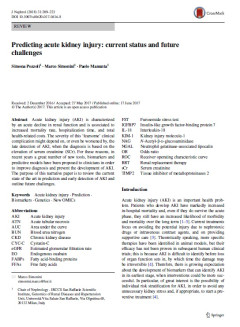
Predicting acute kidney injury: current status and future challenges
Acute kidney injury (AKI) is characterized by an acute decline in renal function and is associated to increased mortality rate, hospitalization time, and total health-related costs. The severity of this ‘fearsome’ clinical complication might depend on, or even be worsened by, the late detection of AKI, when the diagnosis is based on the elevation of serum creatinine (SCr). For these reasons…
- Edition
- -
- ISBN/ISSN
- -
- Collation
- -
- Series Title
- -
- Call Number
- -
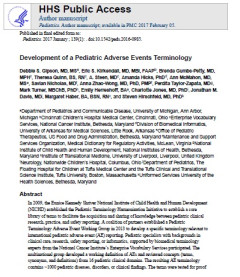
Development of a Pediatric Adverse Events Terminology
In 2009, the Eunice Kennedy Shriver National Institute of Child Health and Human Development (NICHD) established the Pediatric Terminology Harmonization Initiative to establish a core library of terms to facilitate the acquisition and sharing of knowledge between pediatric clinical research, practice, and safety reporting. A coalition of partners established a Pediatric Terminology Adverse Even…
- Edition
- -
- ISBN/ISSN
- -
- Collation
- -
- Series Title
- -
- Call Number
- -
 Computer Science, Information & General Works
  Philosophy & Psychology
  Religion
  Social Sciences
  Language
  Pure Science
  Applied Sciences
  Art & Recreation
  Literature
  History & Geography