Filter by

Efficacy of Methylprednisolone in Preventing Lung Injury Following Pulmonary …
We sought to determine the effi cacy and safety of perioperative treatment with methylprednisolone on the development of lung injury after pulmonary thromboendarterectomy
- Edition
- -
- ISBN/ISSN
- -
- Collation
- -
- Series Title
- -
- Call Number
- -
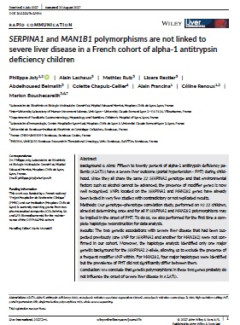
SERPINA1 and MAN1B1 polymorphisms are not linked to severe liver disease in a…
Fifteen to twenty percent of alpha-1 antitrypsin deficiency patients (A1ATD) have a severe liver outcome (portal hypertension -PHT) during childhood. Since they all share the same ZZ SERPINA1 genotype and that environmental factors such as alcohol cannot be advanced, the presence of modifier genes is now well recognized. SNPs located on the SERPINA1 and MAN1B1 genes have already been tes…
- Edition
- -
- ISBN/ISSN
- -
- Collation
- -
- Series Title
- -
- Call Number
- -
Intranasal Corticosteroids in Management of Acute Sinusitis: A Systematic Rev…
Acute sinusitis is a common condition in ambulatory care, where it is frequently treated with antibiotics, despite little evidence of their benefi t. Intranasal corticosteroids might relieve symptoms; however, evidence for this benefi t is currently unclear. We performed a systematic review and meta-analysis of the effects of intranasal corticosteroids on the symptoms of acute sinusitis
- Edition
- -
- ISBN/ISSN
- -
- Collation
- -
- Series Title
- -
- Call Number
- -
Once-Daily Mometasone Furoate Nasal Spray: Efficacy and Safety of a New Intra…
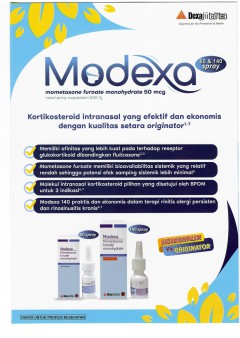
Once-daily mometasone furoate nasal spray (MFNS) is a new intranasal glucocorticoid for the treatment of seasonal allergic rhinitis and perennial rhinitis, and for the prophylaxis of seasonal allergic rhinitis. This paper reviews key findings from the clinical development program for MFNS, comprising more than 20 clinical trials with more than 6000 patients worldwide
- Edition
- -
- ISBN/ISSN
- -
- Collation
- -
- Series Title
- -
- Call Number
- -
Corticosteroid Treatment in Chronic Rhinosinusitis: The Possibilities and the…
Chronic rhinosinusitis (CRS), with (CRwNP) and without (CRsNP) nasal polyps, is one of the most frequent chronic inflammatory diseases, with inflammation of the nasal and paranasal sinus mucosa and sinonasal symptoms lasting for more than 12 consecutive weeks
- Edition
- -
- ISBN/ISSN
- -
- Collation
- -
- Series Title
- -
- Call Number
- -
Absence of Growth Retardation in Children With Perennial Allergic Rhinitis Af…
Intranasal corticosteroids are used widely for the treatment of allergic rhinitis because they are effective and well tolerated. However, their potential to suppress growth of pediatric subjects with allergic rhinitis continues to be a concern, particularly in light of reports of growth suppression after treatment with intranasal beclomethasone dipropionate or intranasal budesonide (see the ar…
- Edition
- -
- ISBN/ISSN
- -
- Collation
- -
- Series Title
- -
- Call Number
- -
Molecular and clinical pharmacology of intranasal corticosteroids: clinical a…
Intranasal corticosteroids (INSs) are effective treatments for allergic rhinitis, rhinosinusitis, and nasal polyposis. In recent years, increased understanding of corticosteroid and glucocorticoid receptor pharmacology has enabled the development of molecules designed specifically to achieve potent, localized activity with minimal risk of systemic exposure. Pharmacologic potency studies using…
- Edition
- -
- ISBN/ISSN
- -
- Collation
- -
- Series Title
- -
- Call Number
- -
Intranasal corticosteroids for allergic rhinitis: How do different agents com…
Intranasal steroids have proved to be an effective and safe form of therapy for allergic rhinitis. However, as the number of new glucocorticoid compounds has increased over the past decade, it has become important to consider whether significant differences exist between these agents. Pharmacologically, newer drugs such as mometasone furoate and fluticasone propionate appear to have substantia…
- Edition
- -
- ISBN/ISSN
- -
- Collation
- -
- Series Title
- -
- Call Number
- -
Efficacy and safety of mometasone furoate nasal spray in allergic rhinitis, a…
- Edition
- -
- ISBN/ISSN
- -
- Collation
- -
- Series Title
- -
- Call Number
- -
- Edition
- -
- ISBN/ISSN
- -
- Collation
- -
- Series Title
- -
- Call Number
- -
Local and Systemic Safety of Intranasal Corticosteroids
The safety and effi cacy of intranasal corticosteroids (INCs) are well established for the management of allergic rhinitis, rhinosinusitis, and nasal polyps. As seen in numerous studies, INCs demonstrate markedly reduced systemic bioavailability compared with oral and even inhaled corticosteroids and have shown an excellent safety profi le over 3 decades of use. Nonetheless, concerns remain am…
- Edition
- -
- ISBN/ISSN
- -
- Collation
- -
- Series Title
- -
- Call Number
- -
 Computer Science, Information & General Works
  Philosophy & Psychology
  Religion
  Social Sciences
  Language
  Pure Science
  Applied Sciences
  Art & Recreation
  Literature
  History & Geography