Filter by
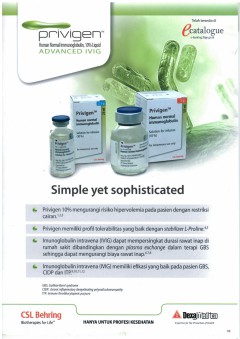
Efficacy and safety of Privigen® in patients with chronicinflammatory demy…
This prospective, multicenter, single-arm, open-label Phase III study aimed toevaluate the efficacy and safety of Privigen® (10% liquid human intravenous immunoglob-ulin [IVIG], stabilized with L-proline) in patients with chronic inflammatory demyelinatingpolyneuropathy (CIDP). Patients received one induction dose of Privigen (2 g/kg body weight[bw]) and up to seven maintenance doses (1 g/kg…
- Edition
- -
- ISBN/ISSN
- -
- Collation
- -
- Series Title
- -
- Call Number
- -
Intravenous immunoglobulin for chronic inflammatory demyelinating polyradicul…
Chronic inflammatory demyelinating polyradiculoneuropathy (CIDP) is a potentially disabling autoimmune disease causing progressive or relapsing–remitting weakness with or without sensory loss. Previous small trials demonstrated short-term benefit from intravenous immunoglobulin (IVIg), and international guidelines recommend IVIg as an option. However, evidence had been insufficient to persuad…
- Edition
- -
- ISBN/ISSN
- -
- Collation
- -
- Series Title
- -
- Call Number
- -
Efficacy and safety of Privigen H, a novel liquid intravenous immunoglobulin …
Intravenous immunoglobulin (IVIG) has become a mainstay of treatment for acute and chronic immune thrombocytopenic purpura (ITP). The efficacy and safety of PrivigenH, a new, ready-touse, 10% liquid human IgG formulation, was evaluated in this open-label, multicentre study. PrivigenH infusions (1 g/kg per day for 2 consecutive days, days 1 and 2) were given to 57 adolescent and adult patients w…
- Edition
- -
- ISBN/ISSN
- -
- Collation
- -
- Series Title
- -
- Call Number
- -
Tolerability of a New 10% Liquid Immunoglobulin for Intravenous Use, Privigen…
The tolerability of L-proline-stabilized Privigen®, a new 10% liquid immunoglobulin for intravenous administration, was assessed at high infusion rates in a Phase III, open-label, single-arm, multicenter study in 45 patients with primary immune deficiencies
- Edition
- -
- ISBN/ISSN
- -
- Collation
- -
- Series Title
- -
- Call Number
- -

Comparison of viscoelastic substances used in phacoemulsification
To evaluate the usefulness of four viscoelastic agents during phacoemulsification: 2% hydroxypropylmethylcellulose (HPMC) (Methocel®), 3% sodium hyaluronate with 4% chondroitin sulfate (Viscoat®), 1 % sodium hyaluronate (Healon®), 1.4% sodium hyaluronate (Healon® GV).
- Edition
- -
- ISBN/ISSN
- -
- Collation
- -
- Series Title
- -
- Call Number
- -
Mixed polymeric systems: New ophthalmic viscosurgical device created by mixin…
The rheological properties of the mixed solution (1:1 and 3:1) showed intermediate characteristics in comparison with the 2 original substances, characterized by a viscosity comparable to that of the superviscous cohesive OVD, but at a higher shear rate (similar to the medium-viscosity dispersive OVD). The new viscous dispersive OVD performed similarly to the mediumviscosity dispersive OVD at l…
- Edition
- -
- ISBN/ISSN
- -
- Collation
- -
- Series Title
- -
- Call Number
- -
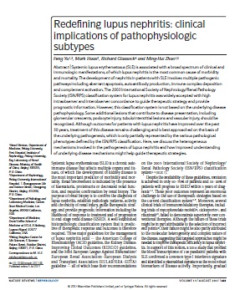
Redefining lupus nephritis: clinical implications of pathophysiologic subtypes
Systemic lupus erythematosus (SLE) is associated with a broad spectrum of clinical and immunologic manifestations, of which lupus nephritis is the most common cause of morbidity and mortality. The development of nephritis in patients with SLE involves multiple pathogenic pathways including aberrant apoptosis, autoantibody production, immune complex deposition and complement activation.
- Edition
- -
- ISBN/ISSN
- -
- Collation
- -
- Series Title
- -
- Call Number
- -
Redefining lupus nephritis : Clinical Implication of Patophysiologic Subtypes.
Systemic lupus erythematosus (SLE) is associated with a broad spectrum of clinical and immunologic manifestations, of which lupus nephritis is the most common cause of morbidity and mortality. The development of nephritis in patients with SLE involves multiple pathogenic pathways including aberrant apoptosis, autoantibody production, immune complex deposition and complement activation.
- Edition
- -
- ISBN/ISSN
- -
- Collation
- -
- Series Title
- -
- Call Number
- -
Management of hyperkalaemia in chronic kidney disease
Hyperkalaemia is common in patients with chronic kidney disease (CKD), in part because of the effects of kidney dysfunction on potassium homeostasis and in part because of the cluster of comorbidities (and their associated treatments) that occur in patients with CKD. Owing to its electrophysiological effects, severe hyperkalaemia represents a medical emergency that usually requires prompt inter…
- Edition
- -
- ISBN/ISSN
- -
- Collation
- -
- Series Title
- -
- Call Number
- -
Pathogenesis, diagnosis and management of hyperkalemia
Hyperkalemia is a potentially life-threatening condition in which serum potassium exceeds 5.5 mmol/l. It can be caused by reduced renal excretion, excessive intake or leakage of potassium from the intracellular space. In addition to acute and chronic renal failure, hypoaldosteronism, and massive tissue breakdown as in rhabdomyolysis, are typical conditions leading to hyperkalemia.
- Edition
- -
- ISBN/ISSN
- -
- Collation
- -
- Series Title
- -
- Call Number
- -
 Computer Science, Information & General Works
  Philosophy & Psychology
  Religion
  Social Sciences
  Language
  Pure Science
  Applied Sciences
  Art & Recreation
  Literature
  History & Geography