Filter by
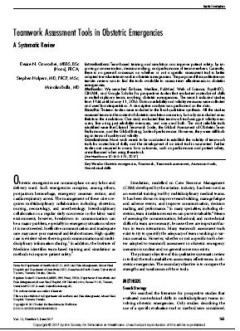
Teamwork Assessment Tools in Obstetric Emergencies: A Systematic Review
Team-based training and simulation can improve patient safety, by improving communication, decision making, and performance of team members. Currently, there is no general consensus on whether or not a specific assessment tool is better adapted to evaluate teamwork in obstetric emergencies. The purpose of this qualitative systematic review was to find the tools available to assess team effectiv…
- Edition
- -
- ISBN/ISSN
- -
- Collation
- -
- Series Title
- -
- Call Number
- -
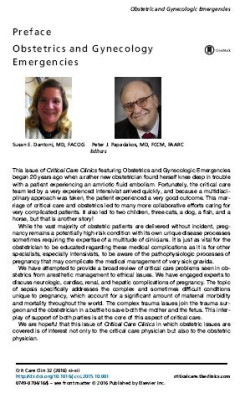
Obstetrics and Gynecology Emergencies
This issue of Critical Care Clinics featuring Obstetrics and Gynecologic Emergencies began 20 years ago when a rather new obstetrician found herself knee deep in trouble with a patient experiencing an amniotic fluid embolism. Fortunately, the critical care team led by a very experienced intensivist arrived quickly, and because a multidisciplinary approach was taken, the patient experienced a ve…
- Edition
- -
- ISBN/ISSN
- -
- Collation
- -
- Series Title
- -
- Call Number
- -
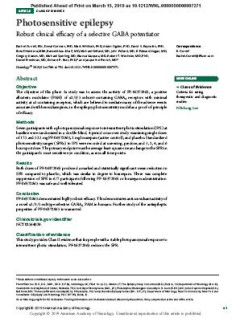
Photosensitive epilepsy : Robust clinical efficacy of a selective GABA potent…
The objective of this phase 2a study was to assess the activity of PF-06372865, a positive allosteric modulator (PAM) of α2/3/5 subunit-containing GABAA receptors with minimal activity at α1-containing receptors, which are believed to mediate many of the adverse events associated with benzodiazepines, in the epilepsy photosensitivity model as a proof-of-principle of efficacy
- Edition
- -
- ISBN/ISSN
- -
- Collation
- -
- Series Title
- -
- Call Number
- -
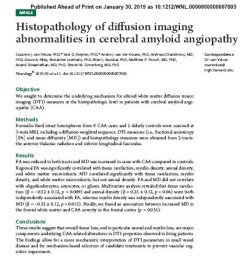
Histopathology of diffusion imaging abnormalities in cerebral amyloid angiopathy
We sought to determine the underlying mechanism for altered white matter diffusion tensor imaging (DTI) measures at the histopathologic level in patients with cerebral amyloid angiopathy (CAA).
- Edition
- -
- ISBN/ISSN
- -
- Collation
- -
- Series Title
- -
- Call Number
- -
The impact of hospital acquired infections with multidrug-resistant bacterial…
To describe overall site-specific Hospital acquired infections (HAI) rates, and to describe the microbiological and antibiotic resistance profiles of infecting pathogens, together with their impact on multidrug-resistant bacteria-associated mortality.
- Edition
- -
- ISBN/ISSN
- -
- Collation
- -
- Series Title
- -
- Call Number
- -
Pola Kuman Pada Ruang Publik, Ruang Pelayanan, dan Ruang Perawatan Rumah Saki…
Rumah sakit sebagai tempat perawatan dan penyembuhan pasien, ternyata rentan terjadinya infeksi penyakit, begitu pula yang terjadi di RSPI Prof. Dr. Sulianti Saroso. Oleh karena itu, perlu adanya penelitian jumlah dan jenis kuman di lingkungan RSPI-SS. Penelitian ini merupakan penelitian observasional dengan pendekatan cross selection. Jenis kuman yang akan diteliti adalah kuman yang terdapat p…
- Edition
- -
- ISBN/ISSN
- -
- Collation
- -
- Series Title
- -
- Call Number
- -
Bacterial contamination of inanimate surfaces and equipment in the intensive …
Intensive care unit (ICU)-acquired infections are a challenging health problem worldwide, especially when caused by multidrug-resistant (MDR) pathogens. In ICUs, inanimate surfaces and equipment (e.g., bedrails, stethoscopes, medical charts, ultrasound machine) may be co taminated by bacteria, including MDR isolates. Cross-transmission of microorganisms from inanimate surfaces may have a sign…
- Edition
- -
- ISBN/ISSN
- -
- Collation
- -
- Series Title
- -
- Call Number
- -
Hospital hygiene and infection control
Management of health-care waste is an integral part of hospital hygiene and infection control. Health-care waste should be considered as a reservoir of pathogenic microorganisms, which can cause contamination and give rise to infection. If waste is inadequately managed, these microorganisms can be transmitted by direct contact, in the air, or by a variety of vectors.
- Edition
- -
- ISBN/ISSN
- -
- Collation
- -
- Series Title
- -
- Call Number
- -
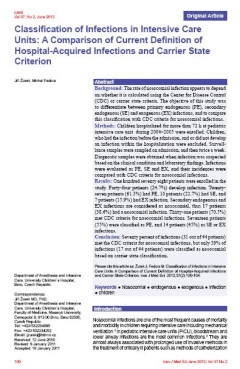
Classification of Infections in Intensive Care Units: A Comparison of Current…
The rate of nosocomial infection appears to depend on whether it is calculated using the Center for Disease Control (CDC) or carrier state criteria. The objective of this study was to differentiate between primary endogenous (PE), secondary endogenous (SE) and exogenous (EX) infections, and to compare this classification with CDC criteria for nosocomial infections.
- Edition
- -
- ISBN/ISSN
- -
- Collation
- -
- Series Title
- -
- Call Number
- -
Metabolic Disease
- Edition
- -
- ISBN/ISSN
- -
- Collation
- -
- Series Title
- -
- Call Number
- -
- Edition
- -
- ISBN/ISSN
- -
- Collation
- -
- Series Title
- -
- Call Number
- -
 Computer Science, Information & General Works
  Philosophy & Psychology
  Religion
  Social Sciences
  Language
  Pure Science
  Applied Sciences
  Art & Recreation
  Literature
  History & Geography